
Technical SEO and information architecture
Site Architecture Checklist: Build for Crawl, UX and AI Search
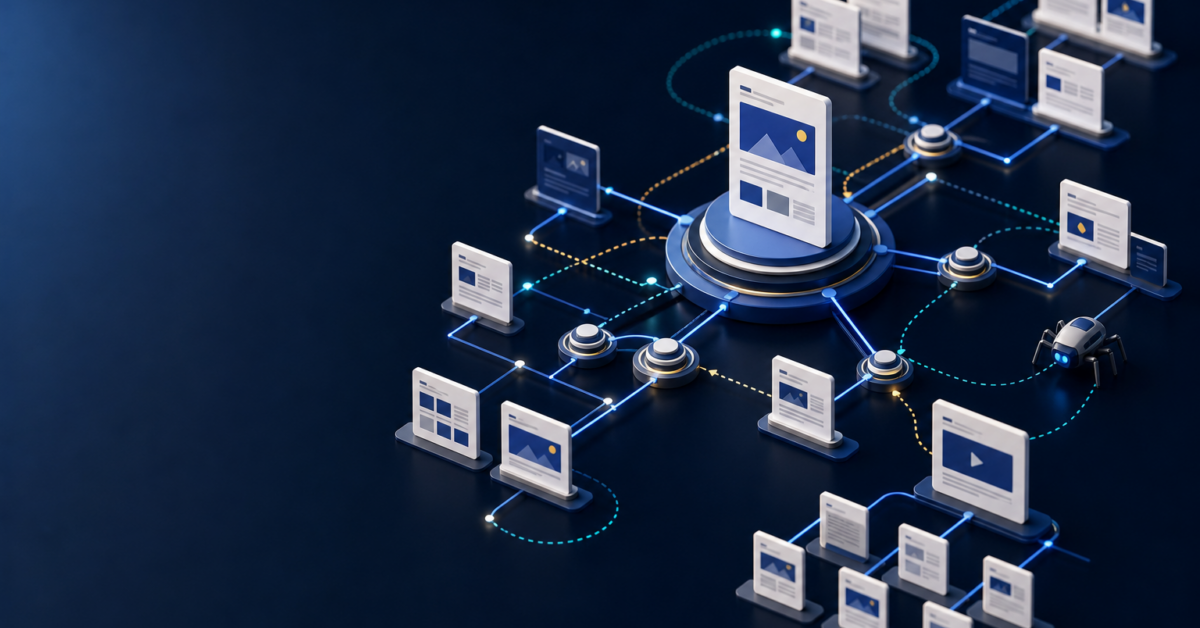
A strong site architecture organizes pages, URLs, navigation, taxonomy and internal links so users and search engines can find and understand important content. Start with a clear hierarchy, keep priority pages reasonably close to navigational hubs, use crawlable HTML links, eliminate unintended orphan pages, control faceted URLs and consolidate duplicates. Then measure depth, inlinks, indexability, crawl activity and conversions. Architecture is not one ranking factor, but it influences discovery, indexing, internal authority, topical understanding and eligibility for conventional and AI search results.
TL;DR
Key Takeaways
- Every important, indexable page should be reachable through crawlable HTML links from at least one findable page.
- Choose an architecture model based on inventory, user behavior and publishing scale rather than copying a universal three-click rule.
- Prioritize internal-link improvements using page value, topical relevance, conversion potential and inlink weakness together.
- Treat XML sitemaps as discovery support, not a replacement for navigation and contextual links.
- Control facets, parameters, duplicates and canonicals before they consume crawl attention or fragment indexing signals.
- Build topic hubs around real entity and intent relationships, but do not enforce rigid silos that block useful cross-topic links.
- Measure architecture with crawl graphs, server logs, indexation data, organic performance and user outcomes.
- AI search visibility still depends on indexability and conventional search eligibility, while citation selection and answer absorption require separate measurement.
What site architecture controls
Site architecture is the system connecting a website’s pages, URLs, menus, directories, taxonomies and internal links. Information architecture focuses on how people understand and navigate information. Technical architecture adds crawl paths, status codes, canonicals, rendering and indexation controls. Effective SEO work requires both.
Google says it primarily discovers pages through links. It recommends crawlable HTML links, descriptive anchor text and a route from a known page to every page that matters. XML sitemaps can supplement discovery, particularly on large or complex sites, but they do not repair an isolated page or communicate its importance as effectively as useful internal links.
Architecture is not a standalone ranking factor. Its value comes from making content discoverable, clarifying page relationships, distributing internal signals and helping users complete tasks. A shallow structure can still fail if it creates irrelevant menus, duplicates or hundreds of undifferentiated links.
Terms to know
- Crawl depth: The number of link steps between an entry point and a URL.
- Orphan page: A page with no discovered internal inlinks.
- Hub page: A navigational or editorial page connecting a topic and its supporting resources.
- Canonical URL: The preferred representative for duplicate or substantially similar pages.
- Internal PageRank: A practical description of authority distributed through internal links, not a metric exposed by Google.
Choose the right architecture model
Most mature sites use a hybrid architecture. The useful question is not which diagram looks cleanest, but which model gives users predictable paths while keeping valuable inventory discoverable and duplicate inventory controlled.
| Model | Best fit | Primary advantage | Main failure mode |
|---|---|---|---|
| Hierarchical | Services, publishers and corporate sites | Clear parent and child relationships | Important pages become buried in deep branches |
| Flat | Small sites with limited inventory | Short paths to most pages | Overloaded navigation and weak grouping |
| Hub-and-spoke | Topic libraries and educational content | Strong topical journeys and contextual linking | Thin hubs built only to target keywords |
| Database-driven | Marketplaces, directories and large catalogs | Scalable page generation and filtering | Unbounded URLs, duplicates and orphan records |
| Faceted | Ecommerce and searchable inventories | Users can refine large result sets | Parameter combinations create crawl traps |
| Hybrid | Large or multi-purpose organizations | Different models can serve different inventories | Conflicting taxonomies and ownership rules |
Do not treat three clicks from the homepage as an absolute rule. Depth should reflect importance and expected demand. A legal archive may reasonably sit deeper than a revenue category, while a valuable long-tail page can remain accessible through its category, related items and contextual content.
The site architecture checklist
- Inventory all known URLs. Combine crawler data, analytics, Search Console, XML sitemaps, content systems and server logs.
- Assign a purpose. Label each page by topic, search intent, audience, funnel role, owner and conversion value.
- Choose one preferred URL. Standardize protocol, host, casing, trailing slash behavior and parameter handling.
- Build a user-centered taxonomy. Use labels people recognize, not internal department terminology.
- Map hubs and destinations. Give every important page a logical parent or hub without preventing relevant cross-links.
- Verify crawlable links. Use normal HTML anchors with usable destinations, including in rendered mobile experiences.
- Write descriptive anchors. Explain the destination naturally instead of repeating generic phrases such as click here.
- Find orphans and weakly linked pages. Repair valuable pages, merge duplicates and retire inventory with no continuing purpose.
- Control filters and search pages. Decide which combinations deserve stable, indexable landing pages and which should remain crawl-controlled or non-indexable.
- Align canonicals, redirects and sitemaps. Sitemap URLs should be canonical, indexable and return successful responses.
- Test templates. Check menus, breadcrumbs, pagination, related modules and JavaScript rendering across devices.
- Establish monitoring. Track depth, inlinks, indexation, crawl activity, traffic, conversions and architecture-related errors over time.
Control crawling, rendering and indexation
Architecture problems often appear as indexation problems. Start by separating discovery, crawling, rendering, canonical selection and indexing. A URL can appear in a sitemap yet remain weakly connected, duplicate, blocked from rendering or judged unsuitable for indexing.
- Facets: Permit only combinations with distinct demand, useful inventory and maintainable content. Prevent effectively infinite sorting, calendar or filter spaces.
- Canonicals: Use them consistently, but do not expect a canonical hint to compensate for contradictory internal links and sitemap entries.
- Redirects: Send retired URLs to a close replacement. Do not redirect unrelated pages to a category or homepage merely to preserve signals.
- JavaScript: Confirm important links and content exist in rendered HTML. Avoid interactions that require clicks, scrolling or client state before a crawler can obtain a destination.
- Pagination: Give component pages crawlable URLs and links. Do not rely exclusively on infinite scroll.
Google says focused crawl-budget work is primarily relevant to very large or rapidly changing sites, including sites around 1 million or more unique pages, sites with roughly 10,000 or more rapidly changing pages, or sites with substantial discovered but currently not indexed inventory. Smaller sites should usually fix broken paths, duplicates and content quality before pursuing elaborate crawl-budget tactics.
Build topical architecture around complete user journeys
Start with entities, problems and tasks, then map query fanout: definitions, comparisons, prerequisites, costs, alternatives, implementation steps and troubleshooting questions. A service page may connect to a comparison, case study, pricing explanation, technical guide and relevant location page. The links should represent meaningful relationships, not a quota.
Use content consolidation when several pages compete for the same intent without serving distinct needs. Merge the strongest material, redirect retired URLs and update internal links to the surviving page. For decaying content, review query loss, outdated claims, broken pathways and changed intent before adding words.
Architecture can also create natural link demand. Original datasets, statistics pages, comparison assets, calculators and expert contribution programs deserve prominent hub placement and durable URLs. Support these assets with digital PR, link-intersect research and outreach to publishers that already reference the subject. Reclaim accurate unlinked brand mentions when a link would help readers verify the source.
Architecture for AI Overviews, Copilot and ChatGPT
Google states that supporting links in AI Overviews and AI Mode must be indexed and eligible to appear in ordinary Search. Crawlable content and internal findability therefore remain foundational. Architecture cannot guarantee selection, but it can make the right passage easier to discover and place in context.
Create pages with answer-first passages, explicit entity relationships, sourced numerical facts, definitions, comparisons and ordered procedures. Connect supporting evidence to the page that synthesizes it. Keep citations near the claims they support and ensure visible content agrees with structured data.
Measure two different outcomes: citation selection, whether a system chooses the page as a source, and citation absorption, whether the answer uses the page’s facts or framing. A 2026 GEO research framework examined 602 prompts, 21,143 search-layer citations, 18,151 fetched pages and 72 page-level features using this distinction. Other emerging research suggests conventional Google visibility can predict AI citation better than page-only features, but results vary by platform and intent. These findings are useful directions, not guarantees.
Diagnose architecture failures with evidence
Do not infer an architecture problem from rankings alone. Compare crawl data, internal graphs, server logs, index coverage, analytics and page purpose. Use the following triage framework.
| Symptom | Evidence to inspect | Likely causes | First action |
|---|---|---|---|
| Important page is not indexed | Rendered links, status, canonical, robots controls, logs | Orphaning, duplication, blocking or weak value | Add a relevant crawl path, then resolve technical conflicts |
| Many URLs are discovered but not indexed | URL patterns, facets, logs and sitemap quality | Duplicate spaces or low-value generated inventory | Restrict creation and indexation by pattern |
| Wrong page ranks | Queries, anchors, canonicals and overlapping content | Intent overlap or unclear hierarchy | Differentiate, consolidate or relink competing pages |
| Deep pages receive little crawling | Depth, inlinks, logs and update frequency | Buried branches or weak hubs | Improve hubs and contextual links |
| Desktop and mobile discovery differ | Rendered HTML and template link counts | Hidden or JavaScript-dependent navigation | Restore equivalent crawlable paths |
| Migration loses traffic | Redirect map, status codes, canonicals and old logs | Broken mappings or changed internal hierarchy | Repair direct redirects and update internal links |
Core KPIs include the percentage of valuable URLs indexed, orphan count, median depth by page class, internal inlinks to priority pages, noncanonical internal links, successful crawler hits, crawl spent on unwanted patterns, organic entrances, assisted conversions and task completion. Compare by template and business segment, not only sitewide averages.
Implementation sequence and migration safeguards
- Baseline: Export current URLs, links, rankings, traffic, conversions, canonicals, sitemaps and log activity.
- Classify: Mark each URL keep, improve, merge, redirect, noindex or remove, with an owner and reason.
- Prototype: Test taxonomy, labels, menus and user paths before changing production URLs.
- Map: Define old-to-new redirects, canonical destinations, breadcrumb paths and internal-link updates.
- Stage: Crawl rendered staging pages while preventing the environment from entering search indexes.
- Launch: Apply direct redirects, update internal links and publish clean canonical sitemaps.
- Validate: Test critical templates, top landing pages and representative long-tail pages immediately.
- Monitor: Review errors, logs, indexation, rankings and conversions daily at first, then weekly as conditions stabilize.
Avoid changing domains, URL paths, navigation, templates and content simultaneously unless necessary. Smaller releases make attribution and rollback easier. Keep redirects active long enough for users, crawlers and external links, and do not create chains when a direct destination is available.
Proven findings, practitioner consensus and uncertainty
Supported by official guidance
Google documents that links are central to discovery, important pages should be reachable from findable pages, anchors should be relevant, and logical organization can improve understanding. Google also analyzes site link structure for sitelinks. Indexed, search-eligible pages are required for supporting links in its AI search features.
Practitioner consensus
Experienced practitioners commonly favor descriptive URLs, useful hubs, contextual links and orphan remediation. Community discussions also warn against rigid silo rules. Reddit reports describe ranking or crawl improvements after internal-link restructuring without new backlinks, but these are uncontrolled anecdotes and cannot establish causation.
Still uncertain
No universal depth, internal-link count or hub size guarantees rankings. Early graph-embedding research, including WebKnoGraph, may improve recommendation workflows but is not proof of ranking impact. Cross-platform AI citation research is evolving, and a structure that supports one answer system may perform differently by query, platform and intent.
Risk and reward: Automated link suggestions can improve coverage on large sites, but unsupervised deployment can create irrelevant anchors and excessive template links. Controlled testing is safer: release changes to a defined page group, record the graph change, monitor crawling and performance, and retain a comparable control group where practical.
Selecting tools or an architecture partner
A small site can begin with a crawler, Search Console and analytics. Larger database-driven sites may need log-file processing, data warehouse joins, automated URL-pattern classification and graph visualization. Evaluate tools by rendered crawling, canonical analysis, parameter handling, custom extraction, API access, scheduling and export quality rather than by the size of a generic feature list.
When hiring a consultant or agency, ask for a URL-level diagnostic, an implementation sequence and measurable acceptance criteria. Strong recommendations should distinguish navigation, indexation and content problems, show the affected page classes, and explain how developers will verify the fix. Be cautious when a proposal promises rankings from a flat structure, recommends linking every page from the homepage, or treats XML sitemaps as a substitute for internal links.
The final deliverable should be implementable: taxonomy rules, page-type specifications, redirect maps, canonical rules, facet policies, link-module requirements, QA tests, dashboards and ownership. Architecture produces durable value only when editorial, design, product and engineering teams follow the same rules.
FREQUENTLY ASKED QUESTIONS
Site architecture: Questions and Answers
What is site architecture in SEO?
Site architecture is the organization and connection of pages, URLs, navigation, directories, taxonomies and internal links. It helps users find information and helps search engines discover, interpret and prioritize URLs.
What is the best website architecture for SEO?
There is no universal best model. Small sites often suit a simple hierarchy, content libraries benefit from hub-and-spoke relationships, and large catalogs typically require a database-driven or faceted hybrid. The best model keeps valuable pages discoverable while controlling duplicates.
Should every page be within three clicks of the homepage?
No. Three clicks is a useful diagnostic heuristic, not an official requirement. Priority pages should have short, logical paths from relevant hubs. Low-demand archives may reasonably be deeper if crawlers and users can still reach them.
How do I find orphan pages?
Compare URLs found by a crawler with URLs from XML sitemaps, analytics, Search Console, backlinks, content systems and server logs. A URL appearing in those sources but receiving no discovered internal inlinks is a potential orphan that needs review.
Do XML sitemaps replace internal links?
No. Sitemaps help search engines discover canonical URLs, especially on large or complex sites, but they do not provide the same navigational context, topical relationships or user pathways as crawlable internal links.
How should ecommerce sites handle faceted navigation?
Allow stable, indexable facets only when they serve distinct demand and useful inventory. Control sorting, tracking and low-value combinations through URL rules, crawling controls, canonicals or noindex decisions appropriate to the pattern. Test that valuable categories remain crawlable.
Can changing internal links improve rankings?
Internal-link changes can improve discovery, clarify relationships and direct internal signals toward relevant pages. Practitioners report ranking improvements, but outcomes depend on content quality, intent, competition and technical conditions. Anecdotal cases do not prove a guaranteed causal effect.
Does site architecture affect AI Overviews and ChatGPT citations?
It can affect whether content is discoverable, indexable and understandable. Google requires supporting links in its AI features to be indexed and eligible for Search. Citation behavior across ChatGPT, Copilot and other systems varies, so architecture should support retrieval without assuming inclusion.
How often should site architecture be audited?
Audit after migrations, redesigns, taxonomy changes or major inventory growth. Dynamic publishers and ecommerce sites may need monthly automated monitoring, while stable small sites can perform deeper quarterly or semiannual reviews with ongoing error alerts.
RESEARCH SOURCES
Sources and Verification
- Google Search Central, SEO Starter GuideOfficial guidance on discovery through links, logical organization, descriptive URLs, canonicalization and sitemaps.
- HTTP Archive, Web Almanac 2025 SEOIndependent web dataset reporting same-site link distributions and other technical SEO characteristics.
- WebKnoGraph2026 research modeling websites as directed graphs and testing embedding-based internal-link recommendations.
- Multi-Platform AI Citation Study2026 study examining how Google rankings, page features, platforms and intent relate to AI citation behavior.
- Search Engine Land, Website Structure GuidePractitioner guidance on shallow logical structures, internal linking and using relevant authoritative pages to support priority URLs.
- Semrush, Website Structure GuidePractitioner resource covering hierarchies, navigation, URLs, internal links and orphan-page remediation.
- Backlinko, Site ArchitecturePractitioner overview of architecture, crawl depth, internal linking and site hierarchy.
- Reddit SEO Community, Site Architecture DiscussionCurrent community discussion reflecting anecdotal opposition to rigid silos. It is not controlled evidence.
- TechRadar, Best SEO ToolsIndependent overview useful for comparing general SEO tool categories and capabilities, not evidence of ranking impact.
- Google Search Central, Get Started for DevelopersOfficial technical foundation for making websites accessible and understandable to Google.
- GEO Citation Framework2026 research framework separating citation selection from citation absorption across prompts, citations and fetched pages.
- Reddit SEO Xpert, Internal-Linking Case ReportUncontrolled practitioner report attributing improvements to internal-link restructuring. It should not be treated as causal proof.
- Google Search Central, Make Links CrawlableOfficial requirements and examples for crawlable HTML links and usable anchor text.
- Generative Engine Optimization Source StudyEmerging 2025 evidence on source preferences in generative search, including the role of earned third-party authority.
- Research sourceConsulted during live web research for this page.
- Google Search Central, Crawl Budget ManagementOfficial guidance explaining when crawl-budget management is relevant for large or rapidly changing sites.
- Research sourceConsulted during live web research for this page.
- Google Search Central, SitelinksExplains that Google's sitelink systems analyze site link structure and recommends concise, relevant internal anchors.
- Research sourceConsulted during live web research for this page.
- Google Search Central, AI Features and Your WebsiteOfficial eligibility and technical guidance for supporting links in Google AI Overviews and AI Mode.
SEOS.CO EXPERT MATCH
Ready to Find the SEO Partner That Can Win Your Market?
Tell us your market, goals and growth targets. SEOS.co will help narrow the field and connect you with a serious SEO partner built for the opportunity.