
The Search Brief · News analysis
Agent Task Observability: Trace the Intended Action to Confirmed Output
Trace agent tasks through fresh evidence, permissions, deadlines, attempts and business outcomes, with a practical evidence schema.
Development covered: Primary documentation checked November 2, 2026

Agent task observability should explain whether an authorized task used the right inputs, current evidence, appropriate permissions and correct execution path before reaching a confirmed result. A process being online or a connector being authenticated is only an intermediate condition. It does not establish that time-sensitive work was evaluated, submitted or completed.
The useful unit is the task intent, connected to its attempts and outcomes. This prevents repeated retries from looking like independent opportunities and makes it possible to distinguish expected rejection, stale data, scheduling failure, execution failure and a display problem. A meaningful trace preserves uncertainty rather than turning missing observations into proof that nothing happened.
Use traces to connect related work
OpenTelemetry describes traces as a way to follow requests through a system, using spans to represent operations and their relationships. Its documentation explains concepts such as trace context and the information associated with spans. This is an observability foundation, not an automatic certification that an instrumented application records every business event correctly. OpenTelemetry traces documentation.
For an agent workflow, connect technical operations to the actual user task. A retrieval span, validation span and submission span are useful only if the record shows which intent they served. A technically complete request trace can still omit the business fact that the wrong product or account was selected.
Keep the semantic meaning explicit. A span named success should identify what succeeded: fetching a page, validating a field, accepting an order or displaying confirmation. Those are different events. An observability system cannot repair an ambiguous event definition merely by collecting more timestamps.
Use identifiers appropriate to the architecture and privacy requirements. A task identifier, attempt identifier, operation identity and business-object reference can connect the path without copying every personal detail into logs. The goal is sufficient evidence for diagnosis, not indiscriminate collection.
Begin with the task contract
Record what the user asked to accomplish and the conditions that define a valid result. A product task may require a specific variant, maximum delivered price and region. A reporting task may require a particular account and date range. A quote request may require review before submission. The trace should preserve those boundaries.
Separate required constraints from preferences. A successful action that violates a required condition is not a valid completion. Conversely, an accurate nonanswer or rule-based rejection can be appropriate when no suitable option exists. The evaluation should not reward activity that changes the user’s problem silently.
Use search intent alignment to define the task represented by an entry page or query. This gives the operational record a reader-centered purpose rather than treating every session as an identical funnel. Understanding, comparing and executing can require different evidence and terminal states.
Capture authorization changes as part of the task context where relevant. A user may begin with research and later authorize submission, or revise a constraint before action. The record should distinguish the current instruction from older preparation state without exposing sensitive conversation content unnecessarily.
Trace the input and evidence path
Record which source versions or data snapshots informed the decision. A page fetched recently can still contain an old policy; a cache hit can return a representation for the wrong region. Collection time, effective version and selected identity answer different questions and should not be collapsed into one freshness label.
Connect source collection to indexing, caching and retrieval where those stages exist. A successful collector does not prove the index updated. A current index does not prove an answer cache was invalidated. A retrieved passage does not prove the generator preserved its qualifications. Each transition needs an observable relationship.
For a local application, retain enough evidence to reproduce significant decisions: relevant input class, source identifiers, selected passages or references, and the rule applied. The precise retention policy depends on sensitivity and operational needs. Do not log secret credentials or unnecessary personal data merely because they were available.
If a stage is external and unobservable, mark it unknown. A commercial answer’s citation does not reveal its entire retrieval context. Describe what was actually observed and avoid inventing hidden internal steps to complete an attractive diagram. Honest boundaries make the investigation more credible.
A worked task trace
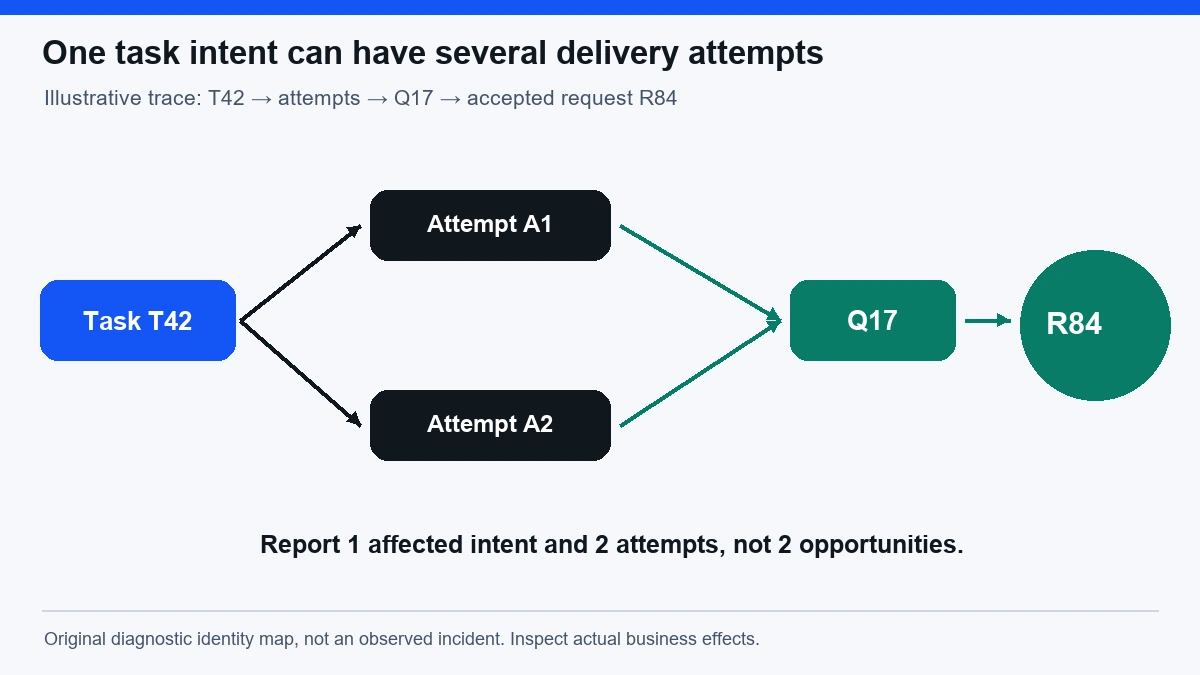
Imagine a fictional user authorizing an agent to request a consultation for Organization Cedar. Task T42 contains the approved destination and form data. Attempt A1 fetches current service information, validates required fields and submits operation Q17. The server records request R84, but the client loses the confirmation response.
Attempt A2 should remain linked to T42 and Q17 if it is recovering the same intended operation. An outcome lookup can establish R84 and show confirmation without creating a second request. The trace can then distinguish one accepted business intent from two delivery attempts.
If A2 instead creates Q18 and R85, the record exposes a duplicate-effect failure. Counting two successful submissions would hide the defect. Counting two missed opportunities would also be wrong because both attempts belonged to one intent. The business-object relationships determine the interpretation.
These identifiers and events are illustrative. They show the evidence needed to explain a failure, not a claim that such a system was tested. A useful trace connects intended constraints, execution and stored outcome so another reviewer can challenge the conclusion.
Measure deadlines across the full path
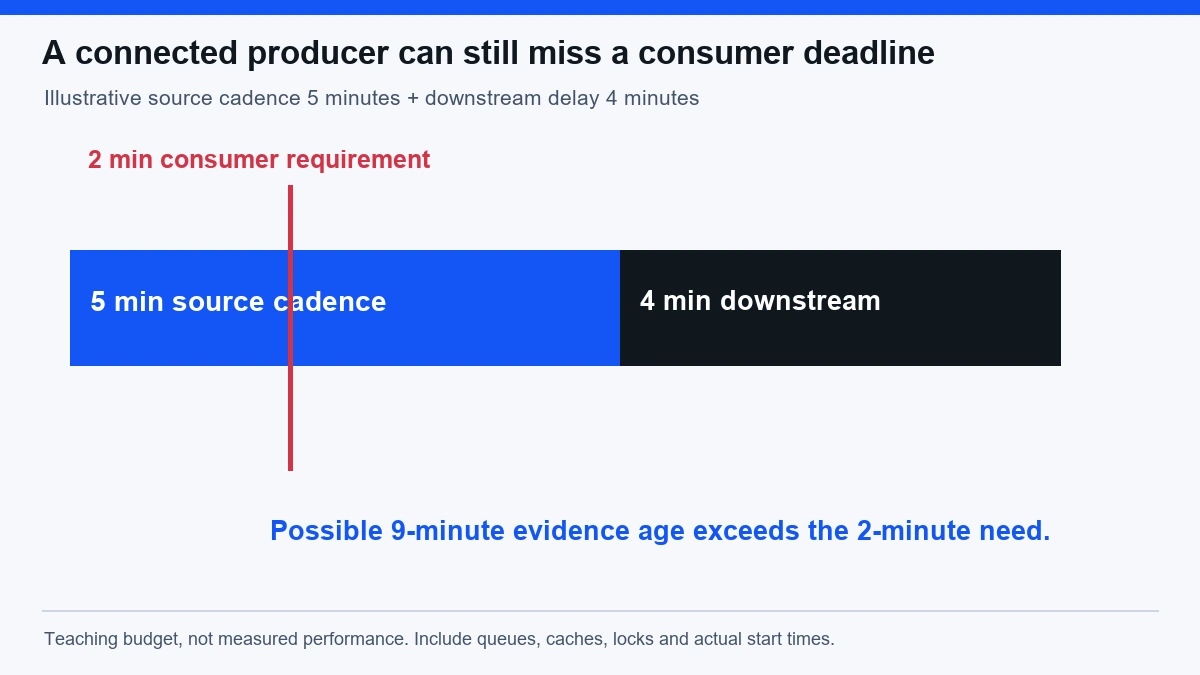
A task can fail because correct work arrives too late. Record request receipt, scheduling, source availability, validation, decision, submission and confirmed output times. Compare the total path with the consumer’s deadline and data-freshness limit rather than timing one fast component in isolation.
Producer cadence matters. If a source updates every five minutes and downstream processing can add four minutes, a consumer requiring two-minute freshness cannot be satisfied reliably by configuration alone. Include queue delay, cache reuse and actual start times. Nominal schedules are not evidence that work ran when expected.
Inspect locks and contention. A background rebuild may hold a shared resource while an independent observer misses a short-lived event. A process can remain alive throughout the incident. The investigation must establish whether the relevant task was evaluated and whether its evidence was current before the deadline.
The technical SEO checklist covers surrounding delivery and rendering checks, but operational timing needs its own record. A healthy page response does not prove that an asynchronous agent task met its deadline or reached the intended external system.
Classify failures by the limiting stage
Expected rule-based rejection means the system evaluated the task and correctly declined under a defined rule. Missing data means required evidence was unavailable. Stale data means evidence existed but failed the task’s validity requirement. These conditions can produce similar visible noncompletion while requiring different responses.
Scheduling failure means eligible work was not evaluated or started within its required window. Execution failure means an attempted operation did not complete as intended. Presentation failure means the underlying task state and displayed result disagree. Keeping these categories separate prevents a display repair from being presented as a complete execution fix.
Unknown should remain a valid category when evidence is insufficient. Missing logs do not prove the task was skipped, and a timeout does not prove the server rejected the operation. Preserve the uncertainty and identify what future instrumentation would resolve it. Do not manufacture a precise cause to make an incident report feel complete.
Assign ownership to the actual dependency. A content team can clarify missing source information, an application team can repair routing or state handling, and an operations team can address deadline or recovery failures. A generic agent failed label obscures the work needed to correct the limiting stage.
Keep attempts and opportunities distinct
Define the unique task or opportunity in terms the business can defend. A user retrying the same quote request ten times is one intent with repeated attempts. A monitoring job evaluating the same state every minute does not necessarily observe a new independent opportunity each time. Report both the unique unit and the observation count.
Avoid inflating impact by summing overlapping error categories. One task can involve stale data and a failed retry. Preserve task-level records so that the union of affected tasks can be calculated without double counting. Category totals are useful diagnostics, but they are not automatically additive business losses.
Do not infer a successful outcome from the absence of an error event. Instrumentation can fail, sampling can omit a trace and a process can stop before writing its final record. A confirmed business outcome is stronger evidence than a quiet log. State the coverage and known collection gaps.
Likewise, do not infer revenue loss from every noncompletion. Appropriate rejection, user cancellation and an unmet required constraint can all be valid outcomes. Use measured downstream effects where available and label estimates. The trace should support a careful interpretation rather than automatically maximize the apparent size of an incident.
Protect observability quality
Keep event definitions and schema versions stable enough for comparisons. If a release changes what confirmed means, annotate the break or provide a mapping. Otherwise, a measurement change can impersonate a product improvement. Retain a small set of reference tasks to verify instrumentation after material changes.
Test the telemetry path itself. A business action can complete while the logging queue fails, or a trace can appear complete while a downstream confirmation is missing. Compare sampled records with authoritative business state. An observability dashboard is another system with its own dependencies and failure modes.
Use appropriate retention and access controls. Diagnostic evidence can contain sensitive task context even when it lacks obvious secrets. Collect the minimum information needed for the defined purpose and apply the organization’s governance requirements. More data is not automatically more useful evidence.
Sampling needs disclosure. If detailed traces cover a subset of tasks, report that scope and how the sample was selected. Reviewing only failures can diagnose defects but does not estimate an overall success rate without a suitable denominator. Reviewing only apparently successful tasks can miss silent errors.
Verify repairs with fresh operational evidence
Reproduce the failure where practical using the relevant conditions. A timing defect may require background load or an interrupted dependency, not just an isolated request. Preserve the original evidence, apply the narrow repair and test the affected path. Avoid changing unrelated decision thresholds merely to make the system appear active.
Confirm that the deployed process uses the repaired code and configuration. A local passing test is not a deployment receipt. A deployment receipt is not evidence that a fresh task completed. Inspect a new operational trace and authoritative outcome before claiming real-world success.
Use the internal linking checklist when the repair includes clearer routes between guidance, task preparation and status pages. Navigation can improve the user journey, while the trace still needs to establish the actual execution outcome independently.
State remaining uncertainty precisely. If the repair passed under normal load but not yet under the original contention pattern, say so. If an external system’s historical state cannot be reconstructed, retain that gap. An honest bounded conclusion is more useful than declaring the whole system fixed after one narrower check.
Questions for an observability review
Is connection status evidence of successful agent work? It establishes that one dependency is reachable or authenticated under the observed conditions. It does not establish fresh data, timely scheduling, correct decisions, submission or confirmed output. Trace the full task before drawing a broader conclusion.
What is the most useful incident artifact? A version-bound record connecting the authorized intent, relevant evidence, timings, decisions, attempts and authoritative outcome. It should identify known failures and unknown stages without conflating repeated observations with unique opportunities.
What should a completion report contain? State what changed, which tests passed, what was deployed, what fresh operational evidence was observed and which dependencies remain uncertain. Those distinctions make the repair reviewable and prevent a healthy dashboard from substituting for an actually completed task.
A task evidence schema
The following fields form a practical starting point for a reviewable task trace. They are a proposed application schema, not mandatory OpenTelemetry attributes. Choose identifiers and retention appropriate to the system, and avoid copying secrets or unnecessary personal information into diagnostic records.
| Evidence field | Question it answers | Example scope | Failure hidden when absent |
|---|---|---|---|
| Task intent identifier | Which user-authorized objective was being served? | One quote request or one constrained product decision | Retries appear to be unrelated business opportunities |
| Attempt and operation identity | Which delivery effort belongs to which action? | Several attempts tied to one intended mutation | Duplicate effects cannot be distinguished from new requests |
| Source version and effective context | Which facts supported the decision? | Exact offer, region, policy version or passage | A recent fetch is mistaken for current business validity |
| Scheduling and transition times | Did work occur within the usable deadline? | Receipt, start, evidence arrival, submission and confirmation | A running process hides missed time-sensitive work |
| Rule or authority result | Why was action permitted or rejected? | Current permission and task-specific acceptance rule | Expected denial is confused with execution failure |
| Business outcome reference | What actually changed or completed? | Accepted request, stored order or confirmed setting | A successful network response impersonates task completion |
| Observation coverage | Which events were actually retained? | Full traces, sampled traces and known collection gaps | Missing data is misreported as absence of failure |
Validate the schema against real incidents and remove fields that do not serve a defined purpose. More telemetry is useful only when it improves the ability to establish and explain the task’s actual outcome.