
The Search Brief · News analysis
Agent Cart Recovery: Preserve the Purchase Intent Without Repeating the Wrong Action
Recover carts without duplicating orders by separating cart, payment and order states, preserving constraints and checking unknown outcomes.
Development covered: Primary documentation checked November 2, 2026
Agent cart recovery should restore a known task state while preserving the user’s item, quantity, price constraints and authorization. It should not treat every interruption as permission to create another order. A cart, a payment attempt and a confirmed order are different business objects, and their states can diverge when a connection fails.
The first recovery question is therefore what has already happened. Did the cart change? Was payment initiated? Did the merchant accept an order? Did only the confirmation fail to arrive? A reliable interface exposes enough evidence to answer those questions or explicitly marks the outcome unknown while it is reconciled.
Start with actionable notifications
W3C’s forms tutorial discusses user notifications, including feedback about errors and successful completion. It explains the importance of understandable messages and identifying how to correct problems. This provides an accessibility foundation for recovery, not a complete payment or order-processing protocol. W3C user notification guidance.
The practical application is to describe the actual condition. An invalid address requires correction. An unavailable item requires a new choice. A payment-service timeout may leave an uncertain outcome. A message that says only “Try again” fails to distinguish those cases and can encourage a duplicate action.
Keep important information available as text and through appropriate semantics. A red border or a disappearing toast is not enough to explain which cart line changed or whether an order was accepted. The user and agent need a stable, understandable recovery path that matches the underlying state.
Do not announce success merely because a button handler finished. The interface should base its message on the relevant server outcome. A checkout animation can accompany a confirmed order, but it cannot establish that the order exists or that the intended items and terms were accepted.
Separate cart, payment and order state
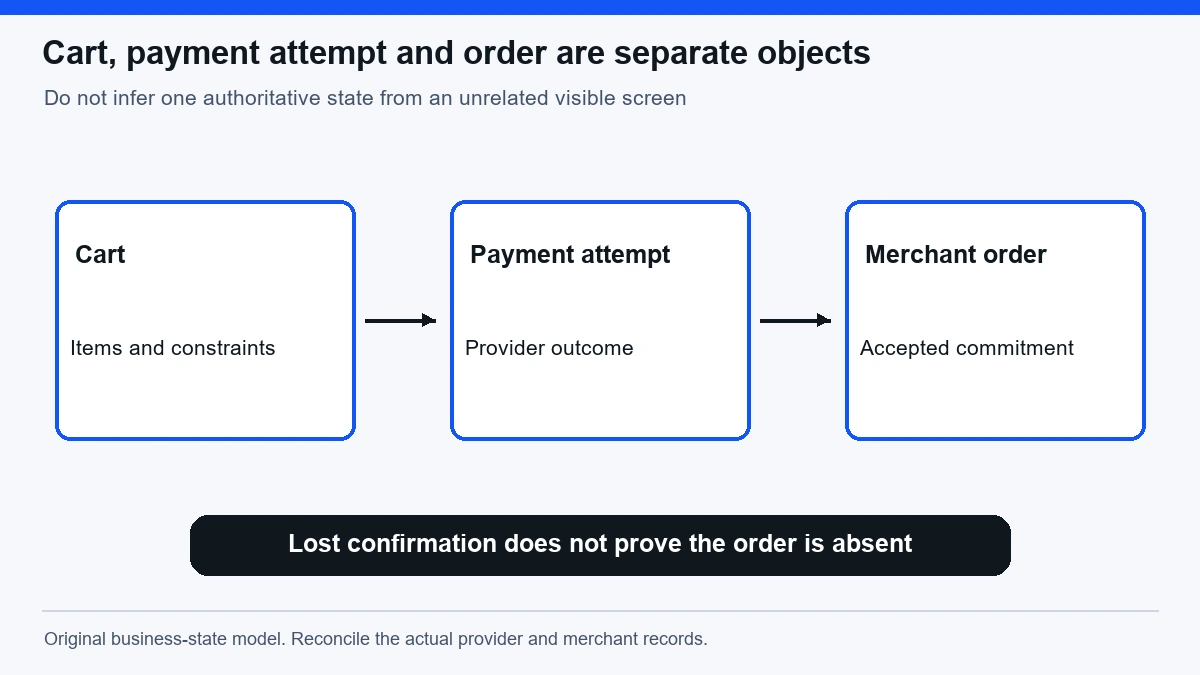
A cart represents selected items and relevant shopping context. A payment attempt concerns a financial operation under the provider’s contract. An order represents the merchant’s accepted business commitment. These objects may be linked, but one should not be used as an unsupported substitute for another.
For example, a cart can remain visible after an order is accepted because the confirmation response was lost. Pressing purchase again may create a second attempt unless the system recognizes the original operation. Conversely, a payment attempt can fail before an order exists. The appropriate recovery depends on the recorded relationship among those states.
Define the source of truth for each transition. The browser’s local storage may preserve a cart draft, while the server owns accepted orders. A payment provider may own the authoritative payment status. A reliable application reconciles those sources through supported mechanisms rather than inferring everything from the page currently displayed.
The ecommerce SEO best-practices guide describes the wider relationship between catalog, offer and fulfillment quality. Cart recovery addresses a narrower operational issue: maintaining the intended purchase through interruptions without inventing a new commitment.
A worked interrupted-checkout example
Imagine a fictional user who authorizes an agent to purchase one blue 750 ml Cedar bottle within a delivered-price limit. The cart review shows the correct variant, one unit, delivery method and total. After the authorized submission, the connection closes before the confirmation page appears.
The merchant may have accepted the order, rejected it or still be processing it. The agent should not assume that the empty or unchanged page proves failure. It should use the supported order-status or attempt-recovery path, preserving the original operation identity where the system provides one.
If the order is confirmed, recovery should display the accepted item, quantity, total and reference. If it was rejected because stock changed, the cart can preserve valid information while explaining the unavailable line. If the outcome remains unknown, the site should say so and avoid presenting a new independent purchase as the obvious next step.
This scenario is illustrative, not a report of an executed purchase test. It demonstrates why client uncertainty and business state must remain separate. A successful recovery is established by the correct authoritative outcome and truthful visible confirmation, not by repeatedly reaching a checkout screen.
Preserve the constraints that justified approval
An approved cart is a particular combination of item identity, quantity, seller, condition, delivery and price. If any material component changes, the old approval may no longer apply. Recovery should make those changes visible before a consequential action rather than silently continuing with new terms.
Keep pack size distinct from quantity. A cart containing two two-packs differs from two single units. If a product was replaced or its catalog mapping changed, verify the actual sellable unit. A familiar name or image is not sufficient evidence that the recovered cart represents the original request.
Promotional discounts and shipping estimates can expire. The interface should identify a changed total and explain the applicable conditions. An agent should not relax a user-defined price ceiling merely to finish checkout. If the new terms exceed the authorized scope, return to a meaningful decision boundary.
Use search intent alignment to keep comparison, cart preparation and purchase distinct in the surrounding journey. A user asking to explore options should not be pushed into a recovered purchase flow that assumes an authorization they never gave.
Recover validation errors locally
When one field is invalid, preserve the correct information where appropriate and identify the repair. An address issue should not erase the cart or force re-entry of unrelated contact details. Clear field-level messages and an understandable summary help both keyboard users and agents locate the problem.
Distinguish format validation from business eligibility. A postal code can be syntactically valid while the merchant does not deliver there. The message should explain the actual limitation and available alternative. Asking the user to reformat a valid address conceals the reason the task cannot proceed.
Do not rely on a visual color change to identify the affected item. If a cart line becomes unavailable, name the item and relevant variant. If only a quantity is unavailable, state the supported amount where the business can establish it. A generic cart error gives no reliable basis for choosing a correction.
Retain safe draft state across navigation and reauthentication where the product supports it. At the same time, recheck account scope and current terms before submission. Recovery should preserve useful work without treating a stale session or old approval as authority for a changed task.
Handle uncertain external outcomes deliberately
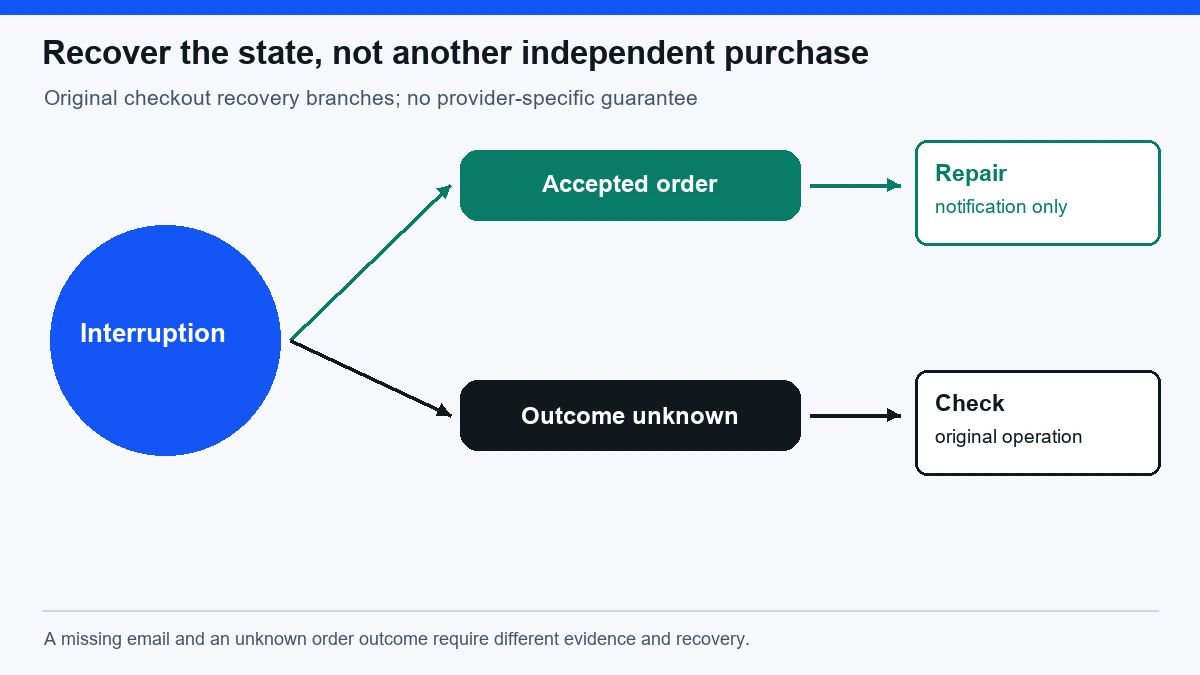
A payment or order request can produce an unknown client outcome when a response is lost. The application needs a supported reconciliation method. This may involve an operation identifier, provider status lookup or a durable order record, depending on the architecture. Do not invent a universal retry rule for every provider.
Separate retrying the same intended operation from creating a new one. Under an appropriate idempotency contract, a retry can recover the original result without repeating the business effect. Without that contract, another submission can have different consequences. The interface should not hide this distinction behind a generic retry button.
Notifications can fail after order acceptance. Resending a confirmation email is not the same as creating another order. Keep downstream communication recovery separate from the business commitment so that a missing message does not trigger duplicate fulfillment work.
If the system cannot establish the historical outcome, preserve that uncertainty and provide an appropriate support route. Do not claim that nothing happened because logs are missing. A careful incident record distinguishes confirmed state, plausible hypotheses and evidence gaps.
Test competing changes and interruptions
Include a product becoming unavailable, a quantity adjustment, a price change, an expired discount, session expiry and a delivery-region change. For each case, specify which information remains valid and which decision requires new review. The test should preserve the user’s constraints rather than reward any completed order.
Test a connection loss before receipt and after acceptance separately. The first can leave no business effect; the second can leave a completed order with missing client confirmation. A recovery design that passes only the first case has not demonstrated protection against duplicate orders after acceptance.
Test concurrent tabs and repeated actions. A disabled button in one tab does not stop another tab or client from submitting. Verify the backend’s actual operation handling and resulting business objects. Count accepted orders, not only successful responses or page transitions.
Use the technical SEO checklist to verify the surrounding page’s delivery and rendering where relevant. Keep checkout correctness separate from public search eligibility. A page can load quickly and remain technically accessible while its recovery state is wrong.
Observe the full task under load
Trace input, cart version, current offer checks, authority decisions, submission, provider response, stored order and visible confirmation. A single healthy dependency does not establish that the complete path met its deadline. Background catalog work or shared locks can delay a critical recheck even when services remain connected.
Compare data age with the consumer’s decision window. A browsing snapshot may be acceptable for discovery but too old for order acceptance. A recovery path should not reuse stale availability solely because the cart draft is convenient. Revalidate the facts that determine whether the action remains appropriate.
Check restart behavior around pending operations. A process should resume or reconcile durable state rather than forget an accepted order or replay a consequential action blindly. A progress flag held only in memory is weak evidence for a business task that must survive interruption.
After a repair, distinguish tests, deployment and fresh operational success. A passing local case does not prove the deployed service uses the repair. Inspect an actual controlled event through the live path where authorized, and name any conditions that remain untested.
Measure recovery without inflating the problem
Group retries under unique purchase intent where the evidence supports it. Ten attempts by one user are not ten independent lost orders. Report unique affected tasks, repeated attempts, duplicate business objects and final outcomes separately. This reveals both the scale and the persistence of the defect.
Do not classify every abandoned cart as an agent failure. A user can intentionally stop, reject changed terms or decide no suitable item exists. Appropriate noncompletion differs from a broken interaction. The evaluation should preserve those reasons rather than maximize completion at the cost of the user’s requirements.
Likewise, do not infer revenue loss by multiplying every error by the cart total. Some tasks would not have converted, some were recovered and some were duplicates of the same intent. Use confirmed outcomes where available and label scenario estimates. Missing observations should remain gaps rather than convenient proof of no impact.
Retain representative failed traces and successful recoveries. A summary percentage cannot explain whether the remaining issue concerns data freshness, authority, validation, external execution or presentation. The next repair should follow the observed limiting stage.
Questions for a cart-recovery review
Does restoring a cart mean the purchase can resume unchanged? Not always. The items, current terms, account context and authorization may need rechecking. Preserve draft work while making material changes visible before a new consequential step.
Does a payment error prove no order exists? Not necessarily. The application must reconcile its supported payment and order states. A client-side error message alone cannot establish the backend outcome. Use authoritative records and the provider’s documented contract.
What should a successful repair demonstrate? It should show the intended item and constraints surviving the relevant interruption, the correct number of business effects, and a truthful final state. The evidence must connect preparation, execution and confirmed output rather than stop at a recovered screen.
A recovery decision table
The correct next action depends on the established state, not the appearance of the last screen. Use this table as a proposed operational tool and adapt it to the merchant’s actual contracts. In particular, do not assume that one provider’s retry semantics apply to every payment or order system.
| Established condition | What remains valid | What must be checked | Safe recovery direction |
|---|---|---|---|
| One address field failed validation | Other valid draft information where policy permits | Specific field requirement and delivery eligibility | Correct the field without creating an order attempt |
| Selected variant became unavailable | Original user intent and other reviewed constraints | Current exact-item availability and permitted alternatives | Explain the rejection and seek a suitable new decision |
| Total increased after review | Product selection may remain the same | Current delivered total against the authorized ceiling | Return to review rather than silently accepting new terms |
| Connection failed before outcome was learned | Original operation identity and approved payload | Authoritative payment and merchant order state | Reconcile or safely resume the same operation |
| Order was accepted but email failed | Confirmed business order and reference | Notification state separately from order existence | Repair communication without recreating the order |
| Session expired during recovery | Safe draft data under the product’s policy | Current account, permissions and prior submission outcome | Restore context before any new consequential step |
Attach actual evidence references when applying the table. A row is not passed because a message exists; the stored outcome and displayed state must agree. Report unknown historical outcomes explicitly when logs or provider records cannot resolve them.