
The Search Brief · News analysis
Agent Product Identifiers: Keep the Same Item From Search to Confirmation
Keep product family, selected variant, offer and accepted order identity coherent, with a sellable-unit checklist and a worked constrained search.
Development covered: Primary documentation checked November 2, 2026
Agent product identifiers should keep a shopping task attached to the exact item and variant the user intended. A familiar product name is often insufficient: size, color, capacity, region, condition, pack quantity and seller can change what is actually being purchased. Reliable commerce experiences preserve those distinctions from discovery through selection, cart, current availability and final confirmation.
The objective is accurate task completion, not a promise that adding identifiers guarantees rankings or AI recommendations. Clear product identity helps people compare offers and detect mistakes. It also gives an authorized agent a stronger basis for matching a request to a real catalog item without substituting a similar-looking product silently.
Product, variant and offer are different identities
Schema.org’s Product vocabulary provides properties for product identity and relationships, including model information and identifiers, and distinguishes product information from associated offers. Its documentation recommends using specific available properties rather than hiding everything in generic property-value pairs. This vocabulary describes data relationships; it does not establish the truth of a merchant’s data or guarantee any search presentation. Schema.org Product documentation.
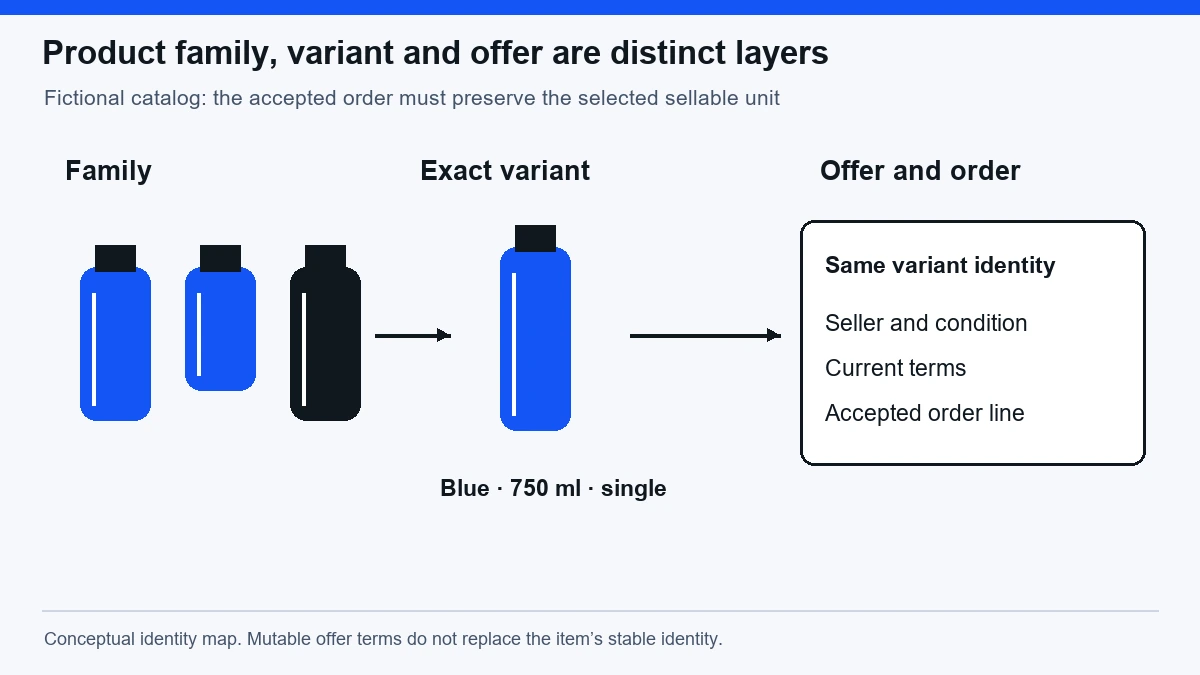
A product family can describe a design shared by several variants. A variant identifies a particular configuration. An offer describes commercial terms from a seller, potentially including price and availability. A user can approve one product configuration while still needing to choose among different offers. Collapsing these layers into one name makes errors harder to detect.
For example, a fictional Cedar travel bottle might come in two capacities and three colors. A blue 750 ml bottle is not interchangeable with a black 500 ml bottle merely because both display the same family title. A two-pack is also different from one unit. Those differences should remain visible and machine-readable where the platform supports it.
Seller and condition can matter too. A refurbished item from one seller may share a model name with a new item from another. A cross-border offer can have different warranty, delivery and compatibility conditions. The page should make the actual offer recognizable rather than relying on the product photograph to carry every distinction.
Build a catalog identity record
Maintain the identifiers the business genuinely uses and understands. A stable internal variant identifier can connect page selection, cart lines and fulfillment records. Manufacturer identifiers or genuine assigned trade identifiers can support broader matching when appropriate. Do not invent external identifiers or copy one across unrelated items to fill a required field.
Record the attributes that define the sellable unit. The appropriate set depends on the catalog: apparel may need size and color; electronics may need capacity, region and connector; supplies may need concentration, package size and unit count. A generic list of attributes is useful only if it captures the distinctions that affect the buyer’s decision.
Separate identity from mutable commercial state. The item’s current price or availability can change without creating a new product. A catalog should not encode today’s price into the only identifier that downstream systems use to recognize the item. Stable identity lets the application recheck changing terms against the same intended variant.
Use the ecommerce SEO best-practices guide for the wider relationship between catalog quality, sellable inventory and customer demand. The identity work here addresses a narrower operational question: whether the item remains the same throughout the task.
Preserve selection in the visible page
A variant selector should state the selected values and update the relevant product details coherently. If changing capacity changes price, availability or image, the page should not leave contradictory old values visible. A selected control and a summary panel should describe the same configuration.
Do not rely only on color swatches without understandable names. A user may need to distinguish navy from black or a patterned option from a solid one. The visible and programmatic labels should make the choice recognizable. Images can reinforce the selection but should not be the sole source of its identity.
Default selections deserve review. A page opened from a link to a particular variant should either preserve that variant or clearly explain the resulting state. Silently defaulting to the cheapest or first available variant can change a user’s intended item before the cart stage. An agent should verify the actual selected configuration rather than infer it from the incoming URL alone.
Keep quantity and pack size distinct. Selecting quantity two for a two-pack means four physical units, while selecting quantity two for a single item means two. A summary should express enough information for the user to check the intended total. This distinction is especially important when the catalog uses similar product names for different package sizes.
A worked variant-matching example
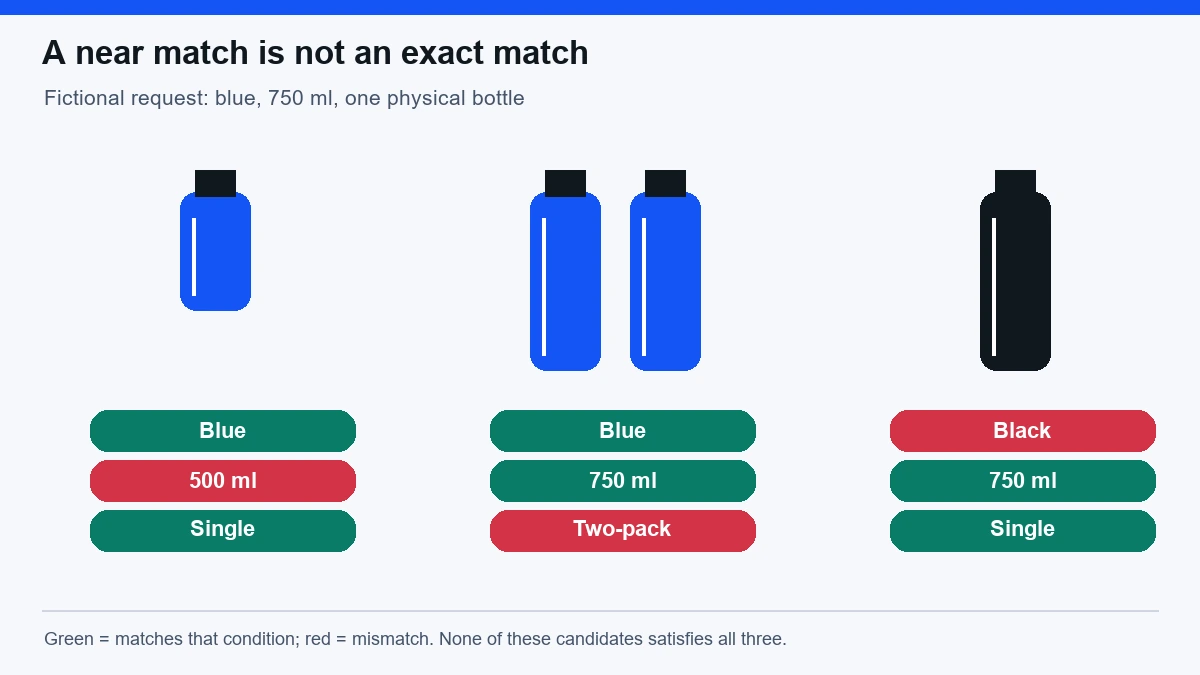
Imagine a fictional user asking an agent to find a blue Cedar bottle with 750 ml capacity, sold as a single unit, within a stated delivered-price limit. The agent first finds the product family page. That establishes a candidate, not a completed match. It must inspect the available variants and the relevant offer conditions.
The page offers a blue 500 ml single, a blue 750 ml two-pack and a black 750 ml single. None satisfies all the requested constraints. A weak workflow chooses the closest image and adds it to the cart. A reliable workflow reports the mismatch or searches for another suitable offer rather than treating partial similarity as permission to substitute.
Suppose a matching blue 750 ml single becomes available. The agent should verify the selected variant, seller, condition, quantity and current total before any authorized purchase step. The cart should retain the same variant identity and display a recognizable description. A hidden identifier alone is insufficient for the user to review the choice.
These products and events are illustrative. They demonstrate a constraint-matching method, not results from a live catalog test. The important record is which requirements were satisfied, which were unknown and which would require the user’s explicit acceptance of an alternative.
Keep structured data aligned with the offer
Structured data should represent facts that agree with the visible page and source catalog. A product’s identifier, selected attributes and associated offer should not contradict the actual purchasable item. Validation can detect syntax problems, but factual alignment requires inspecting the relationships and the delivered page.
Use the structured-data improvement guide to plan truthful markup around visible entities and offers. Do not add a property because it looks advantageous if the business cannot establish the value. A fabricated identifier can make a technical validator happy while making product matching worse.
Variant pages and parameterized selections need coherent URL behavior. The right implementation depends on the platform and indexing intent, but the user-facing selected state should remain understandable. A canonical signal is not a substitute for preserving an authorized shopping choice in the cart and confirmation.
If the page exposes a family-level description while the cart contains a variant-level item, make that transition explicit. A reviewer should be able to connect the two. The same applies to feeds and downstream fulfillment data: different representations can have different purposes while retaining a clear mapping to the actual sellable unit.
Recheck identity at each consequential boundary
Adding an item to the cart should use the intended variant and quantity. The server should validate that identity against the current catalog rather than trust an ambiguous client label. If the variant was retired or replaced, the system should not silently map it to a different item whose details happen to resemble the old one.
At checkout, verify that the cart still reflects the reviewed item and current terms. A change in availability may require a new decision. A price update may require user review under the workflow’s rules. A substitution policy should be explicit rather than inferred from the fact that an agent is trying to finish a task.
The confirmation should name the item sufficiently to detect an error. Include meaningful variant attributes and quantity, not only a broad family name. A final reference can connect the order line to fulfillment, but the human-readable description should also match the intended purchase.
For returns, support and later reorders, preserve historical order identity. Today’s catalog description may differ from what was purchased. The business needs a record of the actual item and terms at the time of the order, while current product pages can evolve. Do not rewrite historical transaction meaning by changing a shared display label without a suitable snapshot.
Diagnose identity failures across systems
Trace the identifier from search result or referring link through page selection, submitted cart request, stored cart line, checkout review and confirmation. A page screenshot alone cannot establish which variant the backend accepted. Inspect the stored business state and its mapping to the displayed item.
Check shared caches and regional state. A cached page may show one variant while an availability service evaluates another. A stale frontend bundle may send an old identifier after the catalog has changed. These are delivery and synchronization defects, not evidence that the user chose incorrectly.
Include imports and catalog updates in testing. A feed job can accidentally reuse identifiers, drop leading zeros or convert strings into numeric values. A quiet manual edit may work while a bulk update corrupts the mapping. Preserve source files, transformations and rejected records so that the cause can be reconstructed.
The technical SEO checklist supplies the surrounding crawl, rendering and canonical checks. Keep product-task verification separate from search eligibility. A perfectly indexable page can still send the wrong variant to the cart.
Test exact matches and acceptable alternatives
Build a small set of realistic requests covering exact identifiers, ordinary descriptions, similar variants, package sizes and unavailable combinations. Define what counts as a match before running the test. A system should not receive credit for completing a purchase that violates a required constraint.
Include ambiguous requests where clarification is appropriate. If the user asks for a Cedar bottle without specifying capacity, the agent may need to compare options or ask a question rather than select arbitrarily. The website can help by making differences visible and providing a coherent comparison path.
Test permitted alternatives separately. A user may authorize any color but require a capacity, or accept a higher price within a revised limit. Record the actual flexibility. An agent should not generalize one accepted substitution into permission to relax every constraint.
Retain failures by unique task intent. Repeatedly observing the same wrong variant is evidence of persistence, not a count of independent missed customers. Report unique requests, attempts, mismatched attributes and final outcomes. This makes the scale and mechanism of the problem easier to understand.
Questions for a product-identity review
Is a product name enough for an agent to buy correctly? Often it is not. The required identity depends on the task and catalog, including relevant variant attributes, quantity, seller and condition. Make those distinctions explicit and verify them at the point of action.
Does structured data guarantee correct matching? No. It can express useful relationships when accurate, but a consumer can interpret it differently or use another source. Validate syntax and factual agreement, then test actual behavior rather than claiming universal agent compatibility.
Should every unavailable item be replaced automatically? Only under an explicit supported policy and the user’s actual authorization. A similar item can differ in a decisive property. When no matching offer exists, an accurate noncompletion can be better than an unauthorized substitution.
What should a repair prove? It should connect the requested constraints to the selected variant, accepted cart line and confirmed order or other intended outcome. Preserve the evidence and distinguish tested behavior from deployed and freshly observed success. The right product arriving at the right stage is the outcome, not merely an enabled purchase button.
A sellable-unit identity checklist
Use this compact ledger when checking a candidate against a request. The fields are illustrative and should be adapted to the catalog. Mark a condition unknown when no suitable evidence exists; do not convert a blank field into a successful match. Keep required attributes separate from preferences the user allowed the agent to relax.
| Identity layer | Illustrative requested value | Evidence location | What would invalidate the match |
|---|---|---|---|
| Product family | Cedar travel bottle | Product title and catalog family relationship | A different model hidden behind a similar photograph |
| Variant capacity | 750 ml | Selected option and accepted variant record | A smaller capacity selected by a default control |
| Variant color | Blue | Named selected swatch and order-line description | An alternative color chosen because it is available |
| Sellable package | One physical bottle | Pack-size definition separate from cart quantity | A two-pack presented with the same broad title |
| Commercial offer | Stated seller and condition | Current offer and checkout review | Refurbished or marketplace terms replacing approved terms |
| Fulfillment scope | Delivery to the required region | Address-dependent eligibility and final review | Pickup-only availability mistaken for deliverable stock |
| Accepted outcome | Same item and quantity | Stored cart or order line plus confirmation | Backend identifier differs from the reviewed selection |
The ledger is a proposed tool, not evidence that this fictional product exists. A completed test should attach actual source or state references to the relevant rows and preserve any mismatch through the incident record. This makes identity verification reviewable instead of reducing it to visual resemblance.