
The Search Brief · News analysis
A Case Study Evidence Ledger: Show What Changed Without Inventing the Result
Build a case-study evidence ledger covering intervention, outcome maturity, testimony, attribution and limits, with a fictional lead-routing example.
Development covered: Primary-source guidance checked November 2, 2026
A useful case study explains the customer’s problem, the intervention, the conditions and the observed outcome with enough evidence to support the conclusion. It should distinguish completed implementation from measured improvement and measured improvement from causal proof. A persuasive story becomes stronger when those boundaries are clear rather than hidden behind a dramatic percentage.
Begin with the records that exist. A deployed configuration, a received lead, an approved customer quote and a change in a dashboard are different evidence types. They can support one narrative, but they do not establish the same claim. Build a ledger connecting each material statement to its source before writing the headline.
The examples below are fictional teaching cases. They do not describe a SEOS.co customer, a real campaign or an observed result. The method is intended to help editorial teams create defensible customer stories while respecting permission, confidentiality and the practical limits of the available data.
Define the story’s decision value
A buyer reading a case study wants to know whether the approach could fit a comparable problem. The most useful details often concern starting conditions, constraints and trade-offs, not only the final metric. A result from a large established company may have limited relevance to a small team with different resources.
Identify the reader and the decision before selecting the story. Is the asset explaining implementation risk, demonstrating a capability or helping compare operating models? The evidence required changes with the purpose. A technical implementation case needs process and verification details; a commercial outcome case needs reliable business records and a defined observation window.
Use the search-intent guide to align the asset with the buyer’s task. A case study should add concrete evidence that a general service page cannot provide. It should not simply turn the service description into a fictional customer narrative.
Write the provisional claim narrowly. “The team deployed a new lead-routing process and verified received records” requires implementation evidence. “The process increased revenue” requires much more. Starting with the strongest available claim keeps the story from outrunning the records.
Inventory the evidence before interviewing for the headline
Collect the original problem statement, relevant baseline reports, release records, test evidence, outcome records and approved commentary. Note the dates, owners and scope of each source. A screenshot without a report definition can be difficult to interpret, especially if filters or event definitions changed.
Preserve negative and unresolved evidence. Failed tests, pending opportunities and affected records can explain the practical work. Selecting only favorable screenshots creates a weaker account of what happened. A credible story can include a repair that was necessary before results could be interpreted.
Separate source availability from publication permission. A team may inspect a confidential report internally without being authorized to publish its details. Record the approved disclosure boundary and use a legitimate abstraction where necessary. Do not invent a customer name or outcome to make missing permission disappear.
If evidence is absent, narrow the story or choose another case. A testimonial can support the customer’s reported experience, but it cannot substitute for missing conversion records. An implementation receipt can support deployment, but it cannot establish that customers completed the task successfully.
Create a claim-level ledger
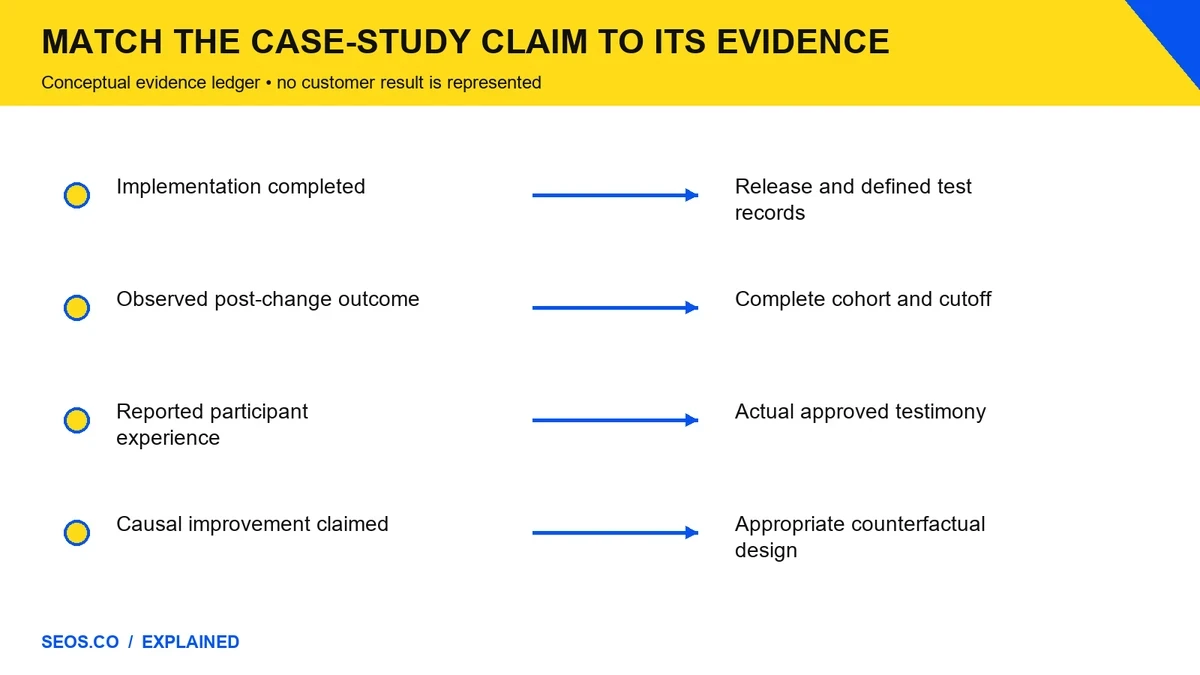
For each material statement, store exact wording, source, observation window, population, unit, calculation and limitation. Add whether the claim is approved for publication and who verified it. This makes review more efficient than asking someone to approve a polished article with unclear factual dependencies.
A claim worksheet can make the difference visible. Every example below is fictional:
| Claim type | Sample statement | Evidence needed |
|---|---|---|
| Implementation | Routing was changed and tested | Release record plus defined test results |
| Observed association | The settled post-repair cohort contains 100 unique inquiries | Complete business records and cutoff |
| Reported experience | A participant reports fewer manual handoffs | Actual approved testimony and context |
| Causal inference | The repair caused additional revenue | Appropriate counterfactual design; not established by this example |
Classify statements as implementation, observed association, reported experience or causal inference. Implementation describes work completed. Association describes outcomes observed around the work. Experience describes what a participant reports. Causal inference requires a design capable of addressing what would have happened otherwise.
A phrase such as results after launch should name the cohort and timing. Did the number concern all inquiries, unique qualified inquiries or won opportunities? Was the latest cohort mature enough for comparison? The denominator and outcome status are part of the claim’s meaning.
Keep numerical transformations visible. A relative increase and a percentage-point increase are different. If a rate rises from 2% to 3%, the absolute change is 1 percentage point and the relative change is 50%. Neither should be substituted for the other to make the result sound larger.
Work through a fictional lead-routing story
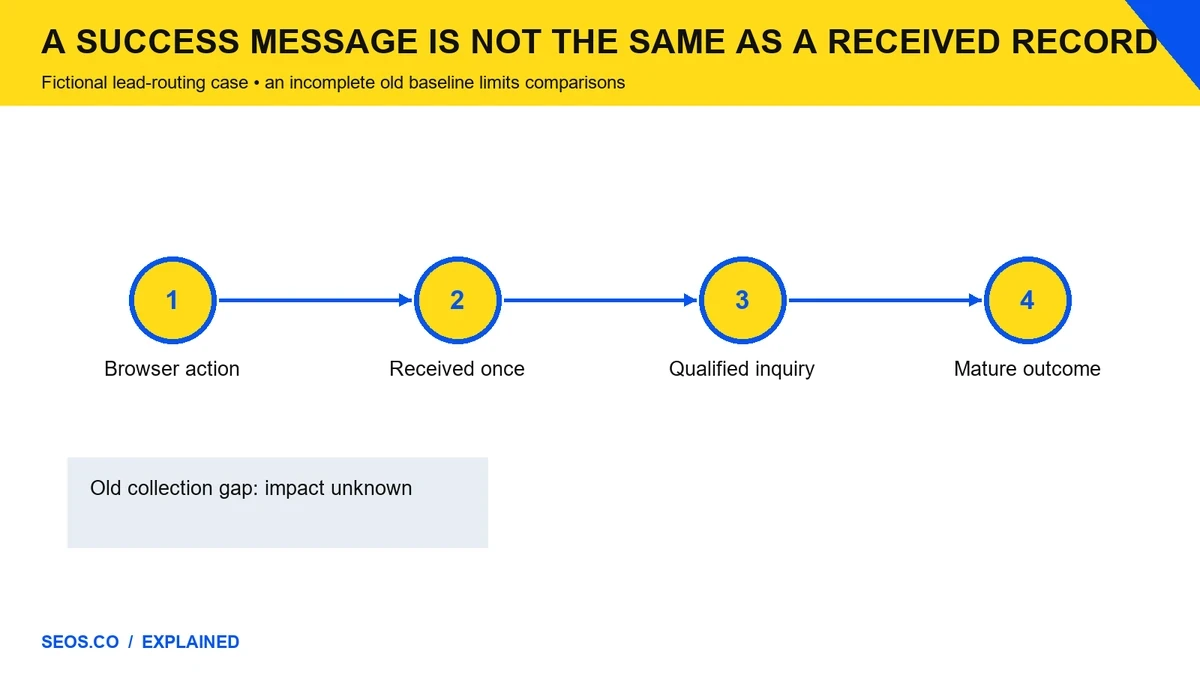
Imagine a fictional service business discovers that its website form displays success but some submissions never reach the sales system. The team repairs the routing, adds duplicate prevention and verifies a defined set of test submissions from browser action to received business record.
That evidence supports a concrete implementation story: the broken path was reproduced, the routing was changed and the tested submissions were received once. It does not yet support a claim that the company’s content strategy increased revenue. The repair restored the ability to observe and act on inquiries.
Suppose a later settled month contains 100 unique inquiries, twenty qualified opportunities and four wins. Those are fictional outcomes for teaching. Before comparing them with an earlier month, the team must ask whether the earlier collection was complete, the qualification rule stayed constant and the buying cycle had time to mature.
If the earlier system dropped records, a simple before-and-after conversion comparison is biased by the measurement change. The case study should explain that boundary. It can report the confirmed post-repair outcome and the earlier data gap without inventing the number of opportunities that would have existed under complete collection.
The useful lesson is still commercially relevant: a visible success message did not establish received inquiries, and end-to-end verification changed the operating reliability. A narrower proven story can be more valuable to a buyer than a broad revenue claim unsupported by the records.
Explain the intervention precisely enough to learn from it
Describe the steps that matter to the problem: input validation, submission handling, destination receipt, duplicate control and confirmation. Avoid a vague statement that the team optimized the funnel. The reader should understand what changed and why it addressed the observed failure.
Name shared dependencies and constraints. A form provider, customer system, consent configuration or delayed background job may affect the path. If the intervention bundles several changes, say so. Later outcomes cannot be assigned confidently to one element merely because it makes a cleaner story.
Include failures and recovery where useful. A retry can produce duplicates if the destination processed the first request but the response was lost. A working implementation needs a defined way to reconcile that uncertainty. The case should explain the observed or tested behavior rather than claim that automation handles everything.
The complete SEO audit guide offers broader context for tracing discovery through completion. A case study can demonstrate one part of that path while stating which stages remain outside its evidence.
Report outcomes with maturity and scope
Define the observation window and the age of each cohort. An opportunity still in evaluation is not a lost sale, and a signed project is not necessarily realized margin. Show pending states where they materially affect interpretation instead of forcing every record into a success-or-failure bin.
Use unique business records when the claim concerns customers or inquiries. Multiple sessions, repeated submissions and several contacts from one organization can inflate counts if treated as separate customers. Deduplicate using the business’s approved rules and preserve the method in the internal evidence packet.
Reconcile cancellations, refunds and later status changes where relevant. A marketing event can persist after a business outcome changes. If the case study uses a frozen historical result, state the cutoff and avoid implying it is a continuously updated current total.
Attribution also needs a boundary. Google Analytics describes attribution as assigning credit across recorded interactions through a chosen model. That allocation should not be casually presented as independent causal proof of a content intervention. Google Analytics attribution explanation.
Keep customer testimony accurate and proportionate
A customer quote should reflect what the person actually said and approved for the stated use. Preserve its source and context. Do not combine fragments into a stronger assertion or remove a qualification that changes the meaning. If a paraphrase is clearer, attribute it as a paraphrase rather than a direct quote.
Confirm the speaker’s role and relevant perspective. A project sponsor can describe the buying experience, while an operations lead may be better placed to describe workflow changes. Neither automatically verifies every technical or financial claim in the article. Attribute the contribution precisely.
Avoid manufactured human review. A customer’s approval of their quote is not approval of the whole research method. A technical reviewer’s check of implementation steps is not certification of revenue attribution. Record who reviewed which version and which claims.
If the customer cannot be named, explain the disclosure level honestly. An anonymized real case still needs internal evidence and permission. A fictional example should be labeled fictional. Calling an invented story anonymized falsely implies a real engagement behind it.
Make the visuals match the evidence
Use a workflow diagram to show the intervention, a timeline to show release and observation windows and a chart only when the underlying data supports it. A dramatic rising line should not be used as decoration when no measured growth series exists.
Include denominators, dates and status labels in real charts. Distinguish provisional pipeline from realized outcomes. If a hypothetical diagram teaches a method, keep that label visible. The image should not become the place where the article’s careful limitations disappear.
A vibrant feature image can express the problem and repair without fabricating a dashboard. Photoreal collage elements such as a broken paper bridge, a verified receipt and a magnifier can communicate the subject. The explanatory graphics should perform a specific reasoning role rather than repeat the headline.
The content SEO guide helps place the case within a useful library. Link from the relevant service or implementation explanation at the point where the case supplies evidence, and link back to the method when the reader needs broader context.
Review the headline against the strongest supported claim
A headline about increasing revenue requires evidence that supports that outcome and attribution. A headline about repairing missing inquiries can be strong when the full path is verified. Do not inflate the scope because a narrower finding feels less marketable.
Check every number in the title, opening, chart, caption and metadata against the same source record. A case can be accurate in the body while its social summary overstates the result. Review the whole distribution packet as one set of claims.
Add a concise limitations paragraph where it helps the reader assess transferability. Name the actual constraints: incomplete baseline, small cohort, bundled intervention, short window or unusual operating conditions. Generic disclaimers are less useful than specific boundaries.
The guide to AI-assisted content and ranking reinforces the wider editorial principle: a polished draft still needs factual accountability. Tools can help organize the narrative, but they cannot supply a customer, a result or a review that did not occur.
Keep the evidence useful after publication
Preserve the approved packet, source definitions and publication version. If a customer requests a correction or later data changes a claim, the team can assess the effect without reconstructing the story from memory. Make material corrections visible where appropriate and update derivative summaries.
Review the case when the product, service or implementation method changes. Historical results can remain valid as history while no longer describing the current offer. Label the time scope and provide the current path rather than silently rewriting the past.
A defensible case study gives a buyer enough detail to judge relevance and enough evidence to trust the stated result. Its power comes from a clear problem, a concrete intervention and a truthful outcome record. The ledger makes those strengths inspectable while preventing a compelling narrative from becoming an invented success story.
Use a transferability note instead of a universal promise
After describing the result, explain which conditions a new buyer would need to compare with its own situation. These can include operating scale, implementation capacity, data quality, starting defects and observation window. The note should identify meaningful differences rather than simply say that results vary.
In the fictional lead-routing case, a business with complete collection would not expect the same measurement effect from repairing a defect it does not have. A business with a different destination system may need another implementation. The useful transferable lesson is the verification method, not a guaranteed count of inquiries or wins.
Ask the customer or factual owner to confirm these boundaries where a real case is used. Preserve the distinction between their experience and the publication’s interpretation. A case study becomes a better decision resource when readers can recognize both the similarities and the limits before applying it to themselves.