
The Search Brief · News analysis
Google Expands VideoObject Guidance: Keep Creators and Interaction Counts Verifiable
Audit video identity, creator provenance and interaction definitions after Google's VideoObject update. Test source, player, visible page and markup together.
Development covered: September 24, 2026 documentation update; checked November 2, 2026
Google's September 24, 2026 VideoObject documentation update adds explicit creator guidance and clarifies supported interaction types. The useful implementation work is to connect each video to an authentic creator identity and a well-defined counter population, then verify that the page, player, and markup refer to the same media object.
The current VideoObject guide documents creator or author as a person or organization, with identifying information. It lists WatchAction, LikeAction, CommentAction, and ShareAction for interaction statistics. Google's changelog identifies the September 24 documentation change.
Those properties describe facts; they do not justify inventing a creator profile or importing unrelated social counts. This article develops a proposed data contract for video publishers, using clearly hypothetical examples rather than reported search experiments.
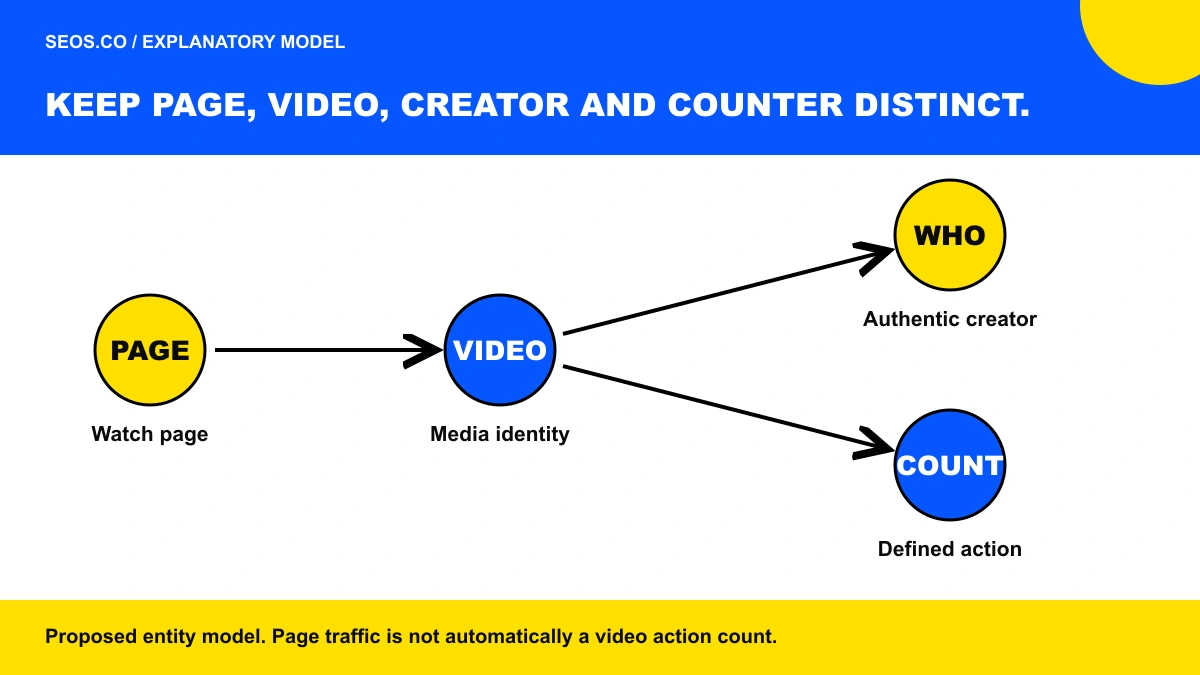
Distinguish the video, page, player, and creator
A video file is not the same object as the page embedding it. A player URL is not automatically the creator's profile. A channel or publisher account may differ from the person who produced the material.
Assign stable identifiers to each entity and record the relationships. The watch page contains or presents a video; the video has the authentic creator relationship supported by the publishing facts.
This distinction becomes important when one video appears on several pages or a page changes its featured media. A template can retain a stale media identifier while the visible player displays another asset.
Build tests around identity, not title alone. Different videos can share a headline, and a title can change without the underlying media changing. Stable IDs let the system compare the correct objects across pages, feeds, and analytics.
Establish creator provenance
Record where the creator relationship comes from: production records, an authorized upload, a maintained editorial credit, or another verified source.
Do not treat the account that imported a file as the creator by default. A migration operator can upload thousands of videos without having created them. Likewise, a CMS administrator is not automatically the author of every page.
Distinguish a creator's public identity from private account data. Use authentic public profiles or organization pages where appropriate; do not expose sensitive information to make an entity look more complete.
Handle collaboration and changing credits deliberately. If the visible page credits an organization while the source record names an individual, resolve the actual publishing relationship rather than choosing whichever field the plugin expects.
Give profiles durable identity
Display names can change or collide. Maintain a stable creator identifier and a current public destination that genuinely identifies that creator or organization.
A renamed creator should not lose the relationship to older videos. A reused username should not transfer credit to an unrelated person. A retired profile needs a deliberate public outcome.
Google's ProfilePage documentation provides relevant markup context for sites with authentic creator profiles. It does not authorize making fictional profiles to satisfy a video template.
Test the profile route directly. A link that works only inside a logged-in application may be unsuitable as the intended public identity reference. Keep access and privacy boundaries correct while verifying the public representation.
Define each interaction counter
Write a counting contract before serializing a number. Specify the action, qualifying event, deduplication, included population, time scope, exclusions, and update cadence.
A view counter might count starts, qualified plays, or another platform-defined event. Do not assume that two services' “views” are interchangeable merely because the labels match.
Likes, comments, and shares have their own semantics. A comment count can include hidden or removed items internally while the visible discussion shows only approved comments. A share count may reflect a specific platform's reshare action rather than every copied link.
The public markup should describe the actual supported fact. If the platform cannot substantiate a count, omitting it is more truthful than filling a default or estimating an impressive total.
Keep counters tied to the correct video
Join counters using the stable media identifier. Page-level analytics can include interactions with several videos, recommendations, advertisements, or unrelated controls.
If a watch page replaces its featured video, the old page total should not automatically become the new video's count. That would preserve a number while changing its referent.
Check embeds. A third-party player can report activity for the media across many sites, while the publisher's own analytics observes only its local page. Those populations differ and should not be silently merged.
Maintain source attribution privately in the data contract. Operators should know which system produced a value and what it measures, even when the public interface uses a simple human-readable label.
A hypothetical counter reconciliation
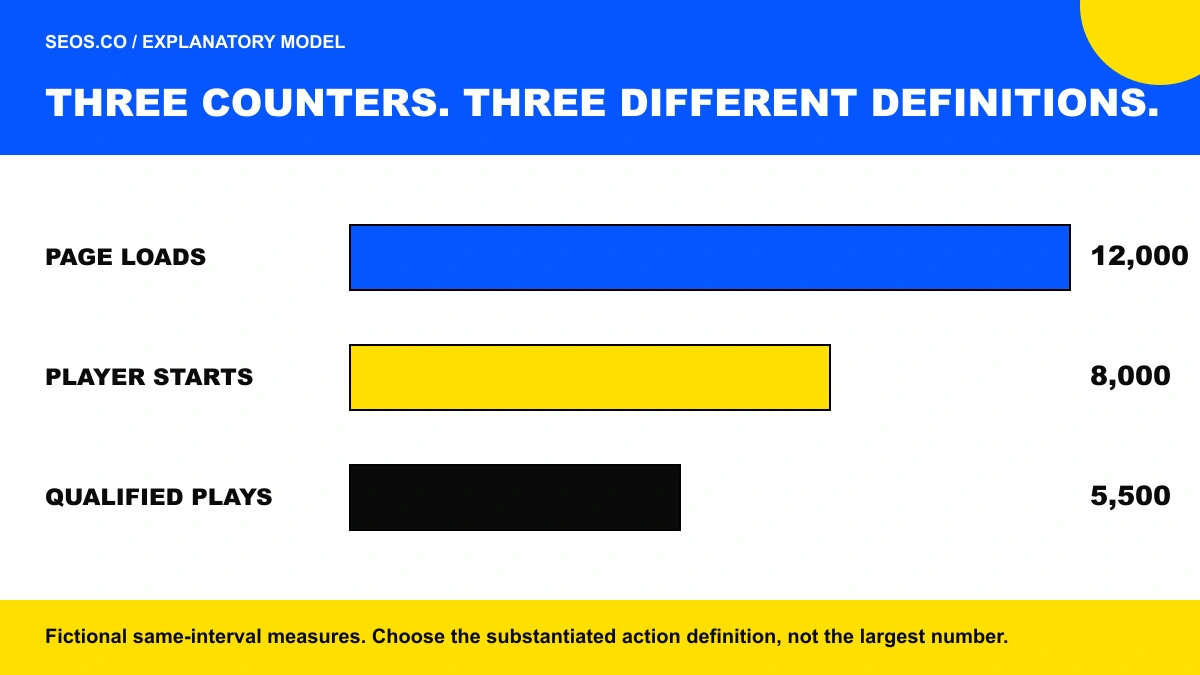
Imagine a publisher observing 12,000 page loads, 8,000 player starts, and 5,500 plays that satisfy its defined viewing threshold during one reporting interval.
Those are three different measures. Serializing 12,000 as the video watch count merely because it is the largest value would change the meaning of the data.
Suppose 500 starts came from an autoplay preview that the platform excludes from qualified views. The counting contract must specify whether that exclusion is already reflected in the 5,500 total. Subtracting it again would undercount.
The example numbers are invented to demonstrate reconciliation, not a benchmark. The correct published value depends on the actual supported action definition and source system, not a universal conversion formula from page loads.
Preserve a coherent snapshot
The structured-data guide explains the source-to-representation relationship behind these field checks.
Creators and counters can update on different schedules. A page cache might refresh its displayed count while structured data still uses yesterday's aggregate.
Record source version, calculation time, and public publication time. Decide the acceptable age for each field according to the product's needs and the applicable documentation.
Use a coherent view where practical. If visible text says one creator and the markup identifies another, a fast counter refresh does not make the representation correct.
Test the update path after edits, profile changes, moderation, and media replacement. An implementation that is correct only on first publication will drift as the library evolves.
Distinguish missing from zero
Zero means the measured action count is zero under the defined population. Missing means the system does not have a substantiated value. Those are not equivalent states.
A newly published video may legitimately have zero interactions. An imported archive may have unavailable historical counts. A source outage may make the current value unknown.
Define serialization behavior for each state. Do not silently convert unavailable values into zero or reuse another video's count to avoid an empty field.
The same principle applies to creator data. An unknown relationship should trigger review or omission according to requirements, rather than inventing a person or organization to complete the object.
Test transformations and integer handling
Counters can be stored as strings, displayed in rounded form, and serialized as numbers. Keep the underlying count distinct from the presentation label.
A visible “5.5K” is a rounded display, not an exact integer to parse back into the source record. Retain the authoritative count and format it separately for each representation.
Check large values, missing values, negative adjustments after moderation, and data imports. A datatype conversion can truncate or overflow a count without making the JSON invalid.
Treat counter decreases as events to understand. They can result from moderation or corrected measurement, not necessarily a broken pipeline. Preserve the reason so monitoring does not automatically restore an obsolete higher number.
Verify the underlying video experience
Review video SEO fundamentals alongside creator and counter markup.
Accurate creator and counter fields do not compensate for an inaccessible player, missing thumbnail, or wrong media file. The page's actual video task still needs to work.
Google's video best practices provide broader discovery and access guidance. Check the actual public route and media resources against the current requirements.
Test direct entry, playback, mobile controls, captions where available, and the intended regional availability. A page can expose valid markup while the visitor receives a blocked or unrelated video.
Keep the main media identity stable through hydration and in-app navigation. A player can update faster than the metadata component, creating a transient or persistent disagreement that a clean-load test misses.
Use schema validation as one layer
Use schema-markup best practices without substituting syntax checks for factual review.
Parse the generated JSON-LD and validate the intended supported feature. Then compare creator and counter facts with their sources and the visible page.
A validator can recognize an InteractionCounter without knowing that its value came from a category total. It can accept a creator URL without establishing that the linked identity actually created the video.
Inspect duplicate markup from themes, plugins, player integrations, and custom components. Two valid blocks can still describe contradictory creators or different media objects.
Assign ownership per entity and use deliberate identifiers. Google's general structured data guidelines remain relevant; correct syntax does not guarantee a rich result or excuse misleading facts.
A worked failure: the creator changed with the uploader
Consider a fictional archive migration where a service account imports every video. The new CMS template maps its author field directly into the video's creator.
The visible credit remains the original production organization, but JSON-LD names the migration account. Syntax checks pass because the field contains a valid-looking person object.
The proposed repair separates editorial page ownership, upload actor, and video creator in the data model. Existing credits are reviewed against actual source records before the new creator field is populated.
Verification samples ordinary imports, collaborations, renamed profiles, and videos with missing provenance. It also tests a future upload so the same shortcut cannot reappear. The scenario is hypothetical, not a claimed publisher incident.
Monitor changes by meaning
Track missing creator relationships, broken profile routes, counter-source failures, stale snapshots, identity mismatches, and malformed markup separately.
Do not alert only when a counter stops increasing. A quiet video can legitimately receive no new interactions. Monitor the freshness of the source and processing path as well as the value.
Count unique affected media objects. Repeated checks of one stale video are repeated observations, not separate lost visibility opportunities.
Join failures to template, player integration, source system, and deployment version. A shared mapping defect calls for a different repair from one incomplete archival record.
Plan a bounded rollout
Start with representative media classes: a standard video, an organizational creator, an individual creator, a collaboration if supported by the actual model, an imported record, and a high-activity item.
Use a small set of known counter inputs to test transformations. Compare exact source values, visible presentation, and serialized fields.
Review public output on desktop and mobile. Check that the page and player remain usable and that attribution is understandable without reading the markup.
Expand after the model and update path are verified. Keep exceptions visible rather than filling unsupported data merely to reach full coverage.
Measure the outcomes separately
Implementation evidence includes correct public identity, truthful creator relationships, substantiated counters, valid markup, and reliable updates.
Search processing and actual feature appearance require later observations. Record URL, query context where relevant, observation date, and any reporting limitations.
Traffic and engagement changes need separate analysis. A new creator field can launch alongside a redesigned player, new content, or a promotion. Timing alone cannot isolate its effect.
Do not call markup successful solely because all properties are populated. Completeness is useful only when the facts are accurate and the page fulfills the visitor's purpose.
Write a small identity-and-counter contract
The following hypothetical contract is useful before any markup is generated. It separates the facts that a renderer might otherwise infer from one generic CMS object.
| Contract field | Authoritative meaning | Check |
|---|---|---|
| Media identifier | The specific underlying video | Player and markup reference the same asset |
| Page identifier | The document presenting the video | Direct route exposes the intended main media |
| Creator identifier | Authentic person or organization relationship | Visible credit and public profile agree |
| Action definition | What event the counter measures | Source population matches the serialized action |
| Counter snapshot | Count and calculation time | No rounded display value is parsed back as source |
| Publication version | The public representation being served | Cached page and markup describe that version |
A contract field is not necessarily a public schema property. It is an internal source of truth used to produce and verify the appropriate public output. Keeping that distinction avoids leaking operational identifiers or inventing unsupported vocabulary.
One practical test uses two videos with the same title and different creators. Navigate between their pages and confirm that the media identifier, creator relationship, and counters change together. A test that compares only titles would miss the swap.
Another uses the same video embedded on two pages. Confirm that its media-level facts remain coherent while page-level traffic stays separate. This catches systems that accidentally use page analytics as the video counter.
Reconcile totals without double counting
Suppose two internal sources report 800 and 600 starts for the same fictional video. The combined count is not automatically 1,400. If both observe some of the same events, addition duplicates that overlap.
If an independently established join shows 200 shared events and the definitions are otherwise compatible, the union would be 1,200 under those assumptions: 800 plus 600 minus 200. Without that evidence, the overlap is unknown.
Do not estimate the overlap merely to produce one attractive number. Retain separate source measures or omit an unsupported aggregate according to the public data contract.
The same caution applies across time. A daily incremental total and a lifetime cumulative total should not be added. Record whether a feed supplies deltas, snapshots, or revisions, then test replay behavior so a retry cannot inflate the number.
These calculations teach data reconciliation; they do not prescribe a universal view-count definition or imply that a search provider accepts every aggregation method.
Practical answers
Can the uploader be used as creator?
Only when that relationship is factually correct. Upload actor, page editor, publisher, and video creator can differ. Preserve those distinctions in the source model.
Can page views become WatchAction counts?
Not automatically. Define and substantiate the actual interaction population. Page loads, starts, qualified views, and cross-platform totals can measure different things.
What should publishers do first?
Audit one video's identity, creator provenance, counter definitions, visible page, player, and markup together. The September update is useful when it improves truthful entity relationships, rather than encouraging another set of fields filled without evidence.