
The Search Brief · News analysis
Google’s UGC Fresh Data Program: What Platform Teams Should Evaluate
Evaluate UGC program readiness through provenance, public identity, moderation, structured data and measured freshness, while respecting unpublished contracts.
Development covered: October 8, 2026 documentation introduction; checked November 2, 2026

Google's UGC Fresh Data Program is a specialized integration for approved platforms with fresh, authentic user-generated content. It is not a general replacement for crawling or the Indexing API. A platform should evaluate eligibility, public content identity, moderation, event freshness, and operational ownership before treating the program as another submission endpoint.
Google added the program documentation on October 8, 2026. It describes a dedicated ingestion pipeline for approved high-volume UGC platforms, public stable content pages with attributable creators, technical readiness, and active moderation. The public page says participation and search appearance are not guaranteed; detailed integration documentation is provided after acceptance.
The analysis below develops a readiness framework from those public requirements. Proposed data models and calculations are illustrative engineering methods, not unpublished Google interface specifications. Do not build against an invented payload contract.
Separate the public program from a generic indexing pitch
The program's purpose concerns fresh UGC and associated interaction signals. That is a narrower scope than “send all our URLs to Google.”
A platform-produced article library, product catalog, or generated landing-page inventory should not be relabeled as independent user content merely to fit the opportunity. Eligibility follows the actual source and nature of the material.
Keep the program distinct from the Indexing API, which has its own documented eligible page types. It also remains distinct from ordinary discovery through crawlable links and sitemaps.
This distinction prevents premature implementation. A team can improve its own publication and moderation pipeline now, while waiting for an actual acceptance decision and supported integration contract.
Audit where content really comes from
Inventory content creation channels: independent user posts, staff posts, imported partner material, automated summaries, generated replies, and platform-owned editorial content.
Assign provenance to each content object. A page can contain several classes at once, such as an independent discussion plus a platform-generated summary. Do not collapse them into one vague UGC flag.
Document who created the underlying material and who can edit or remove it. A user profile field alone does not prove independent authorship if the platform actually generates the content.
Review edge cases with product and policy owners. Sponsored posts, organizational accounts, bots, and imported archives may require distinctions that a simple creation-channel label cannot resolve. Public eligibility guidance is the starting boundary, not permission to invent favorable classifications.
Establish stable public content identity
Use site-architecture best practices to maintain durable discussion and creator destinations.
Each relevant post needs a durable identity and a directly retrievable public page. A feed position or profile listing is not the same resource as a stable discussion page.
Record a content identifier independent of the URL so edits, moves, and retirement remain traceable. Map it to the current public canonical route and creator identity.
Test direct visits without a logged-in session. A page that works inside the app may redirect anonymous visitors to a login screen. Public accessibility must be verified at the actual route, including its assets and essential content.
Preserve useful content in a retrievable document. A public shell that requires several private API calls does not establish that the discussion is accessible. The program opportunity makes the underlying content contract more important, not less.
Make creator attribution authentic and maintainable
A creator relationship should connect the content to a real public profile according to the platform's actual identity model. Do not invent biographies, credentials, or personal identities for automated material.
Distinguish display name from stable creator identifier. Users can rename accounts, and different users can choose the same visible name. The system needs a durable relationship behind the presentation.
Handle account deletion, suspension, and migration deliberately. A content page should not silently acquire another creator because a username was reused.
Keep privacy and safety requirements in the design. Public attribution does not mean exposing private account data. The platform must decide which profile information is legitimately public and maintain that boundary across pages, markup, and exports.
Treat freshness as an end-to-end path
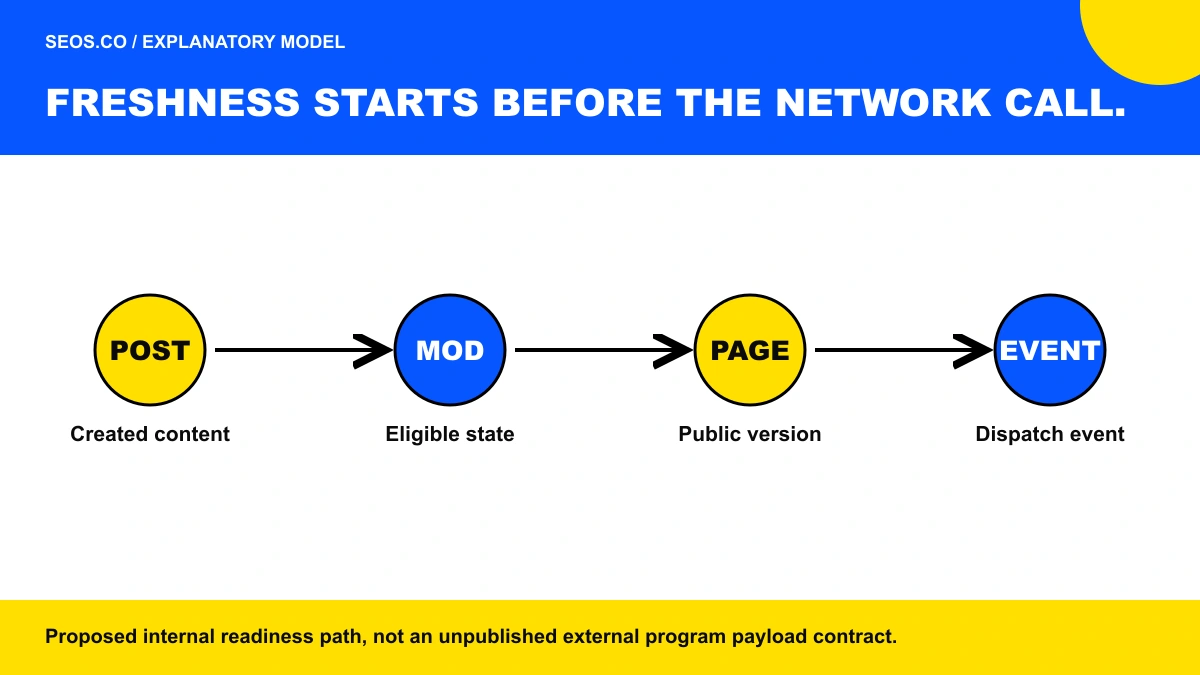
Measure creation, moderation eligibility, public publication, event generation, submission, and later observations separately. A timestamp on the original post does not reveal the delay introduced by each stage.
The public program page expresses expectations for very fresh content and subsequent interaction updates. Use the current source for those requirements, and wait for accepted-participant documentation before implementing exact operational details.
Build an internal freshness budget. If moderation normally takes ten minutes and event processing adds another ten, the public pipeline has a different profile from one that publishes within seconds. That is an engineering fact to quantify, not conceal.
Check whether one busy component can block independent posts. A batch export holding a global lock can cause a platform to miss freshness objectives even while every service remains connected and the exporter eventually succeeds.
Define events before designing a feed
A proposed internal event model can distinguish content creation, substantive edit, moderation change, creator-state change, and interaction-counter update.
Use stable content versions and event identifiers. A retry of the same public version should not become another logical publication. An edit that changes meaning should remain distinguishable from a counter increment.
Record the public state validated by each event. Do not submit an unpublished draft because an upstream database row exists. Do not send a removed post as a fresh update because an older queue entry survived.
These are internal reliability principles. They are not claims about the program's exact external schema, deletion semantics, limits, or retry behavior. Those must come from the actual supported integration documentation supplied to accepted participants.
Maintain a coherent interaction model
The structured-data guide adds context for expressing genuine entities and their relationships.
Define what each counter means on the platform. Views, replies, likes, shares, and other actions can have different counting rules, deduplication, moderation, and privacy implications.
Keep the numerator and population explicit. A reply count might include hidden or deleted responses internally while the public page displays only approved ones. Decide which representation the public data contract requires.
Avoid making numbers appear more precise than the measurement supports. A sampled or delayed counter should not be presented as an exact instantaneous total without context.
Google's discussion-forum structured data guide and profile-page guide provide relevant public markup context. Verify the applicable requirements for the actual content rather than assuming any schema block is sufficient for program participation.
Put moderation before distribution assumptions
Document which states are eligible for public distribution and which are held. Include user reporting, operator review, automated detection, appeals, restoration, and retirement.
A successful submission pipeline should not outrun moderation policy. If a post can be distributed before the platform decides it is public and acceptable, the architecture has created an exposure window.
Test changes after initial publication. A post can be edited into abuse, an account can be compromised, or a discussion can require removal. The event system needs to carry the resulting state change reliably.
Google's UGC spam prevention guidance offers broader platform controls and monitoring context. Program readiness should include that ordinary operational discipline rather than treating participation as an exemption.
A readiness scorecard without fake precision
Use a qualitative scorecard with observed pass, failed condition, dependency, and owner. Do not assign a numerical “Google acceptance probability” without evidence.
| Area | Evidence a team can produce now | Dependency that may remain |
|---|---|---|
| Content provenance | Creation-channel audit and sample review | Clarification for unusual content classes |
| Public identity | Stable IDs, direct URL tests and creator relationships | Program-specific validation details |
| Moderation | State model, reporting path and recovery tests | Accepted integration requirements |
| Freshness | Measured stage latencies and backlog age | External timing and payload contract |
| Technical ownership | Maintained authentication and structured-data capability | Onboarding documentation and acceptance |
The scorecard makes work concrete while respecting what is not yet public. A missing external contract is a dependency, not permission to fabricate one.
A worked freshness calculation
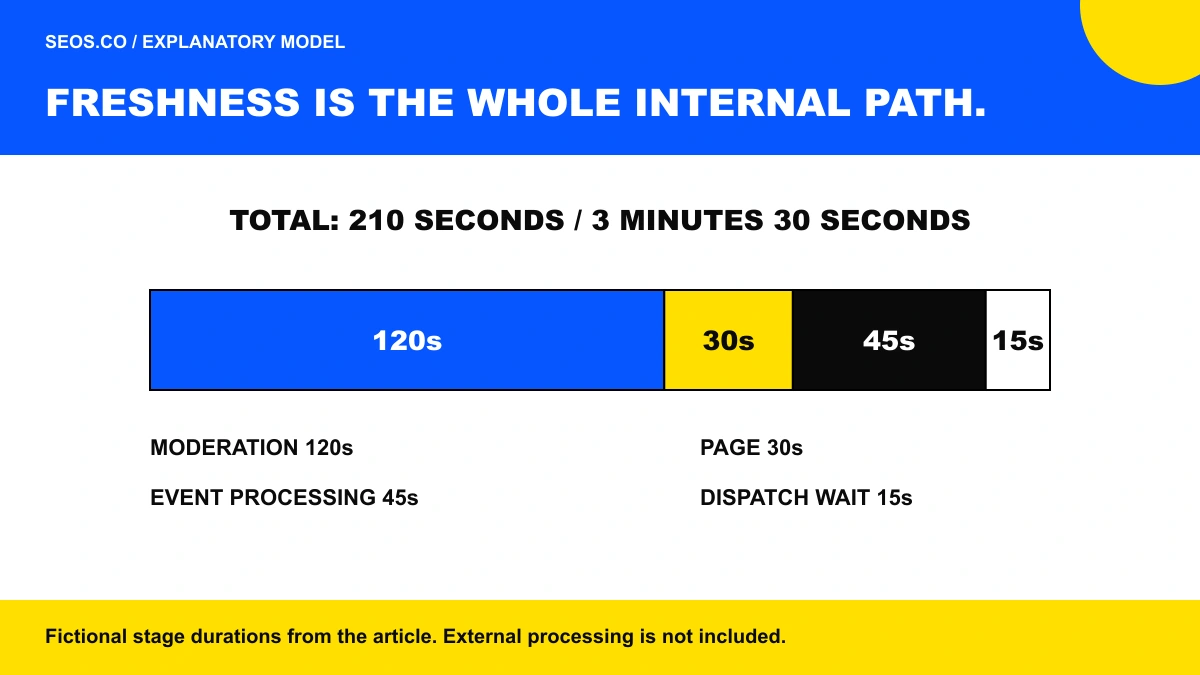
Consider a fictional platform with four sequential stages after a user creates a post: moderation eligibility takes two minutes, public page generation takes thirty seconds, event processing takes forty-five seconds, and dispatch waiting takes fifteen seconds.
Under those scenario assumptions, the internal path totals three minutes and thirty seconds before external processing. That is simple arithmetic, not a measured program result or an accepted timing guarantee.
Now suppose a shared queue adds an occasional twenty-minute delay during imports. The average may still look acceptable if imports are rare, while the affected posts have a very different freshness profile.
Measure distributions and worst relevant intervals, not only a daily average. Segment by creation channel and workload trigger. The useful repair may be queue isolation or incremental publication rather than making the final network call faster.
Test restart and backfill behavior
A durable pipeline should survive a worker restart without losing accepted public changes or replaying an uncontrolled duplicate set.
Keep checkpoints tied to confirmed outcomes under the supported integration contract. Do not acknowledge work merely because it was loaded into process memory.
Backfills need a separate policy from fresh events. An old archive can consume capacity and delay genuinely current content if both share one unprioritized queue. Whether and how historical content belongs in the external program must follow the actual documentation.
Test fairness. A large creator or imported dataset should not indefinitely starve independent posts from other users. Record oldest pending eligible event and per-source backlog so silence becomes diagnosable.
Compare build readiness with business value
Participation effort includes engineering, moderation, operations, documentation, and ongoing maintenance. A platform should identify the audience benefit it expects to investigate.
Define observable outcomes: processing freshness, search exposure where reported, qualified visits, useful reader engagement, and downstream actions. Keep these distinct rather than combining them into one “AI visibility” number.
Record baseline traffic and content cadence before integration when data is available. A later increase during a major news event may reflect demand rather than the integration alone.
Avoid a business case based solely on acceptance. Joining a program is an implementation milestone, not evidence of ranking improvement or commercial return. Set a reasonable evaluation plan with known confounders and honest attribution limits.
What to prepare before applying
Prepare a concise description of the platform's actual content, creator base, public URL structure, moderation process, and technical ownership. Use verified facts rather than inflated volume or invented examples.
Identify sample public pages that genuinely represent the intended content class. Confirm they are accessible and that their visible facts agree with structured data.
Document the current publication and interaction pipelines, including measured delays and recovery behavior. This helps the team understand its own readiness even before any external response.
Do not create unsupported service accounts, external payloads, or speculative submission tools simply to appear prepared. Improve the internal foundations and follow the official application process within authorized scope.
Keep the public website useful independently
Review content SEO best practices when evaluating the independent value of the platform's public pages.
The site still needs coherent navigation, direct content URLs, accurate metadata, and useful page content. A dedicated ingestion relationship does not replace the public reader experience.
Preserve crawlable paths to discussions and profiles where intended. Maintain sitemaps accurately, handle removed pages meaningfully, and avoid exposing private or low-value utility states as public search inventory.
Check mobile reading, authentication boundaries, and reporting controls. Visitors arriving from search should be able to understand the discussion and complete the intended next action.
The durable asset is the platform's reliable publication system. That work remains useful even if an application is not accepted or the program's requirements evolve.
Sample the difficult content classes
A readiness audit should include ordinary posts and cases that challenge the platform's identity model. Select an edited post, a renamed creator, a removed reply, a moderated discussion, an imported record, and a post with an unavailable creator profile.
For each sample, compare the stored content object, public page, creator relationship, visible counters, and structured data. Record disagreements as specific facts rather than reducing them to one opaque readiness score.
A renamed creator tests whether identity survives display-name changes. A removed reply tests whether the counter population and visible discussion agree. An imported record tests whether the platform retained authentic provenance or replaced it with a convenient uploader account.
Review the samples with the people who own moderation and content semantics. An engineer can verify that an identifier resolves, but may not know whether an imported discussion legally and editorially represents the claimed creator relationship.
Use the findings to improve the common data model before building another outward feed. Otherwise, the integration will faithfully distribute inconsistencies that already exist between the website and the source records.
Keep acceptance uncertainty explicit. Passing an internal sample does not establish eligibility for the program, and a public overview cannot resolve every unusual case. Save the specific question for the official onboarding channel rather than inventing an answer that favors participation.
The audit should also establish what remains useful if participation does not proceed. Stable content identity, accurate public profiles, clear moderation state, and measured freshness improve ordinary platform reliability. That makes preparation a defensible investment in the product rather than a speculative dependency on one distribution opportunity.
Practical answers
Is this a new way to submit every page?
No. The public documentation describes a specialized program for approved eligible UGC platforms. General pages and other submission services have different rules.
Should a team build the external payload now?
Only against an actual supported contract available to it. The public overview does not justify inventing unpublished fields, limits, or response semantics.
What is the best immediate step?
Audit provenance, stable public identity, moderation transitions, and end-to-end freshness. Save observed evidence and unresolved dependencies. The UGC Fresh Data Program is worth evaluating as a specific platform integration, while the strongest preparation is a trustworthy content system that already knows what it publishes and when.