
The Search Brief · News analysis
The Original RAG Paper and the Publisher’s Freshness Problem
Trace RAG freshness through source dates, collection, indexing, caching and generation, with a worked freshness budget and recovery checks.
Development covered: April 12, 2021 revision of 2020 paper; primary source checked November 2, 2026
Retrieval-augmented generation can bring external evidence into an answer, but retrieval alone does not guarantee that the evidence is current. RAG freshness depends on the entire path from an authoritative source through collection, indexing, caching, retrieval, generation, and delivered output. A failure at any stage can produce a stale answer even when the model and search service are connected and functioning.
For publishers, the practical response is to make authoritative facts clear, versioned, and accessible. For teams operating an answer application, it is to measure the age and validity of the evidence actually used. A recent fetch timestamp is useful operational information, but it cannot establish that the fetched page describes the currently effective policy.
What the original research introduced
Lewis and colleagues studied models combining parametric memory with a non-parametric retrieval component. Their original RAG work used a dense index of Wikipedia and evaluated knowledge-intensive tasks. The paper describes retrieval as a way to provide external information and provenance alongside a trained model’s stored knowledge. Its historical results do not establish a freshness guarantee for every current application described as RAG. Original RAG paper.
The important distinction is between information stored in model parameters and information supplied from an external corpus at answer time. External retrieval creates an opportunity to update evidence without retraining the entire model. Whether that opportunity is realized depends on the application’s source and update processes. The operational framework below is an original practical extension, not a claim that the paper defines these exact production controls.
Freshness has more than one clock
The publication clock records when a source became available. The effective-date clock records when a policy or specification actually applies. These dates can differ. A policy published in November may take effect in January, while a correction published today may apply immediately. An answer needs the date relevant to the user’s question.
The content freshness workflow turns these clocks into a publisher investigation that traces an owned fact through publication, caches and observed answers.
The collection clock records when the system fetched the source. The indexing clock records when the fetched version became searchable. The retrieval clock records when a passage was selected for a particular request. The answer clock records when the user received the resulting response. Each clock measures a different part of the path.
A page fetched this morning may still contain a policy superseded last month. An index updated five minutes ago may have ingested that obsolete page perfectly. Conversely, a year-old technical specification may remain authoritative. Age alone is not validity; it is a signal that must be interpreted alongside version and source status.
For a publisher, identify the current authoritative destination and make historical versions distinguishable. A useful change history can preserve evidence without presenting old terms as current. Avoid leaving several conflicting pages with identical titles and no version relationship. The ambiguity creates extra work for readers and for any system trying to select suitable evidence.
Build a version chain, not a vague timestamp
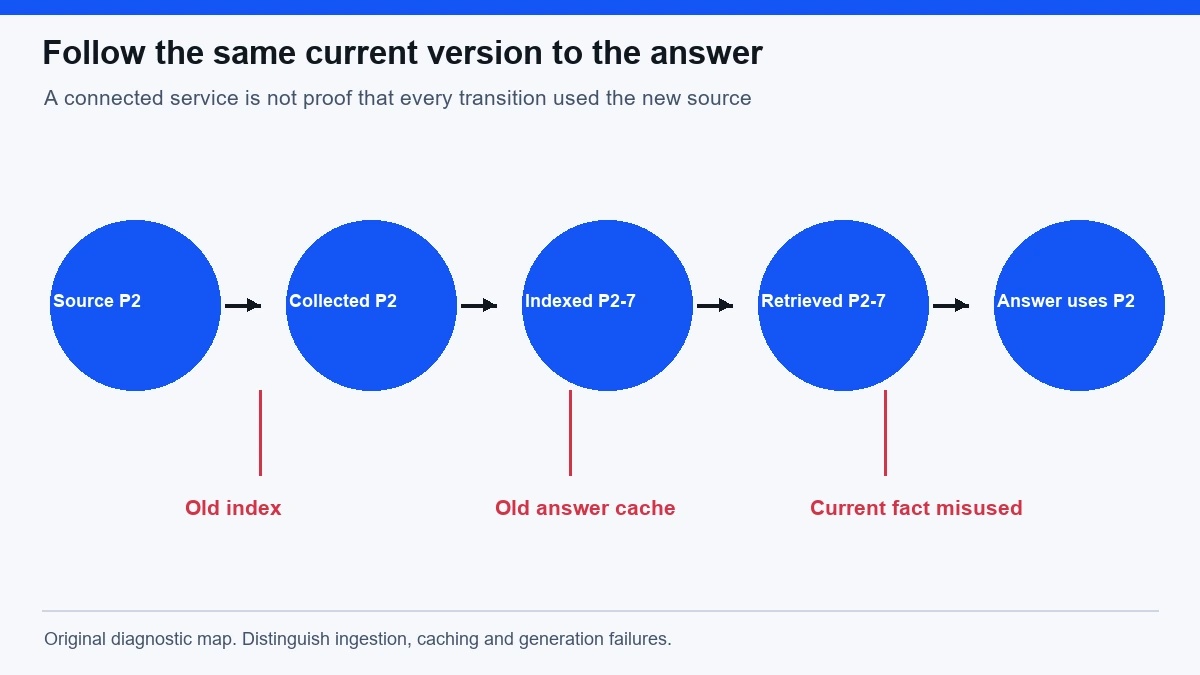
Consider a fictional service whose retention policy changes from 30 days to 14 days. The current page has source version P2, effective June 1. The collector fetches P2, the index stores passage P2-7, retrieval selects that passage, and the answer cites the corresponding page. A complete trace connects the user-visible assertion to the version that supports it.
Now imagine the collector fetched P2 but the index still serves P1 because an update job failed. A successful network request does not establish a successful index update. The defect lies between collection and searchable storage. The repair should verify the stored version and then confirm that a fresh query selects it.
In another case, the index contains P2 but an answer cache returns a response generated from P1. Retrieval may not run at all for the repeated query. The apparent search failure is actually cache invalidation. Inspecting only the current retriever would miss the stage that delivered the stale answer.
A third case selects P2 correctly, but the generator answers from an old assumption and says 30 days. Here the evidence path is current and the use of evidence fails. The repair belongs in answer generation or validation rather than recrawling the page. Distinct stages prevent a team from repeatedly applying the wrong fix.
Work through a freshness budget
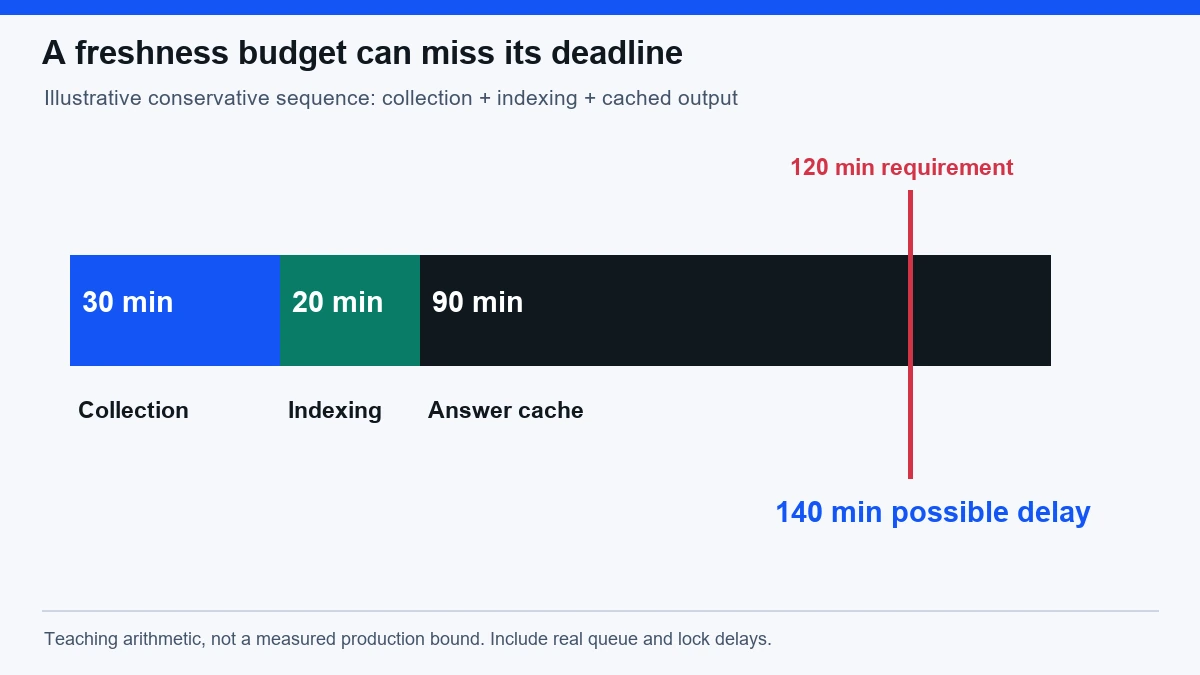
Suppose a hypothetical application promises that current policy changes will be reflected within two hours. The source collection runs every 30 minutes, indexing can take 20 minutes, and the answer cache can remain valid for 90 minutes after an update. In a conservative sequence, the total delay can reach 140 minutes, exceeding the two-hour promise.
This arithmetic does not prove that every request will be stale for 140 minutes. It shows that the configured schedule permits a deadline failure. Average latency can look acceptable while a worst-aligned update misses the requirement. Compare producer cadence plus downstream delay with the consumer’s actual freshness limit.
If the cache is invalidated as part of a confirmed index update, the 90-minute residual may disappear from the critical path. But that is an implementation claim requiring verification. Test an actual version change through collection, indexing, invalidation, retrieval, and delivered answer. A configuration setting alone is weaker evidence than a confirmed fresh output.
Include scheduling contention. A collector scheduled every 30 minutes may not start on time if another job holds a shared lock. A queue can turn nominal cadence into a much longer effective interval. Measure actual start times, completion times, skipped runs, and recovery after interruptions. The existence of a schedule does not prove that its freshness obligation was met.
Preserve history while serving current facts
Historical versions can be valuable for audits, customer disputes, and research. Do not delete them reflexively to make a freshness problem disappear. Instead, label their applicable periods, link them to the current version where useful, and keep their purpose clear. A historical page can remain accurate within its stated time scope.
The current page should identify its effective terms and explain important changes in language the reader can use. A generic updated-today badge does not tell the reader whether the price, exclusion, or procedure changed. Meaningful version notes help distinguish substantive updates from routine page maintenance.
If a document contains both current and historical values, make the relationship explicit. A table with dated rows can be useful; an undated paragraph containing two conflicting limits is not. Retrieval may select a narrow passage, so keep the relevant date and version close to the value they qualify.
For a local application, filters can restrict current questions to current sources while preserving historical retrieval for explicitly dated questions. Evaluate both modes. A filter that always discards old documents can make historical questions impossible to answer, while a filter that ignores dates can contaminate current advice with superseded evidence.
When current and historical resources need distinct navigation paths, apply the internal linking checklist with descriptive version-aware anchors.
Match freshness to the task
A price, stock count, opening status, or outage update can need a much shorter validity window than a conceptual explanation. A universal cache lifetime is unlikely to suit every content type. Define freshness classes around the consequences of stale information and the actual update behavior of the authoritative source.
A short lifetime is not automatically better if the source itself updates slowly or the collection process is unreliable. Frequent fetches can consume resources without producing newer evidence. Measure source changes and successful ingestion, then choose a policy that meets the reader’s decision needs. The goal is current validity, not simply a high request count.
Some questions require transactional confirmation rather than cached informational evidence. An article can explain a booking process, but current availability may need a live authorized system. The answer should distinguish general guidance from confirmed state. A dated source cannot establish that an appointment remains open at the moment of booking.
Other questions explicitly ask for historical facts. In those cases, the freshest document is not necessarily the best source. The application should retrieve evidence appropriate to the requested time. This is another reason to treat freshness as task-relative validity rather than a rule that always selects the most recently fetched page.
Diagnose stale answers end to end
Start with the exact observed answer and the user’s question. Save time, source URLs, visible claims, and applicable context. Determine which fact is stale and what authoritative evidence establishes the current value. Avoid treating a general complaint about inactivity as a complete diagnosis; identify the actual failed event and its expected deadline.
Check source delivery next. Confirm that the current page returns the intended content under relevant access conditions. A deployment may have updated one server while a regional cache still serves an old representation. A browser session showing the new page does not prove that the collector received the same version.
Inspect collection and indexing receipts where the application exposes them. Verify source hashes, passage versions, job outcomes, and timestamps. A job marked complete may have skipped an item or reused a cached response. Preserve error logs and historical evidence so that the investigation can distinguish missing observations from successful updates.
Finally, issue a fresh controlled query and inspect the delivered output. Verify that the deployed process uses the repaired path, rather than merely passing a local test. Repeat under representative load or contention when those conditions contributed to the failure. State separately that a repair is tested, deployed, and observed working in a fresh operational event.
Use the AI visibility mistakes diagnostic to avoid treating source inclusion as proof that current facts were accurately absorbed.
Publisher controls have a limited reach
A publisher can clarify its own source, maintain coherent versions, improve access, and use supported discovery mechanisms. It cannot guarantee when every external engine refreshes an index or how a generated answer combines sources. Report the actions completed and the external observations still pending.
If an external answer remains wrong, preserve the exact mismatch and use an available correction process where appropriate. The evidence packet should include the current authoritative passage and its effective date. Avoid rewriting the page repeatedly without evidence that wording is the limiting stage. Repeated edits can make the source less stable while leaving an external cache unchanged.
Monitor a small set of consequential facts rather than only general brand mentions. A correct service name accompanied by an obsolete eligibility rule is not a successful accuracy outcome. Define which facts matter, what counts as correct, and how unsupported or unavailable answers are handled in the denominator.
Keep business outcomes separate from freshness observations. A current answer may improve customer understanding without producing a measurable referral. A stale answer may create support costs even when citation counts rise. The operational record should retain those distinct effects instead of compressing them into a generic AI visibility score.
The ChatGPT SEO guide adds platform-specific discovery context while keeping externally observed outcomes separate from publisher actions.
Questions for a freshness policy
Does RAG guarantee current information? No. It provides an architecture in which external evidence can be supplied. Current validity depends on source authority, collection, indexing, version selection, caching, and evidence use. The system should demonstrate those stages for the tasks it claims to serve.
Is a recent crawl enough to trust a price? Not necessarily. The fetched page may contain old terms, refer to a different market, or exclude fees that matter to the user. Verify the effective offer and scope. A timestamp is part of the evidence record, not a substitute for understanding the claim.
Should every answer display a timestamp? A meaningful timestamp can help when it identifies what was verified and when. A decorative current badge can mislead if it only reflects page rendering. State whether the date concerns source effectiveness, collection, or answer generation, and avoid implying stronger confirmation than occurred.
What is the first repair when a fresh source produces stale output? Trace the version chain before changing content. Determine whether the old fact came from delivery, collection, indexing, caching, retrieval, or generation. Repair the failed stage, preserve the evidence, and confirm a new end-to-end result under the relevant conditions.
How should a team handle missing logs? Record the gap and improve future observation. Missing receipts do not prove that a source was never fetched or that an opportunity never existed. They limit what can be concluded about the historical incident. A responsible postmortem distinguishes established failures, plausible hypotheses, and facts that cannot be reconstructed.
Verify recovery after an interruption
A restart can leave source collection complete while an index transaction remains unfinished. The process should resume from a durable checkpoint or retry an idempotent update, rather than marking the entire batch successful from an in-memory flag. Test that recovery with a controlled interruption and compare stored versions before and after restart. This is especially important when freshness deadlines continue to run while the application is unavailable. The final evidence should show a newly delivered answer using the intended current source, not merely a healthy process indicator.
RAG formulations and freshness experiment
The original paper distinguishes formulations that condition on the same retrieved passages across an output sequence from one that can use different passages per token. That architectural distinction is not a claim about which formulation a current commercial engine uses.
| Research formulation | Retrieval conditioning distinction | Publisher implication that can be tested |
|---|---|---|
| RAG-Sequence | Same retrieved passage conditioning across the generated sequence | Inspect which version supports the complete answer |
| RAG-Token | Different retrieved passages can contribute per generated token | Inspect whether combined claims remain mutually consistent |
| Either formulation | External corpus and generation remain separate components | Retrieval does not itself guarantee current validity |
| Freshness worksheet stage | Illustrative maintenance-policy test | Evidence required |
|---|---|---|
| Source change | Publish P2 with a new maintenance window | Effective date and authoritative source version |
| Collection and index | Confirm P2 and its retrievable passages | Stored hashes and actual completion times |
| Answer cache | Retire or revalidate P1-dependent output | Cache identity and invalidation evidence |
| Generation | Ask the current maintenance-window question | Answer preserves P2 conditions |
| Timing bound | 30 + 20 + 90 = 140 minutes versus 120 minute requirement | Compare actual cadence and delay, not schedules alone |