
The Search Brief · News analysis
Ragas Evaluation: A High Faithfulness Score Is Only One Part of Answer Quality
Build a Ragas-informed evaluation scorecard that separates relevance, sufficient evidence, faithfulness, freshness and useful task completion.
Development covered: April 28, 2025 revision of 2023 paper; primary source checked November 2, 2026

Ragas evaluation is useful when it helps a team distinguish retrieval problems, evidence-use problems, and answer-quality problems. A high score on one dimension does not establish that an answer is current, complete, suitable for the user, or safe to publish. The practical goal is a scorecard that makes defects easier to diagnose, supported by retained examples and a calibrated review process.
The key distinction is between faithfulness to supplied context and truth about the world. An answer can accurately repeat an obsolete policy. It can faithfully summarize the wrong product’s documentation. It can contain only supported facts while omitting the condition that determines the user’s decision. A serious evaluation program needs to identify those failures rather than allowing one reassuring number to approve the whole pipeline.
What the research framework addresses
The Ragas paper introduced a reference-free approach to evaluating retrieval-augmented generation along several dimensions, including whether retrieved context is useful and whether generation uses it faithfully. The arXiv record includes a 2025 revision of the work originally submitted in 2023. Its framework is primary research on evaluation, not proof that any automated judge is infallible or that a particular metric threshold guarantees production quality. Ragas primary paper.
A useful operational interpretation is to keep the evidence chain inspectable. Save the question, retrieved passages, generated answer, evaluator configuration, scores, and adjudicated defects. The rest of this article develops an original review workflow and illustrative calculations. It does not claim that the paper defines these exact policies or reports these example outcomes.
Separate four questions before selecting metrics
First, did the system retrieve evidence relevant to the question? If a customer asks about archived-record export and receives billing documentation, the context is wrong even if the answer faithfully summarizes billing. Retrieval relevance concerns the relationship between the task and the supplied evidence.
Second, was the evidence sufficient? A passage may discuss exports but omit plan eligibility or permission requirements. It is relevant without being enough to answer. An evaluator should distinguish partial topical context from the complete evidence needed for the requested decision, especially in multi-part questions.
Third, did the answer stay within the supplied evidence? This is the central faithfulness concern. A generator might turn “up to 30 days” into “exactly 30 days” or invent a one-hour guarantee. The source can be excellent while the answer introduces unsupported commitments.
Fourth, did the answer actually serve the user? It may be faithful, relevant, and grammatically clear while ignoring a requested comparison or giving no practical next action. Task usefulness includes answer scope, appropriate qualifications, and the relationship between the information and the user’s constraints. No single support score automatically establishes it.
A faithful answer can be outdated
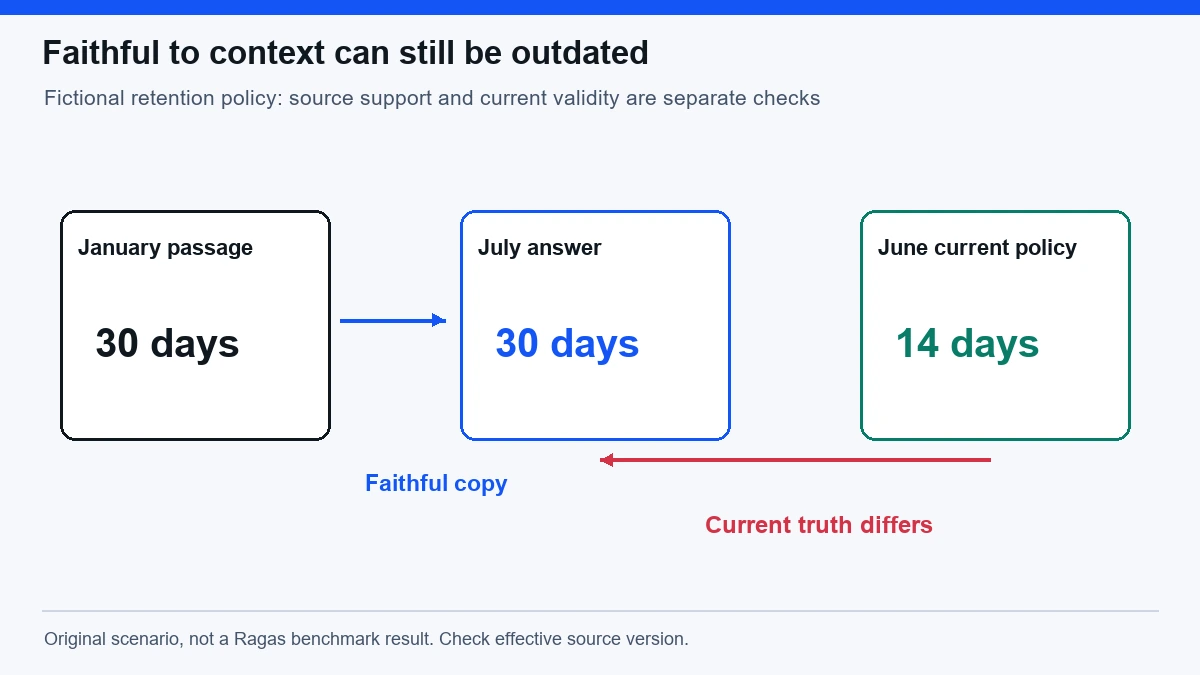
Imagine a fictional service policy stored in a retrieval index. The passage says Cedar Basic includes 30 days of retention, effective January. A new policy published in June changes the limit to 14 days. In July, the application retrieves the January passage and answers, “Cedar Basic includes 30 days of retention.” The answer is faithful to the retrieved text but wrong for a current-plan question.
A faithfulness evaluator that sees only the old passage and answer may reasonably judge the support relationship strong. That is not necessarily an evaluator defect. The missing dimension is temporal validity. The pipeline needs a source freshness policy, version information, and a question-level interpretation of whether the user asked about current or historical terms.
Record effective dates separately from collection dates. A document fetched today can describe an old policy. Conversely, an older publication can remain the current authoritative specification. A simple “last crawled” timestamp cannot decide which case applies. The content and its governing version need to be examined.
For publishers, maintain clear current pages and meaningful change histories where appropriate. Avoid silently replacing a policy while leaving contradictory PDFs and old landing pages indistinguishable. A retrieval system still may choose an obsolete source, but explicit dates and relationships provide a stronger basis for correct selection and later troubleshooting.
The AI visibility mistakes guide treats factual decay as a separate operational concern, complementing this answer-support analysis.
Work through a misleading scorecard
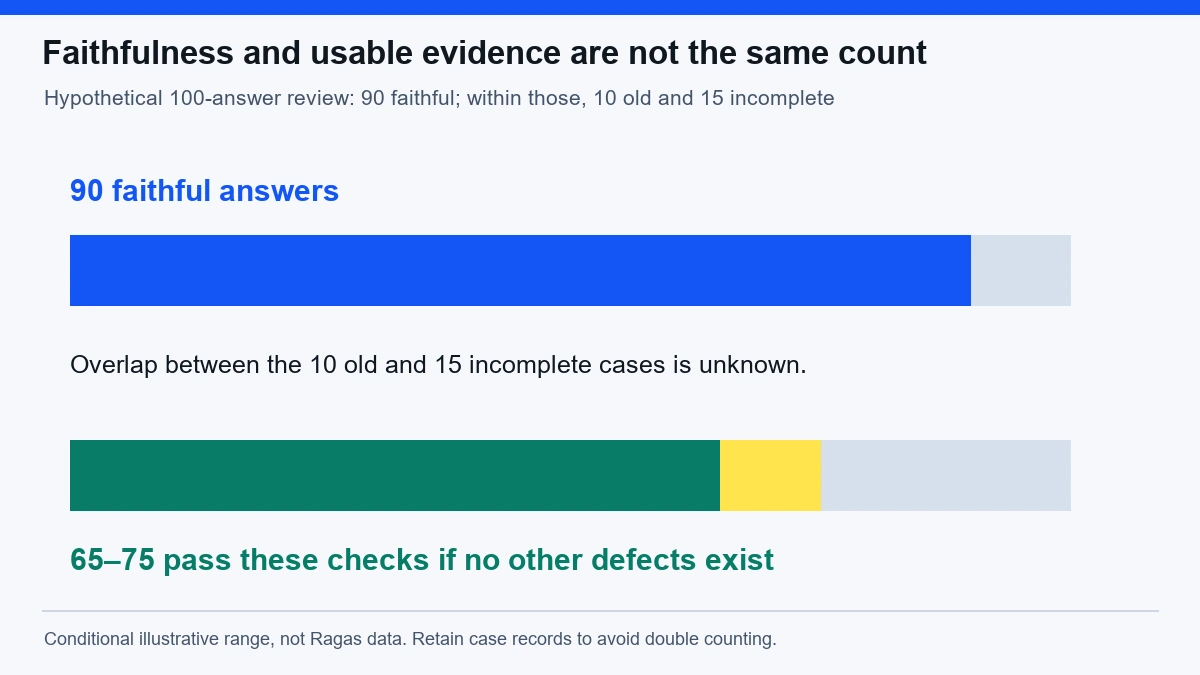
Consider an illustrative evaluation of 100 answers. Ninety answers faithfully reflect their retrieved passages. Of those ninety, ten use obsolete passages and fifteen fail to include a necessary eligibility condition because the context omitted it. The 90% faithfulness rate is compatible with substantially fewer answers being usable for the intended current decision.
Do not subtract overlapping defect counts casually. Some obsolete answers may also omit conditions. Keep claim-level or answer-level records so that the union of defects can be calculated without double counting. A dashboard that adds every issue category can report more defective answers than were observed.
Now suppose a new retriever supplies more current context, and faithfulness falls slightly because the generator struggles with conflicting passages. The pipeline may have improved one stage and exposed another weakness. A single composite score could conceal that useful diagnosis. Review the changed cases and determine whether the next repair belongs in version selection, conflict resolution, or generation constraints.
Use a small number of interpretable dimensions with clear definitions. A score for evidence support, a current-source check, a task-completion judgment, and a severe-error count can be more useful than an elaborate average. Preserve the underlying observations so that the business can change decision thresholds without losing the original evidence.
Calibrate automated judges on real failure modes
Build a labelled calibration set from the application’s own tasks. Include partial support, contradictions, obsolete evidence, numerical transformations, ambiguous product names, and correct nonanswers. If the application handles tables or code, include those formats. An evaluator tested only on straightforward prose may behave differently on the material that matters operationally.
Have reviewers apply a written policy, then retain disagreements before adjudication. A disagreement can expose unclear claim boundaries or inconsistent severity rules. The goal is not to manufacture perfect agreement, but to make the judgment process understandable and improve it where the ambiguity affects decisions.
Compare automated judgments with the adjudicated labels. Inspect false approvals and false alarms separately. A system that flags many harmless wording differences may waste review time. A system that misses unsupported price guarantees may create serious publishing risk. The acceptable balance depends on the consequences of each error, not only an aggregate agreement percentage.
Recalibrate when the judge, prompt, content domain, or source format changes materially. Keep a fixed overlap set so that performance can be compared across evaluator versions. If the evaluator changes halfway through a trend chart, annotate the break or rescore a comparable sample. Otherwise, the measurement instrument can impersonate a product improvement.
Use reference-free evaluation with explicit limits
Reference-free does not mean evidence-free. The evaluation still depends on inputs, definitions, model behavior, and assumptions about support. A generated judge can provide useful scalable signals without requiring a human-written ideal answer for every question, but its decisions remain subject to validation.
Some tasks have verifiable targets that deserve deterministic checks. A requested sum, a date format, a required identifier, or a plan code may be checked directly where the underlying data is authoritative. Do not replace a clear calculation with a vague model opinion when an exact verification is available.
Other tasks require domain judgment. A recommendation may be factually supported yet unsuitable for a particular risk tolerance or operating environment. Preserve a route for qualified review rather than forcing all decisions through a general-purpose judge. The system should be able to say that an evaluation dimension remains unresolved.
A hybrid review can use automated signals to select cases for deeper inspection while retaining representative sampling of apparently good answers. Reviewing only flagged outputs misses silent failures. Reviewing only random outputs can miss rare severe defects. Combining targeted and representative review provides a more informative picture when the sampling methods are disclosed.
Diagnose a low score by stage
If context relevance is poor, inspect the query, corpus coverage, filtering, retrieval candidates, and ranking. A generation prompt cannot create missing evidence. Check whether the correct document exists, whether it is indexed, and whether permissions or filters exclude it. Distinguish absence from an execution failure that prevented a search.
If evidence is relevant but incomplete, inspect passage boundaries and question decomposition. The qualification may be in an adjacent section or another document. A larger context budget can help in some cases, but it can also add irrelevant or conflicting material. Test the actual evidence combination rather than assuming more text is always better.
If support is strong but the answer adds claims, inspect generation instructions and examples. Require the answer to preserve conditions and acknowledge gaps. Evaluate whether the generator is relying on prior assumptions or intermediate draft text. A citation after an unsupported claim should remain a failure even when the source is generally relevant.
If answers are supported but unhelpful, inspect the task definition. Perhaps users need a comparison, calculation, or procedure while the application provides a generic summary. Improving usefulness may require different source material or a structured workflow. Raising the faithfulness threshold cannot solve a mismatch between output format and user need.
For publisher-controlled repairs, the GEO diagnostic guide helps distinguish source access, retrieval suitability and answer use.
Keep operational failures out of semantic averages
An empty answer caused by a timeout is different from a deliberate nonanswer because evidence is insufficient. A missing context caused by a failed connector is different from a successful search returning no relevant document. Record execution state before evaluating semantic quality so that the cause remains visible.
Trace deadlines across retrieval, reranking, evaluation, and response delivery. If an evaluator runs after the user has already received the answer, it may be useful for monitoring but cannot be claimed as a release gate. If evaluation blocks delivery, measure its latency and failure behavior under realistic load.
Check shared resources and restart recovery. A background indexing job can delay retrieval, and a stale cache can serve a previously approved answer after the policy changes. Passing isolated evaluation examples does not establish reliable production behavior. Save fresh operational evidence showing that the deployed configuration uses the intended source versions and checks.
Maintain a clear policy for evaluator outages. The application may fail closed for consequential advice, route to human review, or provide a limited response with explicit evidence boundaries. The choice should reflect the actual task and authorization. It should not be improvised silently when a dependency becomes slow.
Questions for teams adopting Ragas evaluation
Is a high faithfulness score a publication approval? It is one signal about the relationship between an answer and supplied context. Publication also requires current facts, relevant scope, appropriate sources, useful explanation, and any necessary qualified review. Keep those checks visible rather than hiding them inside a composite label.
Can a team compare scores across unrelated applications? Only with care. Different questions, context formats, judge configurations, and policies can produce different scales. A score becomes meaningful through its definition and validation. Cross-application comparisons should state those differences and avoid treating the number as a universal quality currency.
Should every low score trigger a complete rewrite? No. Inspect the failed claim or stage and repair the smallest meaningful defect. Rewriting an entire answer can discard correct content and introduce new errors. Preserve the original observation, corrected output, and reason so that the repair can be evaluated.
What should a useful evaluation report contain? Include dataset selection, question counts, source dates, evaluator version, metric definitions, severe defects, per-category results, representative examples, and unresolved limitations. State which checks were automated and which were reviewed. A report should help another person understand why the system is suitable for a task and where uncertainty remains.
How should a publisher use this research without building a RAG application? Apply the dimensional thinking to editorial QA. Check whether sources are relevant, sufficient, current, and represented faithfully. Label scenarios and calculations clearly. These habits improve source quality and make later AI-answer observations easier to interpret without promising control over external systems.
Define the user’s actual decision with search intent alignment before assigning task-usefulness labels to answers.
Report the review sample honestly
If a team reviews twenty answers from a thousand-answer run, the report should say twenty were reviewed. Automated scores may cover the full run while human judgments cover only a subset. Both can be useful, but they have different evidence scopes. Record how the sample was selected and whether high-risk or failed cases were oversampled.
Keep unique questions separate from repeated observations. Ten runs of one question do not provide the same task coverage as ten distinct questions. Repetition helps assess instability, while question diversity helps assess breadth. A transparent report contains both counts and avoids using a large observation total to imply broader coverage than the evaluation actually achieved.
An evaluation scorecard with separate decisions
This original rail-refund example shows why one high support score cannot approve a current answer. It is not a Ragas benchmark result or a real operator policy.
| Dimension | Question for the reviewer | Illustrative failure |
|---|---|---|
| Context relevance | Does the passage address the requested ticket and journey? | Source discusses another ticket class |
| Evidence sufficiency | Are eligibility, deadline and exclusions available? | Deadline present but cancellation exclusion absent |
| Faithfulness | Does the answer stay within the supplied passage? | Request deadline becomes a payment guarantee |
| Temporal validity | Is the source applicable to the requested travel date? | Old policy accurately summarized as current |
| Task usefulness | Can the user make the requested decision? | Supported background facts omit the refund route |
| Judge-validation worksheet | Record | Inspect |
|---|---|---|
| Calibration set | Representative labelled tasks and difficult support cases | False approvals and false alarms separately |
| Evaluator version | Model, prompt, inputs and metric definitions | Instrument changes across reporting periods |
| Human scope | Reviewed sample and selection method | Do not imply all outputs received human review |
| Escalation | Consequential unresolved claims and owner | No automatic approval from one composite score |