
The Search Brief · News analysis
Lost in the Middle: What Context Position Research Means for Publishers
Understand context-position research without inventing ranking rules. Trace rendered pages, extracted passages and controlled model-context tests.
Development covered: November 20, 2023 revision; primary source checked November 2, 2026
Lost in the Middle is evidence about how tested language models used information positioned inside their input context. It is not direct evidence that moving a paragraph to the top of a web page increases Google rankings or ChatGPT citations. Publishers can apply the research responsibly by making important answers easy to find, preserving qualifications during extraction, and testing page delivery separately from model context behavior.
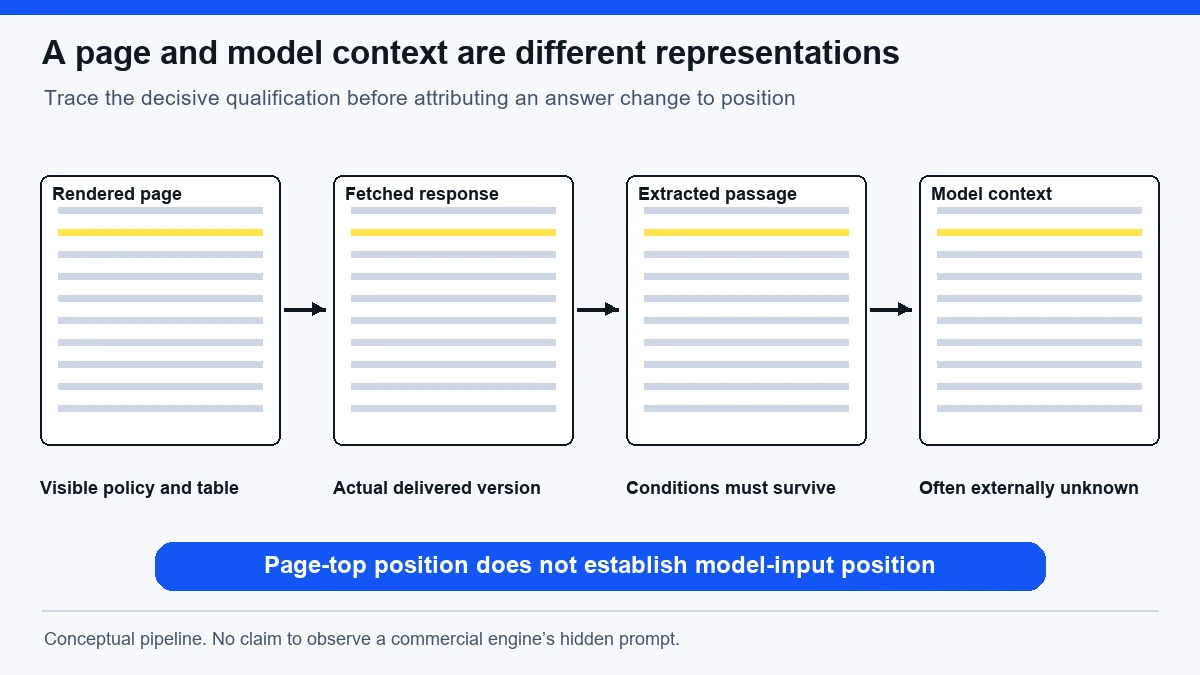
The distinction is practical. A model may never receive the original page in its original order. A retrieval system can select a passage, remove navigation, combine several documents, and rearrange the resulting context. The top of a page and the beginning of a model’s input are different locations in different systems. A credible content experiment must know which location it actually changed.
What the historical study established
Liu and colleagues evaluated multi-document question answering and key-value retrieval. Their paper, revised in November 2023, found that changing the position of relevant information could change performance, with tested models often performing better when relevant information appeared near the beginning or end than in the middle of long inputs. These findings concern the models, tasks, and conditions examined in that research. They are not a current performance estimate for every long-context product. Lost in the Middle primary paper.
A useful inference is that available context and effectively used context are not identical. A system can accept a large input and still fail to use a relevant fact reliably. The publisher’s actionable question is therefore not simply how many words a model can accept. It is whether the evidence required for a particular answer is delivered, selected, and used together.
Follow the information through four representations
Start with the source page as a reader sees it. It includes headings, paragraphs, tables, images, navigation, interactive controls, and perhaps material revealed only after interaction. This representation determines whether people can understand the answer and whether decisive qualifications are visible in the intended task flow.
The second representation is the fetched response. It may contain the entire article, an application shell, a paywall, an error, or a cached version. A perfect visual page does not establish what a particular fetch received. Record the actual delivered content and relevant response conditions rather than relying on a successful visit from an unrelated browser session.
The third representation is extracted or indexed text. A system can remove boilerplate, split the document, merge table cells incorrectly, or lose an image’s explanation. At this stage, the article’s visible hierarchy may survive only partially. A sentence that was clear beside a table header can become ambiguous when copied into an isolated passage.
The fourth representation is the context used for generation. It can combine multiple retrieved passages, prior conversation, instructions, and tool output. The publisher usually cannot observe all of this in a commercial answer engine. That limitation should be explicit. A change in final answer behavior does not by itself reveal where the publisher’s text appeared internally.
Why an answer-first opening can still be useful
A direct opening helps readers establish whether the page addresses their question. It can state the decision, the central distinction, and the main conditions before elaborating. This is an editorial benefit that does not require a claim about a hidden retrieval algorithm. The opening should earn its place by reducing confusion.
Consider a hypothetical guide to exporting account data. A weak opening spends 300 words discussing the growth of business software. A stronger opening explains which export is available, what it contains, what it excludes, and which permission is required. Readers can then decide whether to continue to the detailed steps or use another route.
The stronger opening should not strip away the conditions that make the answer true. “You can export all account data” is simpler than “Administrators can export active records, while archived records require a separate request,” but the simplified version is misleading. Putting the wrong answer first only makes the defect easier to reuse.
Avoid duplicating the same short answer in every section. Repetition can consume space without improving understanding, and conflicting copies become a maintenance problem. Use the opening for orientation, then develop distinct examples, exceptions, troubleshooting, and verification. An answer-first structure is compatible with a substantial technical article when each later section contributes a different part of the task.
A controlled position experiment
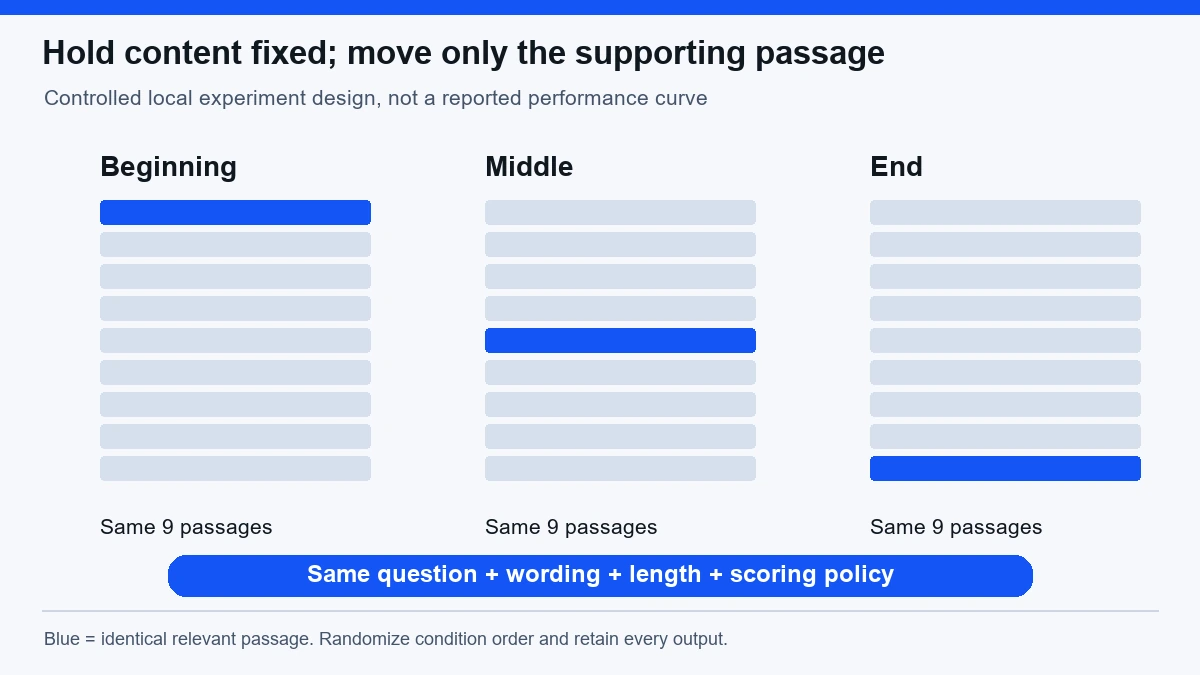
A local evaluation can isolate context position without changing the content itself. Choose a question with one unambiguous supporting passage and several plausible distractors. Keep the question, model settings, passage wording, passage count, and total context length fixed. Move the supporting passage among beginning, middle, and end positions while preserving all other inputs.
Use multiple questions and multiple runs. One failed answer can be an unstable observation rather than a dependable position effect. Randomize the order of conditions to reduce time-related confounding. Save the complete input and output for every run so that unexpected behavior can be inspected rather than reduced to a score alone.
Define success before running the test. For a policy question, success might require the correct retention period and the correct exception. An answer that gets the headline number right but omits the exception should not pass if the exception is essential to the user’s decision. Record partial correctness separately instead of adjusting the rule after seeing attractive results.
Include a condition with no supporting evidence. This checks whether the model gives a confident answer from prior knowledge or guesses despite absent support. A position experiment is more informative when it separates successful evidence use from an answer that would have been produced without the relevant passage.
A worked example without invented study results
Imagine a fictional document set describing the Cedar service. One passage says administrator exports include active records but exclude archived records. The question asks whether a manager can export an archive without administrator access. Distractor passages discuss ordinary downloads, billing access, and account ownership. The correct response must preserve both the permission and archive conditions.
Place the support passage first in one input, centrally in another, and last in a third. Do not alter its wording or add headings that reveal the correct answer in only one condition. If the first condition includes a bold “Administrator restriction” label and the middle condition does not, the experiment changes prominence as well as position.
Suppose a teaching dataset contained 30 questions with three positions and two repetitions, giving 180 answer observations. The unit of generalization remains the question family and tested configuration, not 180 independent customer needs. Related observations should remain grouped when summarizing uncertainty. This arithmetic illustrates a design; it does not report an executed experiment.
After scoring, inspect whether errors involve the headline answer, a qualification, an irrelevant citation, or invented details. The same overall accuracy can conceal very different failure modes. A model that repeatedly drops exclusions may require a different production safeguard from one that consistently retrieves the wrong product version.
Test extraction before blaming context position
For a publisher, the first investigation should confirm whether the relevant facts survive delivery and extraction. Retrieve the page through the supported testing tools available for the site, inspect the actual text, and compare it with the rendered view. Save the response version and timestamp. A missing paragraph cannot be rescued by rearranging model context later.
Tables deserve particular attention. A cell reading “30 days” is useless without the row and column labels that identify the plan and retention type. Verify that a text-only representation preserves those relationships. Where necessary, add a concise explanatory sentence near the table so that the critical comparison remains understandable outside the visual grid.
Image-only evidence needs a textual equivalent appropriate to its role. A graph may require a caption and a description of the finding, units, population, and limits. Alt text should describe the image meaningfully, while the surrounding article should explain the decision-relevant evidence. Do not hide an entire technical argument inside an alt attribute.
Interactive components can introduce a similar gap. If a price or exclusion appears only after a user selects a plan, inspect how that state is represented in accessible content and delivered responses. The issue may be state-dependent availability rather than a model’s inability to process a long article. Diagnose the representation that actually lost the information.
The GEO diagnostic sequence helps place extraction failures in the wider path from accessible source to observed answer.
Keep retrieval and generation measurements separate
A retrieval check asks whether the system found the necessary passage. A generation check asks whether the answer used it correctly. A page can pass one and fail the other. If the evidence was never retrieved, a generation-only remedy is unlikely to address the observed fault. If the evidence was retrieved correctly, adding more topical text may only obscure the decisive condition.
Maintain an error ledger with distinct stages: response unavailable, extraction incomplete, passage not selected, wrong version selected, evidence misinterpreted, and final answer inaccurately presented. Some external systems will expose only the final stage. Mark earlier stages unknown rather than assigning them a convenient cause without evidence.
For a local application that exposes retrieval traces, save passage IDs and ranking positions alongside the answer. A simple change in chunk size can alter which conditions travel together. If an exclusion lands in the next chunk, the model may receive a superficially relevant but incomplete context. The remedy may involve semantic grouping rather than moving the whole article introduction.
For a commercial answer engine, use repeated observable tests and careful language. “The updated condition appeared in four of six observed answers” describes evidence. “The engine moved our paragraph to the front of its prompt” describes an internal action that the publisher has not observed. The former can guide practical decisions without inventing system behavior.
Design for a reader who lands in the middle
A useful section should establish its subject clearly enough that a reader arriving through a deep link can understand it. Define pronouns, identify the product or policy version, and keep crucial conditions close to the claim. This improves ordinary navigation and makes extracted passages less dependent on distant context.
For example, replace “It is included on this plan” with “Archived-record export is included on the Cedar Enterprise plan.” The specific wording answers what is included and where. It should not become a reason to stuff every sentence with the product name; the aim is resolving real ambiguity, not mechanically repeating entities.
Use descriptive headings that identify tasks and distinctions. “When an export excludes archived records” tells a reader more than “Important considerations.” A heading is an orientation aid, not evidence in itself. The section still needs the actual policy, source, example, and verification steps necessary to complete the task.
Connect that section to its next useful resource with the internal linking checklist, using an anchor that identifies the destination’s task.
Questions content teams should ask
Does this study prove that shorter pages perform better? No. Context position research does not establish a universal ideal article length. A short page can omit essential evidence, and a long page can organize complex decisions well. Choose depth based on the task, then make each section substantively useful and easy to navigate.
Should every answer be repeated at the end because tested models sometimes used end-position evidence well? No general publishing rule follows from that observation. A conclusion can synthesize a decision and next action, but duplicating claims to occupy particular locations adds maintenance risk. Test the intended system if a position hypothesis matters to a specific application.
Can a content team guarantee that a qualification survives summarization? It cannot guarantee an external system’s behavior. It can publish clear, current, accessible evidence, verify its own representations, monitor observed errors, and submit precise corrections through available channels. Those actions improve the evidence basis while preserving an honest boundary around outcomes.
What is the first useful action on an existing article? Select its most consequential answer and trace the supporting fact through rendered view, delivered response, and text extraction. If the fact or condition disappears, fix that concrete loss first. Only after the evidence survives should the team interpret later answer differences as possible retrieval or generation effects.
If the page’s primary task is unclear, resolve search intent alignment before testing paragraph placement.
Track the source version through a repair
When a page is corrected, retain a stable change record containing the former wording, the new wording, and the effective date. Later answer observations may still reflect an older fetched copy. Comparing the cited destination and current page alone can obscure that lag. If the application exposes source timestamps, inspect them; if it does not, mark the version unknown. This protects the investigation from claiming that an engine ignored a correction when the corrected material may not yet have reached its retrieval context.
Position-test matrix
The historical paper tests how relevant-information position affects model use under specified tasks. A publisher’s page order is a different representation. This original library-policy worksheet isolates position in supplied context without assuming control over an external engine’s hidden prompt.
| Condition | Supporting library-policy passage | Other passages | Fixed requirements |
|---|---|---|---|
| Beginning | Identical support at the first tested position | Same distractors in controlled order | Same question, total length and scoring rule |
| Middle | Identical support centrally positioned | Same distractors and quantity | No extra heading that reveals the answer |
| End | Identical support at the last tested position | Same distractors and quantity | Same model configuration and observation policy |
| No evidence | Supporting passage removed under a defined control | Matched replacement context where appropriate | Detect answers produced without supplied support |
| Review field | Concrete library-task example | Acceptance check |
|---|---|---|
| Question | Can a visiting scholar borrow reference-only volumes? | Task and audience stay constant |
| Required condition | Reference-only items remain in the library | Answer preserves the exception |
| Evidence use | Exact supplied policy passage | No invented borrowing permission |
| Repetitions | Save each output and condition order | Report question breadth separately from repeated runs |