
The Search Brief · News analysis
AI Search Content: Write Technical Passages That Remain Useful Outside the Page
Improve technical AI-search content with scoped claims, a connector rewrite, extractable tables, useful failure examples and a loss-of-context review.
Development covered: Primary-source guidance checked November 2, 2026
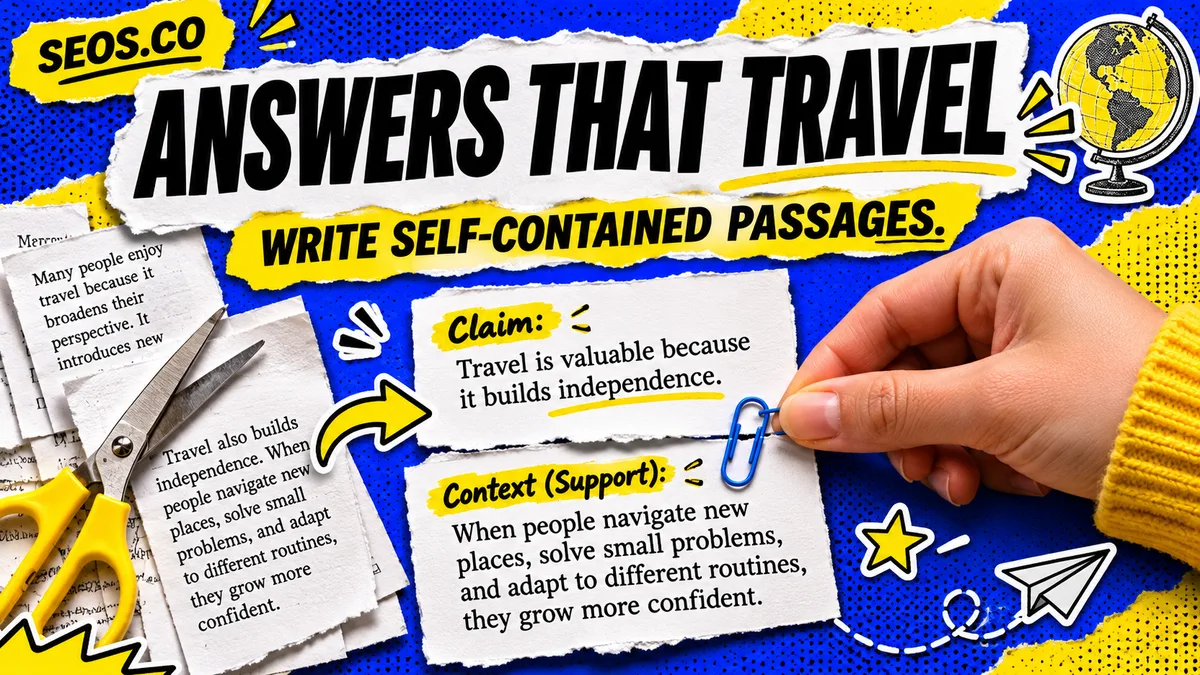
Useful AI search content explains a real task with enough local context that an extracted passage remains accurate. That means naming the relevant product or process, stating conditions beside the claim and keeping limitations attached to the promise they qualify. A short answer can orient the reader, but the full page should provide the evidence needed to act safely and confidently.
This is a writing and verification discipline, not a guaranteed citation format. Publishers generally cannot see or control every passage boundary used by an external search system. The practical test is whether the important information remains understandable when someone encounters a section, a table row or a few paragraphs without the original navigation.
The examples below use a fictional inventory connector. They demonstrate how to improve technical specificity without inventing product facts. The example values are illustrative. An actual publisher must replace them with verified operating behavior, approved limits and current documentation before presenting them as a real offer.
Start from the decision the passage must support
A reader asking whether a connector supports warehouse stock updates needs more than a definition of integration. They need to know which records move, in which direction, under what conditions and how failures are handled. If those facts determine suitability, they belong in the answer rather than behind vague language about seamless automation.
Use the search-intent guide to confirm which task the passage serves. Write the intended decision at the top of the internal brief. For example: “Determine whether the connector’s update cadence and recovery behavior fit the warehouse’s receiving process.” This gives the writer a clear scope and helps the reviewer reject irrelevant feature lists. A passage can be comprehensive for that decision without covering the entire product.
Identify the facts required to answer it. These might include supported source records, approved destination states, synchronization cadence, processing latency, retry behavior, duplicate handling and manual intervention. If the team does not know one of those values, record the dependency. Do not fill it with a plausible number because a complete-looking paragraph feels more polished.
Then determine which qualifications must travel with each claim. A cadence may apply only to one plan. A latency measure may describe normal operation rather than a guarantee. A recovery procedure may require administrator access. These are not decorative caveats; they are part of the meaning the customer needs.
Replace ambiguous promises with scoped statements
Consider an illustrative weak passage: “Our connector syncs your data in real time. It works automatically and keeps every warehouse up to date. Setup is simple, and errors are handled for you.” The words suggest useful behavior, but they do not define records, timing, scope or responsibility. The passage cannot support a reliable buying decision.
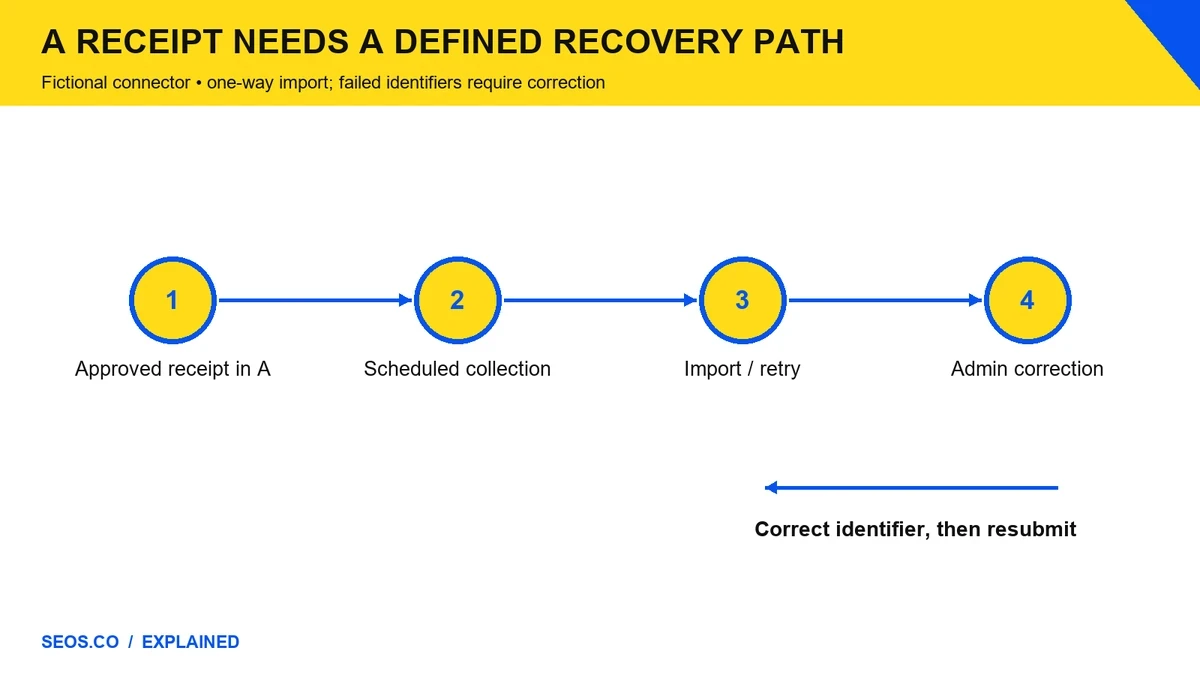
A stronger fictional version reads: “The sample connector imports approved purchase-order receipts from System A into System B on a fifteen-minute schedule. After collection, processing normally takes up to five minutes in this example. Failed records enter a retry queue; records that still fail after three attempts require administrator review. Stock adjustments made directly in System B are not exported back to System A.”
This version identifies direction, records, cadence, processing delay, recovery and a material exclusion. It also distinguishes a schedule from completion latency. It is more useful because the conditions constrain the claim. In real documentation, the publisher would verify each detail with the product owner and state whether the timing is a target, observation or contractual commitment.
The rewrite should not be treated as a universal paragraph template. A local service page, a research explainer and a comparison guide need different evidence. The transferable principle is to make the claim’s subject, scope and boundary explicit wherever losing them would change the decision.
Keep context local without repeating the whole page
Pronouns and shorthand can become ambiguous outside the original page. “It handles them automatically” depends on earlier nouns and may lose its meaning when extracted. Replace ambiguity where it matters: “The connector retries rejected receipt records automatically.” The result is usually clearer for a person skimming the page as well.
Use a short context sentence at the start of a technically dense section. Identify the relevant version, workflow or market. Then develop the explanation naturally. Repeating the entire brand introduction in every section creates clutter and can make the content feel mechanically assembled without improving understanding.
Keep one main purpose per paragraph when a subject is complex. A paragraph that combines product eligibility, pricing, support and an unrelated case study becomes difficult to cite or review. Separate those ideas where their evidence differs, while keeping the qualifications close to the relevant statement.
Avoid placing a positive assertion in one section and its essential exclusion several screens later. “Supports SAP” followed much later by “custom development required” can mislead a skim reader or an extracted answer. A more useful statement says that SAP connectivity requires a custom assessment and explains the available process in the same local context.
Design tables so relationships survive extraction
A table is useful when it compares the same attributes across alternatives. It is weak when column headings do all the explanatory work and individual cells become meaningless alone. Include units, conditions and clear row labels. Avoid relying on color, checkmarks or an image to convey a material limitation.
For the fictional connector, a row labeled “Frequency” with cells “15” and “5” is ambiguous. A better row identifies “Scheduled collection interval” and “Typical processing duration after collection,” with minutes explicitly stated. Those are separate concepts, so combining them under one generic speed heading can create a false expectation.
The fictional connector’s timing and recovery fields can be presented as a table without collapsing their meanings:
| Field | Illustrative value | Meaning and boundary |
|---|---|---|
| Record direction | Approved receipts from System A to System B | One-way import; stock adjustments are not exported back |
| Collection schedule | Every 15 minutes | Waiting for the next collection is separate from processing |
| Processing after collection | Up to 5 minutes in the example | Illustrative operating condition, not a product guarantee |
| Retry handoff | Administrator review after 3 failed attempts | Invalid source identifiers still require correction |
Inspect the table as linear text. Read row label, column heading and cell value together. If the relationship becomes unclear, revise labels or add a concise explanatory sentence. The aim is not to optimize for one unknown parser; it is to preserve meaning across ordinary reading, accessibility tools and text extraction.
Use examples that expose the operating boundary
An example should test the part of the explanation customers could misunderstand. For the connector, show a receipt approved one minute after a scheduled collection. Explain when it would next be eligible for collection and what processing adds. This is more useful than repeating that the system saves time.
Then show a failure case. A record with an invalid item identifier enters the retry process. If the identifier remains invalid, retries alone cannot make it valid. Explain who corrects the source data, how the record is resubmitted and how duplicate processing is avoided. Do not imply that “automatic retries” eliminate the need for operational ownership.
Include a recovery example when the workflow is time-sensitive. If the connector is offline for an hour, does it collect changes made during downtime or only new changes after restart? That behavior determines whether missed records can be recovered. An honest unknown is better than a reassuring assumption that the system catches up automatically.
Keep examples distinct from tested results. Label a demonstration as hypothetical unless it was actually executed and recorded. If a real test exists, state the environment, version, inputs and limitations. A worked example can teach the reader without pretending to be evidence of production reliability.
Attach evidence to the exact claim
Link a technical behavior to the source that establishes it. A general company homepage is weak support for a precise retry limit. A product specification, supported integration guide or versioned release note is more appropriate when it directly documents the behavior. The evidence must match the claim’s scope and date.
Place source links where their relationship is clear. A single link at the end of a paragraph containing six unrelated assertions can leave the reader guessing what it supports. Break the paragraph or state the source’s coverage explicitly. Citation quantity is less important than whether the decisive statement can be checked.
Historical retrieval-augmented-generation research separates model parameters from retrieved external material and explores combining them for knowledge-intensive tasks. That background helps explain why source quality and provenance matter, but it does not reveal the internal retrieval design of every current assistant. Avoid presenting one research architecture as a description of all commercial search products. Original RAG paper.
For changing facts, include meaningful version context. A capability can be accurate for release three and wrong for release two. The reader should be able to tell which implementation the passage describes. Updating a date without verifying the underlying behavior does not make the source current.
Run a loss-of-context review
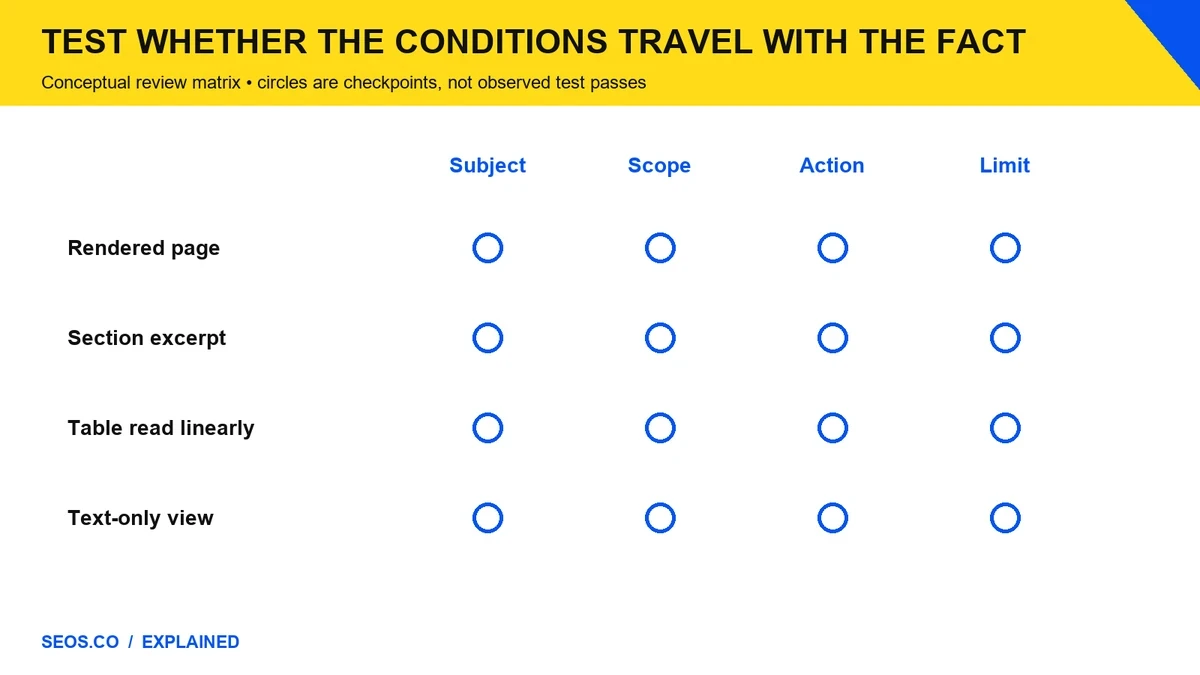
Select the most consequential passages and read them independently. Can a reviewer identify the subject, the applicable conditions, the action and the limitation? If not, the passage depends too heavily on material that may not accompany it. Repair the missing context rather than adding repeated keywords.
Next remove visual cues. Read a text-only version of the delivered page where available. Check whether icons, expandable panels, diagrams and tables retain their meanings. A technically accurate source document can lose important information when a publishing template hides labels or omits an explanation from the accessible text.
Then inspect a bounded extraction, such as one heading and the following paragraphs. This is a diagnostic simulation, not proof of how a particular engine chunks your page. Its value is identifying places where an ordinary excerpt could become misleading. Preserve the test method so another editor can reproduce it.
A historical study of long-context models found that relevant information’s position affected performance in its evaluated tasks. That finding does not establish a current universal word-count or paragraph-position rule. It supports testing retrieval and context use rather than assuming that adding more text automatically improves an answer. Lost in the Middle.
Preserve complete answers while improving readability
For the broader strategy, see how content SEO works. Answer-first writing does not mean reducing a complex subject to a slogan. Give the direct response near the beginning, then explain the conditions, method, worked examples and failure modes. A reader should be able to orient quickly and continue into the evidence needed for a serious decision.
Use headings that identify the question or decision. “How failed receipts are recovered” is more informative than “Additional considerations” when recovery is the subject. Descriptive headings improve navigation and help editors see whether the promised answer actually exists. A heading alone does not count as answering the question.
Remove repetition that merely restates the opening. Replace it with useful distinctions: schedule versus latency, supported versus custom integration, retries versus correction, source freshness versus displayed date. These distinctions add depth because they prevent specific misunderstandings. Extra words that do not change understanding should not be defended as optimization.
Keep calls to action relevant to unresolved decisions. After explaining a custom integration boundary, invite the reader to request a compatibility assessment with the required inputs. A generic sales interruption after every section adds little. The next step should follow naturally from the information the page has established.
Measure usefulness separately from citation outcomes
Before publication, ask whether a reader can complete the intended evaluation using the page. After publication, inspect delivered content, accessibility and the main action. These checks establish useful implementation. They do not establish that an assistant will cite the page or that a ranking will improve.
The GEO improvement guide connects content repairs with a wider observation program. Observe a defined panel of relevant questions if AI visibility is an objective. Save exact prompts, conditions, answers and sources. If a passage is cited inaccurately, inspect the local context and the cited claim. The remedy might be a clearer qualification, but it might also be an external synthesis error that the publisher cannot fully control.
The practical standard for AI search content is durable meaning. A strong passage remains precise when skimmed, quoted, read aloud or encountered outside its original layout. The writing earns its usefulness through verified facts and clear boundaries, with citation and commercial outcomes measured afterward rather than promised by a formatting recipe.
Keep the next action consistent with the explanation
If a guide says an integration requires compatibility review, its next step should request the systems, versions and workflow needed for that review. A form promising immediate activation would contradict the careful qualification. Inspect the confirmation message too: receiving a request is different from approving an implementation or confirming an appointment.
Verify the delivered form, the received business record and the customer-facing confirmation separately. An accurate call to action does not establish that the request arrived or was approved. Check a valid submission, a missing required field and an incompatible-system request. The confirmation should preserve the compatibility-review condition rather than imply immediate activation. Preserving context at conversion matters because the customer should not lose the limitation at the moment they act.