
The Search Brief · News analysis
What the Original GEO Paper Actually Measures
Read the original GEO study carefully: visibility metrics, effect sizes, transfer limits and a worked evaluation plan for real editorial decisions.
Development covered: June 28, 2024 revision; primary source checked November 2, 2026

The original Generative Engine Optimization paper is useful evidence that presentation and evidence choices can change visibility inside a particular experimental answer system. It does not establish a universal recipe for Google or ChatGPT, and its headline improvement is not a forecast of website traffic. A business should use the research to form precise editorial hypotheses, choose an appropriate outcome, and test those hypotheses against its own audience and current systems.
That distinction matters because several events sit between publishing an improved page and earning a qualified customer. A page has to be accessible, discovered, retrieved, selected, used accurately, and associated with a useful next action. An experiment can improve one event while leaving the others unchanged. Reading the research carefully makes the resulting content program more ambitious about evidence and more disciplined about what it claims.
The research finding and its boundary
Aggarwal and colleagues introduced GEO-bench and methods for measuring source visibility in generated responses. The version revised in June 2024 reports visibility improvements of up to 40% under its evaluated conditions and notes that effectiveness varies across domains. This is historical experimental research, not a November 2026 measurement of all commercial answer engines. The paper is the primary source for that finding and the proper place to examine its methods before borrowing any reported effect. Original GEO paper.
The practical reading is conditional: a tested transformation changed a defined visibility metric in the study’s environment. The transformation, metric, query distribution, underlying sources, engine implementation, and comparison condition all belong to the result. Removing those conditions turns an experimental observation into a much broader claim than the evidence supports.
An executive summary should therefore state what improved and where. “The research demonstrates that source presentation can affect measured answer visibility” is a defensible description. “Adding statistics increases our ChatGPT leads by 40%” adds an engine, a business outcome, and a transferable effect that have not been established. The latter sentence cannot become accurate merely by attaching the paper’s URL.
Visibility needs an explicit unit
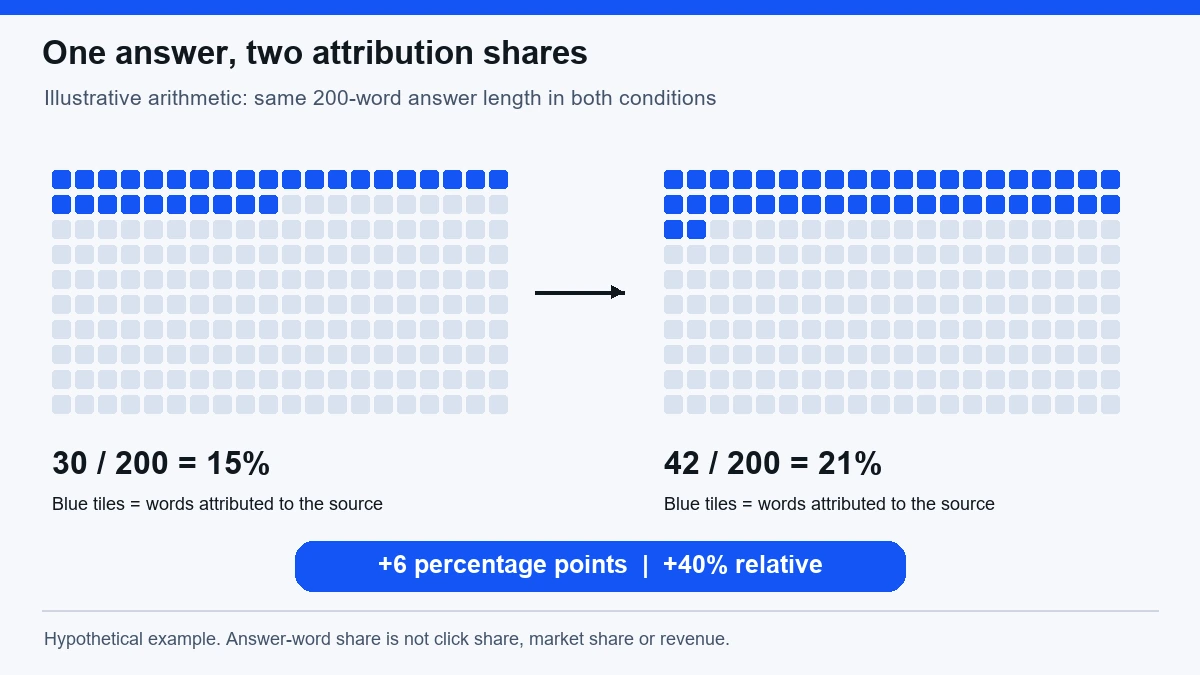
Consider an illustrative answer that contains 200 substantive words and uses 30 words attributable to one publisher. A simple attributable word share would be 30 divided by 200, or 15%. If an edited source later contributes 42 words to an otherwise comparable answer, its share becomes 21%. The difference is six percentage points; the relative increase is 40%. These numbers are a teaching example, not a reconstruction of a paper result.
Neither percentage says that 21% of searchers saw the publisher, that 21% clicked, or that the publisher captured 21% of a market. The denominator is answer words in this example. If the answer becomes longer, source attribution changes, or the scoring rule discounts different positions, the reported value can change even when the publisher’s practical prominence appears similar.
Write the unit beside every result. Possible units include answers containing a citation, eligible prompts containing a correct recommendation, attributable answer text, or qualified sessions arriving from an assistant. They answer different questions. A team can measure several, but should resist combining them into an unexplained visibility score that cannot tell an editor what changed.
A second illustrative answer might cite the publisher once in a source list while giving a competitor the entire recommendation paragraph. Citation presence is positive evidence of source inclusion. It is weak evidence of recommendation ownership. If the business goal is becoming a suitable vendor choice, the evaluation must inspect who was recommended, for what task, and with which qualifications.
The AI visibility measurement mistakes guide provides a complementary diagnostic for keeping citations, mentions and commercial outcomes separate.
Evidence enrichment is an editorial operation
A useful interpretation of the research is to make claims easier to assess. Suppose a software comparison currently says a product is “fast, flexible, and affordable.” An editor can replace that sentence with the actual pricing basis, the workload used in a disclosed performance test, and the configuration limits relevant to the buyer. This improves the page’s decision value whether or not an answer engine later cites it.
The editor must first possess reliable evidence. Adding a number because quantitative statements look authoritative is the opposite of evidence enrichment. A throughput figure without input size, hardware, software version, concurrency, and measurement window can mislead more effectively than a vague adjective. Its apparent precision does not supply the missing context.
Useful statistical context often includes the population, period, geography, definition, denominator, and uncertainty. A survey of current customers does not automatically describe all prospective buyers. A median can obscure the expensive upper tail. A modelled estimate differs from an observed count. Editors should preserve these distinctions near the claim, where a reader can use them without opening an appendix.
Quotations require the same discipline. A quotation should contribute attributable expertise or a meaningful primary statement. It should not be manufactured, stripped of qualifications, or used to imply that a person reviewed the page. If an article does not contain an actual expert interview, the appropriate improvement is better sourcing and analysis rather than an invented human voice.
Build an experiment around one reader decision
Start with a real question such as, “Which backup approach meets a small firm’s recovery requirements?” Select pages that already address that decision and identify the precise evidence gap. Perhaps retention, restoration time assumptions, and exclusions are scattered across several paragraphs. A reasonable intervention is a visible comparison table that brings those facts together while preserving the detailed explanation.
Define the expected mechanism before editing. The table may help users compare options and may make the qualifying facts easier to extract together. That is a hypothesis. It does not establish that any provider has a table preference or that a table will produce an answer citation. The observation plan should be capable of showing no effect.
Keep a dated copy of the original page and record every substantive change. If the intervention simultaneously changes the title, pricing, canonical URL, navigation, and content evidence, a later shift cannot be cleanly attributed to the table. Sometimes a bundled repair is commercially sensible; describe it as a bundle rather than pretending it isolates one cause.
Choose prompts around the reader’s task, including constraints that the page can genuinely answer. Avoid prompts that explicitly request the publisher or demand that the engine cite a particular URL. Those are useful for checking retrieval or brand accuracy, but they do not represent neutral discovery. Maintain separate prompt sets for discovery, comparison, and branded fact checking.
For the broader implementation sequence, use the practical GEO improvement guide, then keep this experiment limited to its declared reader decision.
A worked decision record
Imagine a hypothetical evaluation with 40 stable comparison questions. Each question is observed in three fresh sessions before an edit and three afterward, producing 120 answer observations per period. The team records citations, correct qualifying facts, suitable recommendations, and irrelevant recommendations. No results in this example describe SEOS.co or a real client.
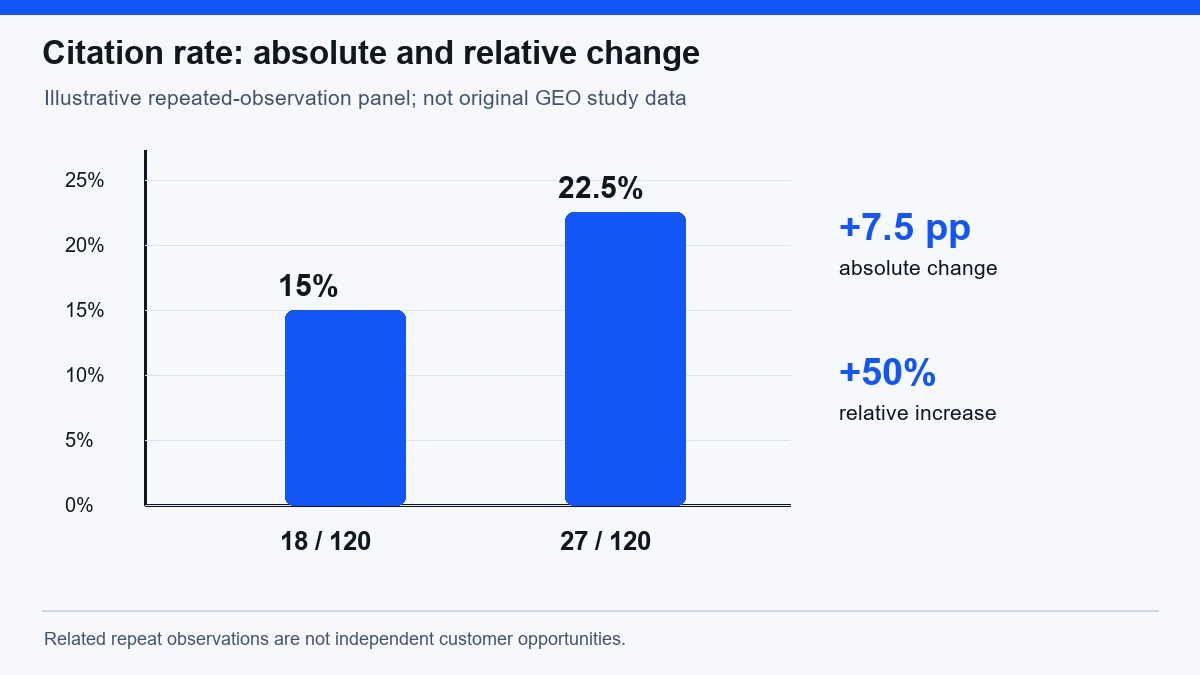
Suppose the page appears in 18 baseline answers and 27 later answers. The crude citation rate rises from 15% to 22.5%, a change of 7.5 percentage points. Reporting only the 50% relative increase would hide the small absolute base. Reporting 27 independent customer opportunities would also be wrong because repeat observations of the same question are related measurements.
Now suppose correct qualifying facts rise from 12 to 24 answers, but suitable recommendations rise only from eight to nine. That pattern suggests the page may be serving more often as factual support without materially changing recommendation selection. The content change could still be valuable. The team should judge it against its declared outcome rather than promoting whichever number looks largest.
The record should retain the actual answers and cited destinations. A URL-level increase might be caused by a canonical consolidation or a redirect, while the publisher’s total inclusion is unchanged. Similarly, a citation to an old PDF might appear to validate the updated HTML article even though the new evidence was never used. Inspecting destinations prevents a dashboard from inventing a mechanism.
Why transfer to a current engine is uncertain
A research system is a particular combination of retrieval and generation choices. A commercial engine can use different indexes, retrieval policies, answer formats, safety systems, personalization, and source-selection rules. Even two experiences from the same provider may behave differently. An experimental result supplies a reason to investigate; it does not identify the internal architecture of a product that was not studied.
Time is another boundary. Source pages change, competitors publish new material, interfaces change, and models are updated. An observed effect can disappear without proving that the original experiment was invalid. It can also persist for reasons different from the original hypothesis. Preserve the date, interface, search-enabled state, locale, and observable configuration so that future comparisons remain interpretable.
Do not solve uncertain transfer by changing a page after every disappointing prompt. Frequent reactive edits destroy the baseline and can make a useful page unstable for readers. Set an observation window suitable for expected discovery and refresh delays, document known changes, and distinguish a technical access failure from an eligible page that simply was not selected.
Technical eligibility also deserves its own record. If the page is inaccessible to the intended crawler, editorial experiments cannot fairly test evidence presentation. If the page is accessible but not indexed, the limiting stage differs again. The original GEO finding is not a reason to skip the ordinary troubleshooting path from delivered content through observed retrieval and output.
Protect against selective success stories
A program that runs ten interventions and reports only the strongest improvement will overstate its likely repeatable benefit. Save the full intervention register, including unchanged results, regressions, and ambiguous cases. Failed tests often expose an incorrect mechanism, an unsuitable query family, or a measurement problem that a successful screenshot would conceal.
Predefine which outcome governs a decision. If citation presence is the primary outcome, a change in wording sentiment should be secondary unless the decision rule is revised transparently. If the program’s purpose is qualified leads, source visibility is an intermediate measure. It can guide diagnosis, but a favorable intermediate measure cannot automatically settle the commercial question.
Separate practical importance from detectability. A tiny improvement measured reliably across a large panel may not justify an expensive content process. A promising improvement in a small panel may deserve another test rather than immediate deployment. Record the expected value, production cost, maintenance burden, and potential harm from misleading simplification before scaling a format across a large site.
What should an editor change tomorrow?
Inspect one high-value article and identify its most consequential unsupported or hard-to-use claim. Replace vague assertions with supported details, preserve the conditions that make them true, and organize the explanation around a real decision. That work produces a stronger asset without requiring an assumption that a commercial engine follows the research system’s scoring behavior.
Then establish a small reproducible observation record. Save the page version, the question family, the target engine conditions, the evidence fields, and the intended interpretation. A useful result explains what happened well enough that another person could challenge it. A screenshot accompanied by a promise of universal GEO improvement cannot meet that standard.
If the missing information reflects a mismatch with the reader’s task, work through search intent alignment before changing presentation.
Questions the headline does not answer
Does the paper prove that a specific keyword density improves AI visibility? No such universal production rule follows from the reported visibility finding. Exact terminology can help a page answer its topic clearly, but a house writing convention should not be presented as an experimentally established requirement of every engine. Measure reader comprehension and factual coverage alongside any text changes.
Does a citation automatically mean the publisher’s brand benefited? No. An answer can use a source’s information while naming another organization, recommending another vendor, or describing the source incorrectly. Review citation context and brand accuracy independently. If a page is repeatedly cited for a fact but never considered for a service, that is a diagnostic observation rather than proof that the engine is broken.
Should a company wait for perfect causal evidence before improving content? No. A team can make useful editorial improvements because they serve readers, while reserving causal language for stronger evidence. The distinction allows action without turning uncertainty into marketing certainty. It also makes later research easier because the original rationale and actual outcomes remain separate.
Can research replace direct customer understanding? It cannot identify which missing information prevents a particular buyer from choosing confidently. Support tickets, sales questions, product limitations, and observed user tasks supply that context. Research can shape how the team tests an answer; it cannot manufacture facts about the offer or replace the need to answer a worthwhile question.
Keep evidence and creative format separate
A visually appealing comparison block can make a page easier to scan without adding any new evidence. Record that benefit honestly. If the source facts remain unchanged, the intervention primarily concerns presentation. If the editor adds a new disclosed test, the intervention also concerns evidence availability. Keeping these records separate makes later analysis more informative: the team can determine whether the observed change followed better facts, clearer organization, or a bundled update that cannot distinguish the two. This distinction also improves maintenance because a designer can update the layout without accidentally changing the factual basis of the claims.
Worked rate table and experiment worksheet
The following rates use the article’s hypothetical repeated-observation panel, not the original paper’s data. They distinguish an absolute change from a relative change and retain the same denominator.
| Observation | Cited answers | Eligible answer observations | Citation rate |
|---|---|---|---|
| Before the illustrative edit | 18 | 120 | 15% |
| After the illustrative edit | 27 | 120 | 22.5% |
| Absolute difference | 9 additional observations | Same 120-observation denominator | 7.5 percentage points |
| Relative rate increase | 22.5% divided by 15%, minus 1 | Relative to baseline rate | 50% |
| Experiment field | Record before editing | Why it matters |
|---|---|---|
| Reader decision | One defined comparison or implementation question | Prevents unrelated traffic from defining success |
| Intervention | One evidence or presentation change with saved versions | Keeps the causal hypothesis inspectable |
| Primary outcome | Citation, correct recommendation or another declared measure | Prevents selecting the most flattering result afterward |
| Observation unit | Unique questions and repeated answers recorded separately | Preserves dependence and actual task coverage |
| Commercial bridge | Qualified sessions and outcomes measured separately | Avoids converting answer visibility into invented revenue |