
The Search Brief · News analysis
Hreflang Validation: Audit Locale Clusters as a Graph
A graph-based locale audit with cluster assertions, reciprocal relationships and a comparison of wrong category fallbacks with genuine product equivalents.
Development covered: Primary-source guidance checked November 2, 2026

Hreflang validation should test relationships between real localized pages, not merely whether an annotation contains a plausible language code. A syntactically valid alternate can still point to a redirect, a non-equivalent product, an inaccessible page, or a URL whose canonical signals conflict with its intended role.
A graph-based audit treats each localized resource as a node and each declared alternate as an edge. It then checks identity, accessibility, reciprocity, and useful regional differences. This guide proposes that method with fictional catalog examples. It does not report an experiment or promise that annotations will force a particular regional result.
Start with equivalent resources
Choose the stable resource that connects the locale versions: a product identifier, article identifier, or service offering with a documented regional equivalent. Similar slugs are not enough.
A fictional US product called Model A may be unavailable in Germany, where Model B occupies a similar category position. Those are not automatically alternate versions of the same product. A language switcher that sends every unavailable product to the German category preserves navigation but does not establish resource equivalence.
Record whether each locale version is translated, regionally adapted in the same language, or intentionally absent. An absent version should remain an explicit absence in the registry rather than being filled with a convenient homepage URL.
Google's localized versions documentation describes annotations for language and regional variations. Use that relationship as the foundation, then validate that the actual pages preserve it.
Build a locale registry
The international SEO guide connects locale identity with the actual audience and offer.
Create one record per resource cluster with stable identity, locale code, public URL, publication state, canonical target, and equivalent-resource owner. Add regional constraints such as currency, availability, service area, and required disclosures where relevant.
The registry should drive alternate generation rather than merely mirror whatever tags happen to be on the page. Otherwise, a bad annotation can become its own supposed source of truth.
Version the registry and record publication events. When a translation is retired or a product becomes regionally unavailable, consumers need to update annotations, navigation, and sitemaps coherently.
Separate content language from market. English-language pages for different countries can have meaningful regional distinctions. A country code alone is not a language. Validate combinations against current supported conventions rather than inventing codes from internal merchandising labels.
Model the cluster as nodes and edges
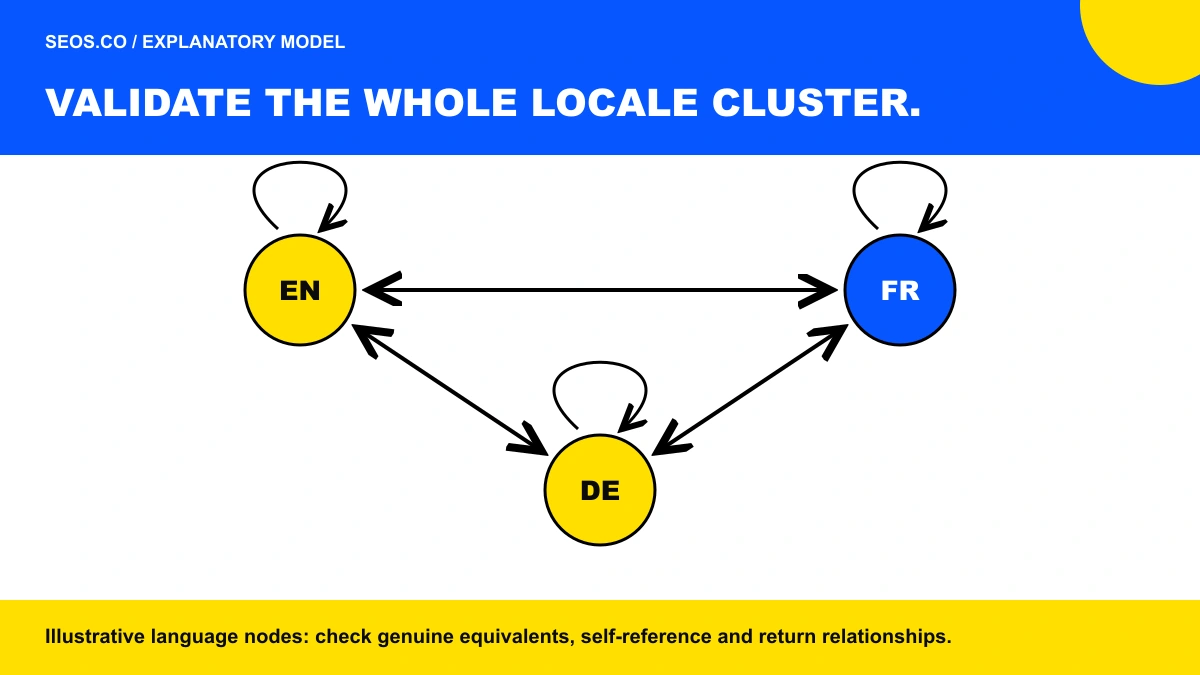
Each eligible localized URL is a node. An annotation from one page to an alternate creates a directed edge. The expected graph is based on the registry's published equivalents.
For a three-locale resource, inspect every node's declared set, including itself. Check return relationships and destination identity. Google's documentation specifies self-reference and reciprocal relationships; isolated tag presence does not establish those conditions.
Store expected and observed edge sets separately. That allows an audit to identify missing edges, extra edges, wrong targets, and stale members. A simple total count would conceal a cluster with the right number of annotations pointing to the wrong pages.
Use graph visualization for exceptions, not only for presentation. A node with no incoming or outgoing relationships can indicate an unintegrated translation. Several clusters converging on one locale homepage can reveal a fallback rule that erased resource identity.
Check destination delivery before annotation syntax
Fetch each alternate directly. Record requested URL, redirects, final URL, status, canonical, robots state, language, and main-content identity. A correct-looking annotation to an unusable destination does not complete the relationship.
Test the public host without employee authentication or saved preferences. Localization middleware can redirect a clean visitor according to IP location, cookie state, or browser language. A switcher that works after setting a preference may hide the direct-route behavior.
Preserve the requested locale in the URL contract. If every locale URL redirects to whichever market the server infers, a crawler may be unable to retrieve the intended variants consistently.
Google's multi-regional and multilingual guidance discusses locale-specific URLs and serving behavior. Apply the relevant principles to the actual application's public routing, then verify the result rather than assuming the framework handles it.
Align canonical and alternate relationships
Review how canonical tags work before combining representative and alternate relationships.
Canonicalization and hreflang answer different questions. One concerns representative selection among duplicate or similar pages; the other describes localized alternatives. Conflicting policies can make the intended graph incoherent.
For substantially translated pages, do not automatically point every locale canonical to the original-language page. For regional variants in the same language, review the duplication and regional policy deliberately. Google's canonicalization overview addresses regional variants alongside alternate annotations.
The validation record should show the canonical destination for every node. Flag annotations that point at a URL whose identity is then redirected or consolidated elsewhere. Follow the relationship far enough to understand the intended resource.
Avoid solving all international problems by adding more tags. If pages lack meaningful localized information, or the wrong offer is served, the underlying content and routing need attention. Markup cannot make an unsuitable destination appropriate for a market.
Choose one maintainable annotation method
Google documents HTML, HTTP headers, and sitemaps as equivalent methods for declaring localized relationships. Maintaining all three independently can create disagreement without adding a useful assurance.
Choose the method that fits the platform's publishing and operational model. HTML can be straightforward for server-rendered pages. Headers can suit non-HTML resources. Sitemap-based declarations can centralize a large inventory when the registry is reliable.
If several methods are already present, compare their observed sets. Do not assume they agree because they originated from the same database. Separate generators can apply different publication filters or cache different versions.
Assign a single policy owner and shared data source. Consumers can produce different representations, but they should resolve the same versioned locale cluster. The important engineering property is consistency, not a particular serialization format.
Validate syntax without confusing it with meaning
Check supported language and region code formats, fully qualified URLs, escaping, duplicate entries, and malformed elements. These are deterministic checks and should run automatically over the intended inventory.
Then perform semantic checks: equivalent content, correct market, truthful availability, language consistency, and accessible switching. A parser cannot decide whether a Canadian visitor should receive US-only shipping terms.
Inspect the rendered document when client execution changes annotations. A correct initial set can be replaced by default-locale state during hydration. Record both representations and identify which component owns the transformation.
Keep validation outputs specific. “Invalid hreflang” is less useful than “German alternate points to a redirect ending at the French category.” The latter describes the relationship an engineer can reproduce and repair.
Audit the language switcher as a user journey
Use the international SEO checklist to review the broader localized journey alongside graph assertions.
A switcher should help visitors reach a useful equivalent or clearly explain when one is unavailable. Preserve context when it exists. Do not silently drop a visitor from a detailed guide into a generic homepage without explanation.
Test keyboard access, visible labels, selected state, mobile interaction, and back navigation. Language names should be understandable to the intended audience. Flags alone can be ambiguous because language and country are different concepts.
Verify the direct destination independently of the switcher's client state. A click that first writes a cookie may make an otherwise unstable URL appear to work. Public localized URLs should have a coherent retrieval contract.
The switcher and alternate generator should consume the same registry while serving different purposes. The switcher is a user interface; hreflang is a machine-readable relationship. One does not prove the other is correct.
A worked scenario: translated products with a shared fallback
Imagine a fictional retailer with English, French, and German product pages. The German catalog lacks translations for some products. To avoid empty annotations, the template points missing German alternates to the German category.
The graph audit shows many unrelated product clusters sharing the same German node. Direct fetches confirm that the category is accessible, so a status-only check passes. Identity comparison reveals the real mismatch.
The proposed repair removes unsupported equivalence claims and records missing translations explicitly. The language switcher can offer the German category as a clearly labeled navigation alternative, while the alternate registry contains only genuine resource equivalents.
Verification checks expected edge sets, destination identifiers, canonical behavior, and the user-facing fallback message. It also tests publication of a new German translation so the cluster gains the correct node without retaining the old fallback. The scenario is illustrative, not an observed retailer case.

Handle publication and retirement as graph updates
Publishing a translation changes more than one page. Every relevant member may need an updated alternate set, and navigation or sitemaps may need changes as well.
Use a durable event containing cluster identifier, locale, public URL, version, and intended transition. Consumers should acknowledge the version they published. That makes propagation delay measurable.
Retirement requires removing stale edges and choosing a meaningful destination outcome. A deleted locale page should not remain advertised indefinitely because only its own record changed. Test the fan-out to sibling pages.
Check restart recovery. If a worker stops midway through updating a large cluster, can it resume without losing members or producing contradictory sets? Idempotent versioned jobs make these transitions easier to reason about than a sequence of untracked page edits.
Test cache variation and regional routing
Compare equivalent requests across relevant regions and clean states. Record host, path, relevant headers, cookie state, cache outcome, and final content identity.
A cache keyed without locale information can serve one market's annotations or body to another. Conversely, unnecessarily varying on every preference can fragment the cache and hide inconsistencies in small tests.
Do not infer authentic crawler treatment from a user-agent substitution alone. Simulated requests help reproduce delivery, while verified crawler logs or supported inspection tools provide different evidence.
Preserve the locale registry version in operational diagnostics where feasible. When a response contains an old alternate set, the team can then trace whether generation, invalidation, or edge delivery lagged behind the intended publication event.
Measure the right scope
Report unique resource clusters, eligible locale nodes, expected edges, failed nodes, and failed relationships. Do not count every missing reciprocal edge as a separate lost search opportunity.
For example, one broken locale URL can cause several relationship failures within its cluster. Those are useful technical observations, but they may represent one affected destination. Keep resource impact distinct from assertion count.
Segment by template, locale, generator version, and failure signature. A shared fallback bug deserves a template repair; a single missing translation may require an editorial task. Aggregating both into one error total obscures ownership.
State sample coverage. Automated syntax and graph checks can cover the full inventory, while language and offer suitability may require qualified review of meaningful samples and exceptions. Do not claim full localization quality from tag validation.
Verify after deployment
Confirm the new registry and generator versions are active. Fetch representative repaired clusters through the public route and compare observed edge sets with expectations.
Test the original failure condition. If the bug involved missing translations, include one absent locale and one newly published locale. If it involved stale cache, verify convergence after a cluster update without manual intervention.
Use supported search inspection for representative pages where access permits, retaining indexed and live observation dates. URL Inspection documentation explains those different views. A correct live graph is implementation evidence; it does not prove that every regional result has changed.
Continue observing the intended reader outcomes. Correct locale pages should deliver appropriate information and functional next actions. Search selection is one stage of the journey, not a substitute for a usable regional experience.
Use graph arithmetic to size the checks
For a fictional cluster with four published locale pages, a complete directed declaration set including self-reference contains sixteen relationships: four declarations from each of four pages. Excluding self-reference leaves twelve cross-page relationships. These counts are simple arithmetic, not a requirement to publish four locales or a prediction of search behavior.
The calculation helps detect incomplete audits. Testing one English page's four declarations covers only one quarter of the full expected directed set in that example. The other pages can still contain stale or contradictory targets.
When one locale is retired, the expected set changes. Three remaining pages produce nine relationships including self-reference. A validator should recompute that expectation from the registry version, rather than retain a fixed count and report every change as an error.
Use identifiers to compare sets. A cluster with sixteen annotations can still be wrong if one destination is repeated under several locale labels. Count expected pairs of source identifier and locale destination, then check the actual destination identity.
This also explains why assertion totals should not become impact totals. Removing one node from a four-node cluster can invalidate several incoming and outgoing assertions while affecting one retired destination and its siblings' metadata. Report the node failure, the relationship failures, and the user-facing scope separately.
For large sites, run these inexpensive graph checks before manual review. They can concentrate qualified language and merchandising review on clusters with unexpected structure, while retaining a deliberate sample of structurally clean clusters to detect errors the model cannot recognize.
A cluster assertion table
The graph model becomes implementable when each relationship has an observable assertion.
| Assertion | Expected evidence | Failure example |
|---|---|---|
| Resource equivalence | Stable resource identity and reviewed locale relationship | Product alternate points to a broad category |
| Direct retrieval | Public requested locale route returns the intended page | Clean visit is redirected to the default market |
| Declared membership | Observed alternate set matches the versioned registry | Retired translation remains in sibling annotations |
| Return relationship | Relevant published member declares the corresponding relationship | One template omits the original locale |
| Coherent identity | Canonical and alternate policies preserve the intended node | Annotation names a route consolidated elsewhere |
The table describes a proposed audit contract. Valid syntax remains necessary, but it cannot establish the semantic relationships on its own.
Practical answers
Does valid syntax mean hreflang is working?
No. Syntax is one check. The destination must exist, represent the intended equivalent, remain accessible, and participate in coherent relationships. Canonical and routing behavior can undermine otherwise valid annotations.
Should missing translations point to the homepage?
Do not claim a homepage is an equivalent article or product merely to fill an annotation slot. Record the absence. The user interface can offer a clearly labeled broader destination without misrepresenting it as the same resource.
What is the first useful audit?
Select one important resource cluster and compare the expected locale registry with direct public responses and observed annotations. Expand the resulting checks by failure signature. Hreflang validation becomes reliable when it verifies a living relationship graph, rather than a collection of isolated tags.