
The Search Brief · News analysis
Canonical Diagnostics: Trace Why Google Picks a Different URL
A practical investigation method for canonical mismatches: compare content, redirects, rendering, caches and discovery signals, then verify each stage of repair.
Development covered: Primary-source guidance checked November 2, 2026
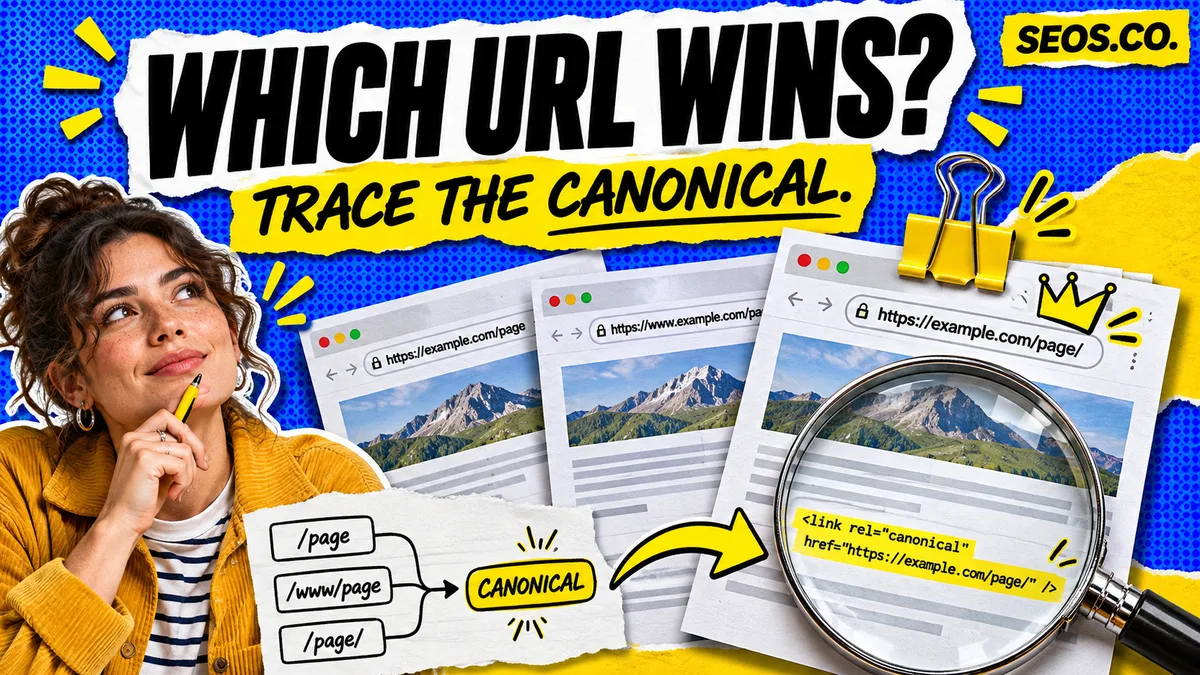
Canonical diagnostics starts with a cluster of URLs, not a single tag. To explain why Google selected another URL, compare the actual content and every observable signal across the preferred page, the selected page, and their important variants. Then verify which versions Google fetched, which version the application served, and whether a later crawl has processed the repair.
A correct canonical element on today's response proves only that one declaration is correct now. It does not establish what Google saw last week, whether a cached response contains another declaration, or whether the two pages deserve independent destinations. This guide presents an investigation method for technical SEO teams. Its evidence ledger and worked examples are proposed operating methods, not reported client experiments.
What canonicalization does—and what your declaration means
Canonicalization selects a representative URL from pages that are duplicates or substantially similar. Google identifies the main content and evaluates signals when choosing that representative. Its documentation distinguishes redirects and canonical annotations as strong signals from sitemap inclusion as a weaker signal. Those signals express a preference; they do not compel Google to accept a page that conflicts with the rest of the evidence. Google's canonicalization overview and canonical declaration guidance describe those distinctions.
The practical implication is that canonical diagnostics has two separate questions. First, did the site express the intended preference consistently? Second, is that preference coherent with the pages users actually receive? A tag cannot make a discontinued product identical to its replacement, make a translated page an English duplicate, or preserve an independent search destination whose main content duplicates its sibling.
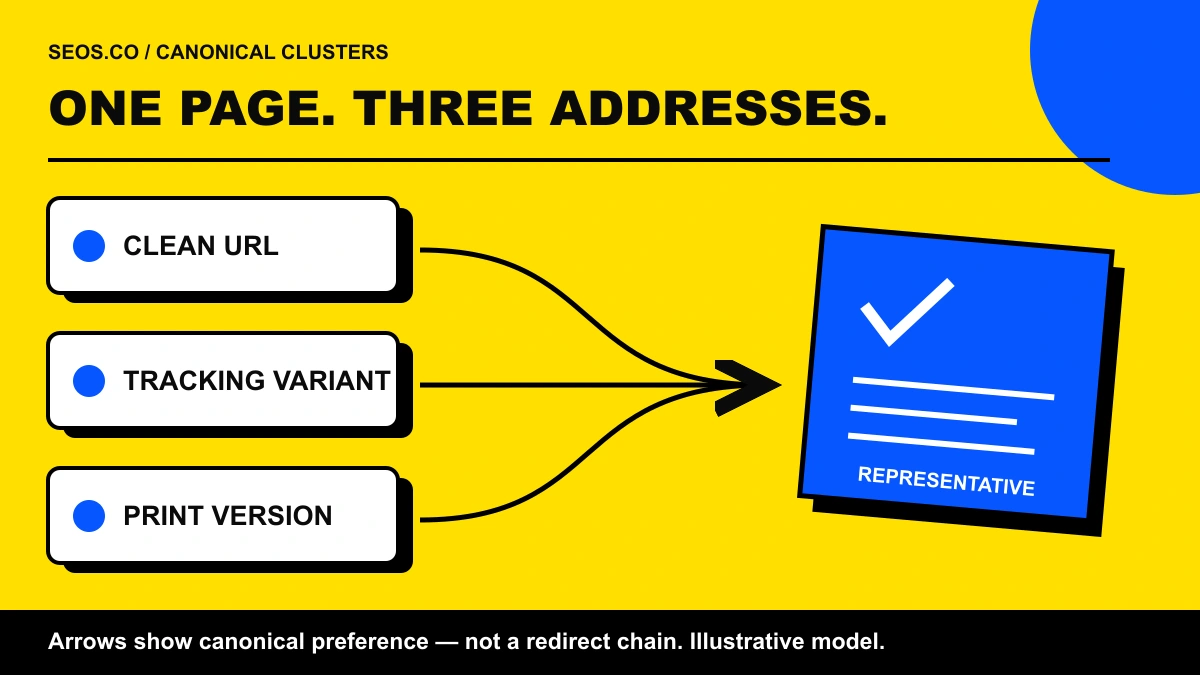
Define the intended outcome before changing anything. A tracking variation may need consolidation into the clean product URL. A distinct regional page may need independent eligibility. A print version may remain available to users while suggesting the article as representative. Each case calls for different acceptance evidence. Treating every excluded variant as a defect encourages unnecessary changes to otherwise sensible behavior.
Build a URL-cluster evidence ledger
Create one investigation record per suspected cluster. Give each URL a stable identifier and retain the exact requested URL, including case, parameters, encoding, and trailing slash. Store the final response destination separately. If your spreadsheet overwrites the requested URL with the destination, you lose the very behavior you need to diagnose.
For each member, capture the status, redirect chain, canonical declarations in headers and HTML, robots directives, sitemap membership, internal link targets, main-content fingerprint, and observation time. Also retain the original response and rendered HTML as separate evidence. Record the deployed application version and cache status when your infrastructure exposes them.
Add Google-selected canonical and user-declared canonical values from URL Inspection where available. Keep the last crawl date alongside them. A current fetch and an older indexed observation belong on the same timeline, not in a single undated “canonical” column. URL Inspection documentation explains the indexed and live views; use each for the question it can answer.
A useful ledger separates facts from interpretation. “The live HTML points to /products/blue-widget/” is a fact. “The search engine has not reevaluated this repair” is a hypothesis until crawl timing and inspection evidence support it. “The canonical tag is ignored” is usually too broad to help an engineer reproduce anything.
Compare the content before debugging the tag
Extract the main content from each candidate with navigation, recommendations, cookie notices, and footer material excluded. Preserve product identifiers, prices, availability, substantive descriptions, headings, and regional constraints. A whole-document similarity score can be dominated by shared templates and conceal the differences that matter.
For a hypothetical catalog, suppose /chairs/model-a/ and /chairs/model-b/ use the same manufacturer description but differ in dimensions and compatible accessories. If those differences only appear in an image or after a selector interaction, an initial HTML comparison may make the pages look equivalent. The first repair is to expose the meaningful differences reliably, rather than merely repeating a self-canonical declaration.
Reverse the test as well. Two URLs may have different titles and introductory paragraphs but expose the same product list in the same order. That does not automatically establish that both should be independent landing pages. Ask what reader task each URL completes and whether that distinction survives extraction. Canonical diagnostics should reveal an architecture problem when one exists, not disguise it as a markup problem.
Use fingerprints for triage, then inspect the decisive fields. Exact hashes catch identical extracted bodies. Token similarity can flag near duplicates. Neither proves that two offers are interchangeable. Keep a short human explanation of why the pages should consolidate or remain separate.
Trace every competing declaration
Check canonical elements in the delivered head, canonical HTTP headers, redirect targets, XML sitemaps, navigation, breadcrumbs, and prominent contextual links. Resolve relative declarations against the fetched document URL. Count declarations rather than accepting the first one a crawler reports.
One common application failure is divided ownership. A CMS extension emits the clean route, the theme emits a legacy route, and a client component adds a third declaration after hydration. Each developer can inspect their own output and believe it is correct. The combined response is contradictory.
Assign canonical ownership to one layer. Other layers may consume that result, but they should not independently infer the destination from request parameters, browser state, or environment variables. A shared function should receive a stable content identifier and return the public URL according to the site's routing policy.
Test the function against meaningful variations: alternate hostnames, HTTP requests, uppercase paths, tracking parameters, pagination, locale prefixes, preview routes, and unknown identifiers. These are examples of cases to select from, not a demand to change every site's existing URL conventions. Preserve functioning URLs unless the investigation establishes a reason to migrate them.
Inspect the rendering dependency chain
Compare the response HTML with the rendered document. A server canonical that disappears or changes during hydration deserves investigation even if the visible article looks normal. Google's JavaScript guidance advises against changing an existing canonical to a different value during rendering and warns about conflicting declarations. JavaScript SEO basics.
Reproduce in a clean browser state. Disable stored cookies, remove service-worker effects where relevant, and test a direct navigation rather than only an in-app route transition. The application may derive its canonical from stale client state after the visitor changes products. A crawler entering the URL directly can receive another result.
Then test the dependencies deliberately. If the content API fails, does the page preserve the correct identity or fall back to a generic category? If a locale service times out, does the canonical suddenly point to the global homepage? If the route resolver loads late, does an SEO component briefly emit a placeholder URL?
The release requirement is stable identity through supported states. It is not enough that the final screenshot appears correct after every dependency succeeds on a developer's machine. Record the response, the rendered state, and the error state so the repair addresses the mechanism rather than one favorable observation.
Separate cache faults from application faults
Canonical diagnostics often spans more than the origin application. An edge cache can serve HTML generated before the repair. A page cache may key only on pathname while regional behavior depends on hostname or query state. A stale fragment can insert metadata from another content object.
Compare equivalent requests at the same layer. Record host, route, relevant request headers, authentication state, cache outcome, response age when available, and response hash. Avoid changing several request characteristics at once and attributing the difference to a user agent. A simulated crawler request is useful for reproducing delivery; it is not proof of an authentic Googlebot fetch.
If the origin is correct and the edge is wrong, fix invalidation or cache-key behavior. If both are wrong, investigate generation. If only one geography or device class is affected, compare routing and variant selection before assuming search engines have made an arbitrary choice.
A cache purge is a recovery step, not necessarily a complete repair. Ask why the obsolete declaration survived and what event will invalidate it next time. A regression test should update a content object's canonical mapping, publish it, and confirm that all supported delivery paths converge on the new declaration.
A worked investigation: the parameter URL that became representative
Consider a fictional product page at /tools/torque-driver/ and a campaign variation ending in ?campaign=autumn. Search inspection reports the campaign URL as selected. The clean page contains a self-canonical, so the team initially assumes a search-engine error.
The ledger reveals a more useful story. Product cards generated during the campaign link to the parameter URL. The sitemap contains the clean page, but an edge rule cached the campaign response under a path-only key. Both variants intermittently receive a canonical containing the parameter. A recent crawl occurred during that inconsistent delivery period.
The proposed repair has three parts: make internal discovery use the clean route, correct canonical generation so tracking parameters cannot become identity, and repair the cache key or generation path that mixed variants. The sitemap already expresses the desired route, so rewriting it adds little.
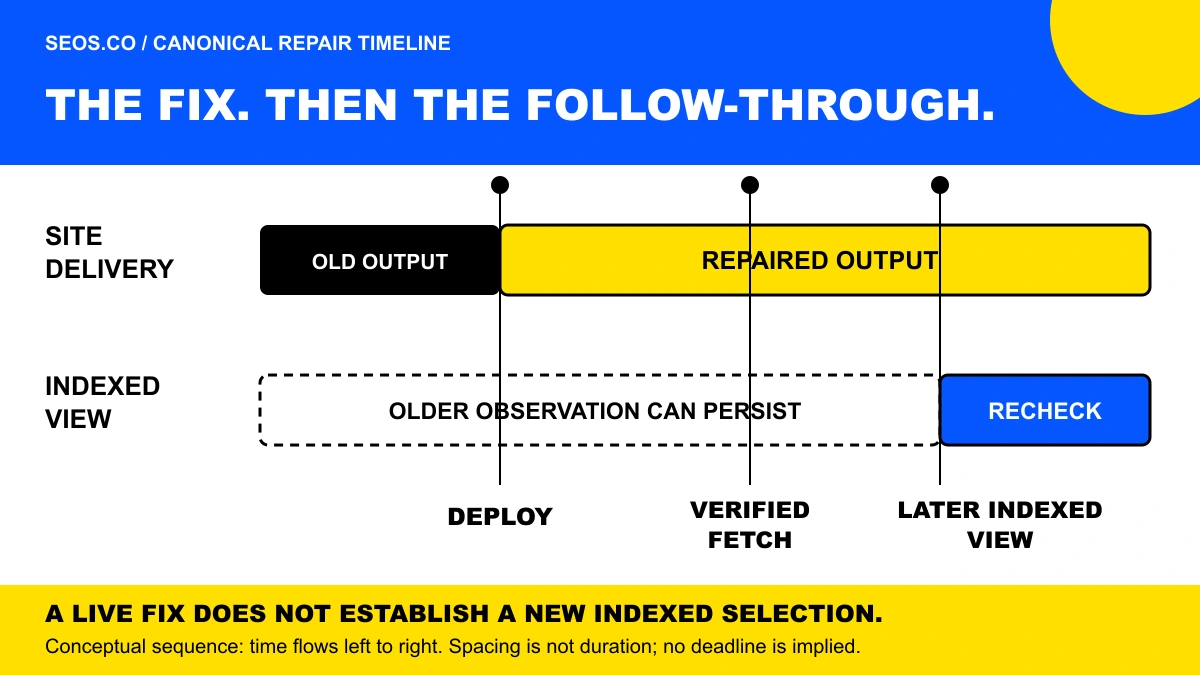
Verification happens in stages. First, fresh requests show consistent declarations across supported variants. Second, application and cache tests reproduce the former failure conditions without reproducing the defect. Third, new crawler evidence shows the repaired response being fetched. Finally, indexed inspection can establish whether the selected canonical changed. Passing stage one does not justify claiming stage four.
A compact ledger and reproducible first check
The following rows are fictional observations for the campaign scenario, included to show the structure of a useful ledger. They are not measurements of SEOS.co or another live store. In a real investigation, retain the full response and exact timestamp behind each row.
| Requested URL | Response | Declared canonical | Internal discovery | Crawl evidence |
|---|---|---|---|---|
| /tools/torque-driver/ | 200, inconsistent cached variants | Sometimes includes ?campaign=autumn | Some product cards use campaign URL | Earlier crawl predates repair |
| /tools/torque-driver/?campaign=autumn | 200 | Campaign URL in defective variant | Campaign cards point here | Selected in older indexed observation |
| Clean route after repair | 200, consistent tested output | Clean route | Cards now use clean route | Fresh crawler observation still required |
A clean declaration for this hypothetical resource would look like this in the document head:
<link rel="canonical" href="https://example.com/tools/torque-driver/">
The example domain is illustrative. Replace it with the actual preferred public route when testing your own implementation. Confirm there is one coherent declaration rather than adding another tag alongside an existing conflicting one.
A minimal GET-based capture can preserve headers and the response body together:
curl -sS -D headers.txt -o body.html 'https://example.com/tools/torque-driver/'
Inspect the response status and any canonical HTTP header in headers.txt, then inspect the document head in body.html. Repeat for the important variant and compare the returned content identity. This command does not execute JavaScript and therefore cannot establish the rendered state.
A HEAD request such as curl -I can be a quick header check, but some applications and intermediaries handle HEAD differently from GET. Do not use a successful HEAD response as proof that the full document is correct. Likewise, adding a crawler user-agent string can help reproduce a delivery rule but does not turn the request into an authenticated crawler observation.
Do not follow redirects blindly during the first capture if the redirect itself is under investigation. Preserve each hop and its location before fetching the final destination. That keeps the requested route, transition, and resulting document distinguishable in the ledger.
Prioritize fixes by affected intent
Not every duplicate status warrants the same urgency. A tracking URL consolidated into its clean page may be expected. A revenue-producing regional page consolidated into an unsuitable global page may prevent users from reaching the correct offer. A print version selected for an article can damage navigation and conversion even if the text remains searchable.
Quantify unique affected content objects or reader destinations. Ten parameter variants for one product are not ten lost product opportunities. Conversely, one erroneous template rule can affect thousands of independent products. Report both the underlying objects and the duplicate URL volume so stakeholders understand scope without inflated counts.
Use a priority record containing the intended page, affected task, observed selection, evidence date, plausible mechanism, proposed change, and verification owner. Leave estimated revenue effects blank unless analytics and a defensible attribution method support them. A canonical mismatch is an observable technical condition; its commercial impact needs separate evidence.
For large inventories, group by failure signature. Shared wrong hostname, missing locale prefix, category canonical on item pages, and conflicting rendered declarations are useful classes. Investigate a representative example from each class, then run the resulting assertion across its full affected scope.
Avoid repairs that make the evidence harder to read
Do not block a page in robots.txt merely to force a different canonical. That can prevent a crawler from seeing the declaration you want it to process. Similarly, noindex has a different purpose from representative selection. Google's noindex guidance requires crawler access to observe the rule.
Do not redirect every duplicate to the homepage. A destination must preserve a meaningful relationship to the original task. If a variant still needs to work for users, a redirect might remove valid filtering, printing, localization, or attribution behavior. Decide whether the variant should continue existing before selecting a consolidation method.
Avoid changing URL structure, content, internal linking, and canonical rules simultaneously unless a larger migration truly requires it. Bundled changes complicate diagnosis and rollback. Where a template fault is isolated, repair that fault and retain the evidence that demonstrated it.
Finally, do not repeatedly submit inspection requests as a substitute for fixing inconsistent output. Repetition cannot compensate for a page that alternates between identities. Stabilize the producer, confirm delivery, and then observe processing.
What should a canonical release check include?
A useful canonical-tag release check tests a representative preferred URL, important duplicates, one missing route, and any locale or parameter boundary implicated in the defect. Confirm successful intended responses, direct permanent redirects where appropriate, one coherent canonical declaration, correct robots behavior, and discovery links that agree with the intended destination.
Retain the response and rendered evidence with timestamps. Compare content identifiers rather than only titles. Verify the sitemap's inventory and the navigation generator's output. If the repair affects a shared template, broaden the check to every URL that uses the relevant rule or a clearly stated bounded sample plus automated assertions.
Define rollback conditions before deployment. Examples include a canonical pointing outside the intended host, several independent products collapsing to one category, or valid locale pages inheriting a default-language canonical. Keep the previous mapping and deployment artifact so a rollback restores known behavior rather than improvising another routing policy.
After deployment, monitor fresh requests and subsequent inspection observations. Google's canonical troubleshooting guide addresses reevaluation and common causes. There is no honest universal deadline for a repaired page to receive the desired selection.
Questions technical teams should answer
Is a different Google-selected canonical always an error?
No. It can be a sensible consolidation of equivalent URLs. The important question is whether the selected destination preserves the intended content and user task. Investigate when selection conflicts with meaningful page distinctions, creates an unsuitable experience, or reflects inconsistent technical signals. An excluded duplicate does not by itself establish lost visibility.
Can a self-canonical guarantee indexing?
No. It declares a preferred representative for that URL's content. Index eligibility, content usefulness, discovery, processing, and representative selection remain separate questions. A self-canonical on an inaccessible, empty, or duplicate page cannot substitute for the underlying conditions needed to support an independent destination.
What proves the repair worked?
Delivery evidence proves the repaired signals are live. A subsequent authentic crawler observation proves the repaired output was fetched. An updated indexed observation can prove that the selected canonical changed. Search impressions and qualified visits establish additional outcomes. Keep these milestones separate so a passing implementation test is not reported as a ranking recovery.
The next useful action is to choose one important mismatch and build its cluster ledger before editing. Once the conflicting signal or content relationship is visible, the repair becomes smaller, testable, and easier to preserve across the next release.